
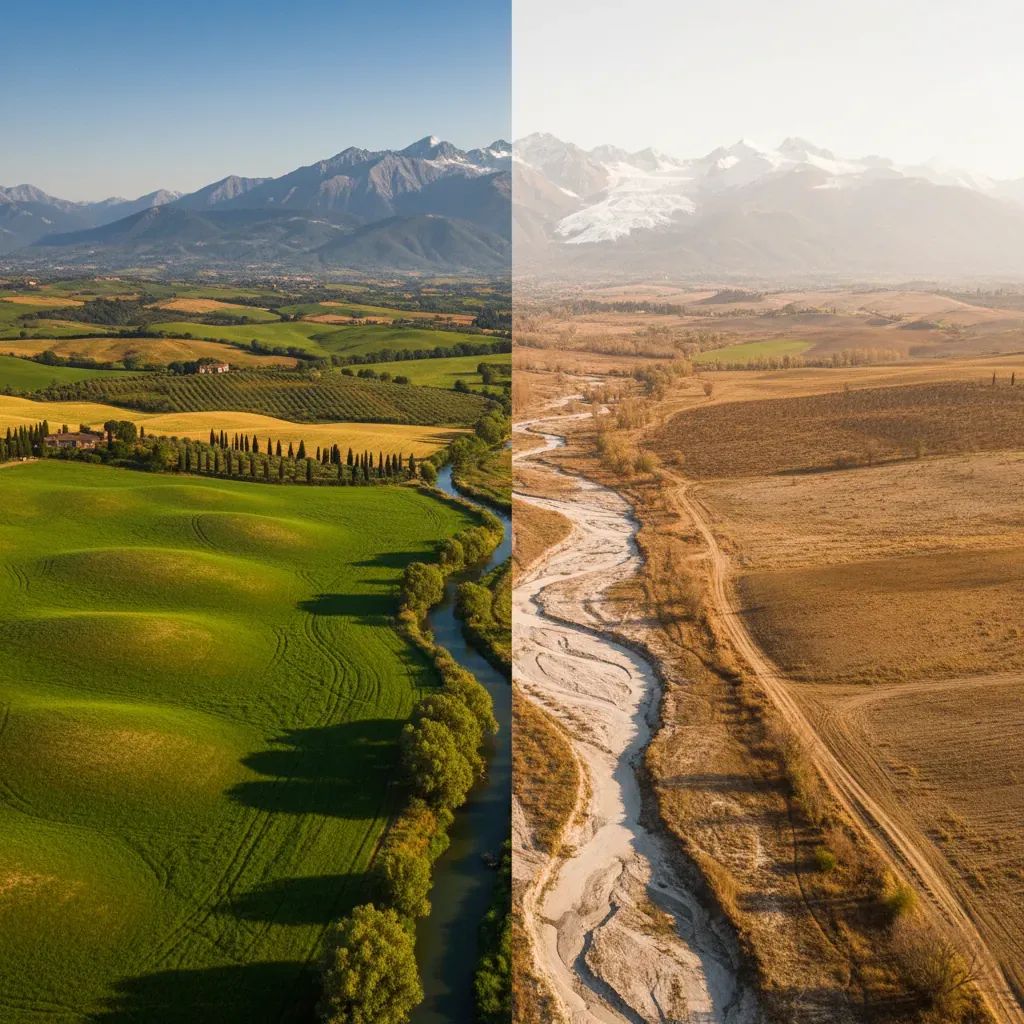
The Italian agricultural sector is facing a structural transformation as climate extremes reshape centuries-old production systems—from maize fields failing without irrigation to mussel farms collapsing under 30°C sea temperatures. A comprehensive survey by Legacoop Agroalimentare, Italy's cooperative federation, has revealed that the country's food production capacity is hanging by a thread, sustained only by earlier infrastructure investments and a rare favorable spring.
What This Means for Residents
For Italians and those living in Italy, these shifts translate directly into higher food prices, reduced availability of traditional products, and uncertainty around staple foods. Residents should expect notable increases on everyday items: pasta, cooking oil, fresh produce, and seasonal vegetables will likely see price hikes throughout 2026 and beyond. Regional specialties—Parmigiano Reggiano, Prosecco, regional olive oils—may transition from everyday staples to seasonal or occasional purchases as yields contract and production costs rise.
DOP, IGP, and IGT designations (Protected Designation of Origin, Protected Geographical Indication, and Typical Geographical Indication—EU quality certifications guaranteeing products' regional authenticity) are under direct threat. These protected status foods that define Italian culinary identity face climate-induced degradation that could compromise their distinctive characteristics and availability.
Why This Matters
• Water turned toxic: Salt wedges are pushing 30-40 km inland along the Po River and Puglia's waterways, rendering irrigation water useless for agriculture.
• Economic toll: The sector faces estimated losses exceeding €1.5 billion this summer alone, with projections of €12.5 billion annually by 2050 without structural adaptation. For household budgets, this translates to sustained pressure on food affordability and product selection.
• Food security at stake: Legacoop's president warns that no individual farm can withstand the coming transformation—regional and cross-border cooperation is now critical.
• Mussel mortality crisis: Mediterranean mussels are dying en masse when water exceeds 30°C, with scientific models predicting chronic stress thresholds will be crossed between 2035 and 2040.
When Salt Meets Farmland
The phenomenon known as cuneo salino—saltwater intrusion—has emerged as one of the most insidious threats to Italian agriculture. As drought reduces river flow, seawater advances upstream, contaminating freshwater sources and sterilizing soil.
In the Po Delta, the situation reached critical levels in June when saltwater pushed 18 km inland, forcing irrigation consortia to suspend water withdrawals. Areas irrigated by the lower Po have become unusable, with contaminated land potentially remaining sterile for three years. Flow rates at Pontelagoscuro dropped below the critical threshold of 450 cubic meters per second, rendering anti-salt barriers ineffective.
Puglia faces a parallel crisis. The region declared a water emergency in October 2025, extending through October 2026, after reservoir levels fell below 50% of the ten-year average. Regional authorities banned non-essential water use—no garden irrigation, no courtyard washing, no pool filling—as supplies dwindled to levels that may last only through January. More than 57% of Puglia's agricultural land now faces desertification risk, compounded by salt intrusions along coastal rivers.
The Maize Collapse
Italy's maize production has been devastated in 2026. Despite decades of innovation—drought-resistant hybrids, precision irrigation, agronomic advances that reduced heat sensitivity by 65%—the crop cannot withstand prolonged exposure to this summer's temperatures.
Losses in the Pianura Padana and northern regions like Piedmont and Lombardy have surpassed 30% on average, with some zones reporting 70% crop failure and others facing total wipeout. The Accademia dei Georgofili described the situation in May as a structural crisis: rising input costs, shrinking acreage, and climate-induced instability converging to threaten Italy's position as a major maize producer.
A 2025 study in Science Advances warned that global warming will increase yield variability worldwide, undermining the stability of maize supplies—a prediction now playing out across the Po Valley.
Boiling Seas and Dying Shellfish
The Adriatico Alto and the Riviera delle Palme have witnessed mass mortality events in mussel and clam farms. When seawater temperatures exceed 30-32°C for extended periods, Mediterranean mussels (Mytilus galloprovincialis—the species farmed throughout the Adriatic and Mediterranean) are pushed beyond their physiological limits. Heat stress reduces oxygen concentration, accelerates algae growth, and triggers cascading ecosystem failures.
A 2026 study published in Environmental Pollution, based on ten years of monitoring in the Ligurian Sea (2014-2023), found that ocean acidification contributes approximately 40% of the biological stress observed in mussels—more than heavy metal contamination. The study's projections are stark: Italian mussels could cross the threshold of chronic stress as early as 2035-2040 under current emission trajectories.
Coldiretti Pesca issued an urgent alert for 2026, describing the overheated sea as an existential threat to Italy's fishing and aquaculture industries.
Scorched Orchards and Vanishing Harvests
Even high-altitude fruit regions like Trentino are reporting heat damage. Fruit is literally scorching on the branch, while accelerated ripening schedules and erratic weather patterns disrupt harvest calendars.
Italy's fruit and vegetable sector is projected to contract 5-10% in 2026, with losses reaching 20-25% in some categories. The combination of drought, heat, and extreme weather has proven catastrophic. In 2025, unseasonably warm weather in Puglia triggered early flowering in cherry orchards, only for late frosts to obliterate 70-100% of the harvest.
National fruit production has declined nearly 25% compared to 2024, making nutritious fresh food less accessible as yields drop and costs rise.
Paradoxically, rising temperatures have opened new opportunities: over 1,000 hectares of tropical fruit—avocado, mango, papaya—now flourish in Sicily, Calabria, Sardinia, Puglia, and Campania, a phenomenon dubbed the "tropicalization" of Italian agriculture.
Wine and Oil: Heritage Under Pressure
Vineyards in southern Italy face both quantitative and qualitative decline, forcing producers to adopt heat-resistant grape varieties and revise centuries-old cultivation techniques. Wine quality and availability will be directly impacted, affecting both local consumption and export markets.
Olive oil, a cornerstone of the Mediterranean diet, remains vulnerable despite a modest recovery forecast for 2025. Residents who rely on Italian olive oil for cooking and daily nutrition should monitor regional supplies and anticipate potential price volatility.
The Broader Economic Impact
Coldiretti estimates agricultural damages at over €20 billion in the past four years. For summer 2026 alone, industry groups CIA-Agricoltori Italiani and Confagricoltura project losses exceeding €1.5 billion due to reduced output, higher input costs, and fewer viable work hours in extreme heat. These losses will ripple through food supply chains and household grocery bills nationwide.
The Case for Structural Intervention
Cristian Maretti, president of Legacoop Agroalimentare, emphasizes that the sector's current resilience stems from investments made years ago and a favorable spring—not sustainable conditions. "If we look to the future, we cannot assume things will always work out this way," he stated. "Structural action is required."
Legacoop is calling for climate modeling through 2100 to guide infrastructure planning capable of securing agricultural capacity. The federation argues this is not just an industry concern but a matter of continental food security.
Cooperative farms are already deploying precision agriculture tools, alternative water sources, and advanced monitoring systems. Legacoop promotes research into reducing pesticide and antibiotic use, developing Assisted Evolution Techniques (TEA) for climate-resilient crop varieties, and restoring soil fertility through carbon sequestration projects like GECO 2.2 and STARTER.
However, individual farms cannot shoulder this burden alone. Maretti stresses the need for reinforced cooperation on three levels: among Italian regions to coordinate water and territorial policies; among European nations to pool strategies and resources; and among farms and cooperatives to share investments in research, innovation, and infrastructure.
Infrastructure: The Missing Pillar
Legacoop is pushing for decisive public investment in reservoirs (invasi) and irrigation systems. Italy currently captures only 11% of rainwater—an inefficiency that exacerbates drought vulnerability.
Proposed solutions include integrated water management, precision irrigation networks, and large-scale infrastructure projects designed to withstand both drought and flood extremes. The federation also advocates for maintenance and upgrading of aging water distribution systems, which lose vast quantities through leakage.
The Piano Nazionale di Adattamento ai Cambiamenti Climatici (PNAC), Italy's national climate adaptation plan, underscores the urgency of boosting the agricultural sector's adaptive capacity through infrastructure, soil management, and the development of stress-resistant crop varieties.
Where to Stay Informed
Residents can track water restrictions and local climate impacts through regional environmental agencies and agricultural departments. Many Italian regions now maintain public dashboards on water availability and farming advisories. Cooperatives and local farming organizations frequently publish guidance on expected product availability and seasonal impacts—a valuable resource for planning household purchases and understanding market fluctuations.
A Landscape in Flux
Italy is considered a climate hotspot within the Mediterranean, where changes are more intense than in many other regions. By 2050, agricultural drought frequency is projected to rise 35%, while heatwave duration could increase by 1,461%.
Over 60% of Italian territory was affected by drought conditions in August 2026, with the Po Basin in the north experiencing particularly critical water shortages. Pests and diseases are proliferating as ecological balances shift, adding another layer of vulnerability to stressed crops.
Without coordinated action—spanning farm-level innovation, cooperative aggregation, and public infrastructure—Italy risks losing not only economic output but also the cultural and gastronomic heritage embedded in its agricultural landscape. The message from Legacoop is clear: adaptation at scale is no longer optional; it is a prerequisite for survival.


