
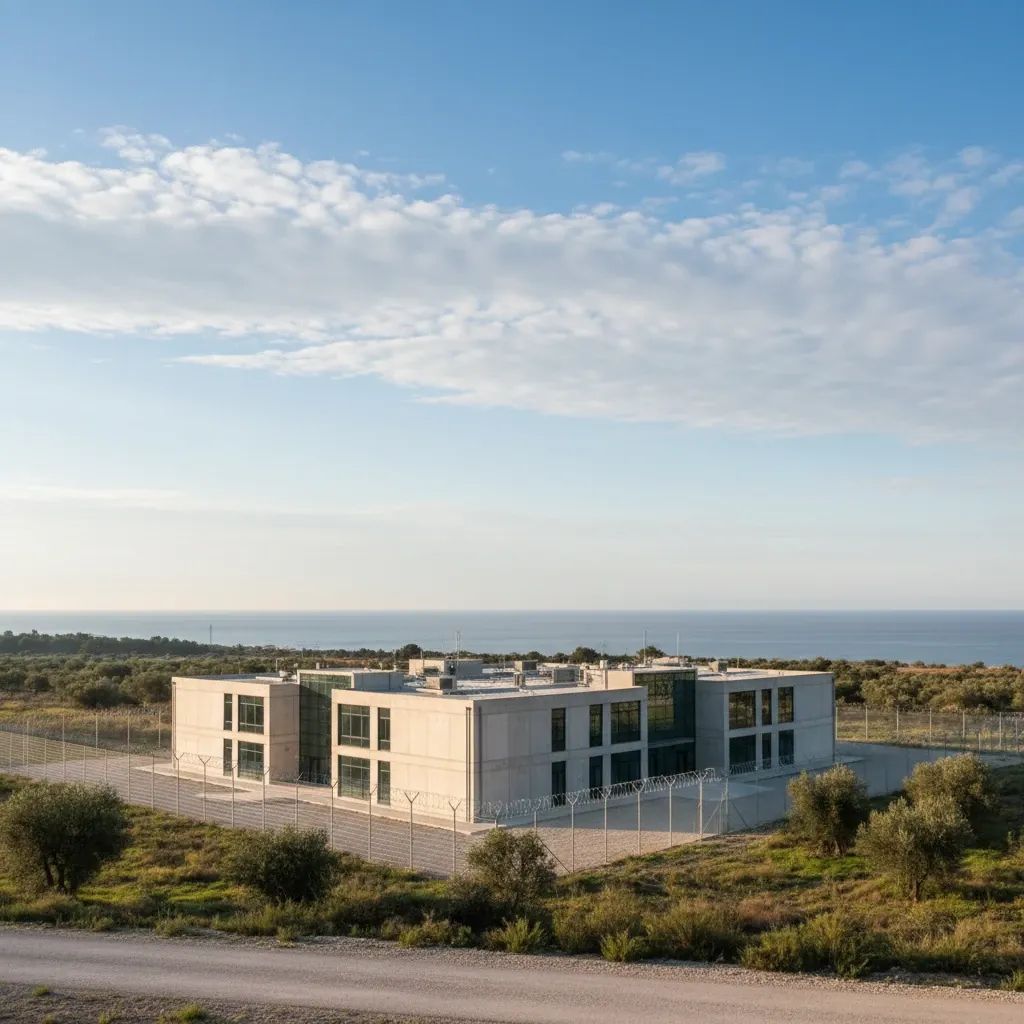
Italy's Brothers of Italy party dispatches parliamentary delegation to inspect controversial Albanian detention center
Italy's Brothers of Italy party is sending a nine-member parliamentary delegation to the Gjader detention facility in Albania on Monday, as the €680M project faces mounting scrutiny over costs, efficacy, and operational performance. The visit aims to demonstrate that the center is functioning as designed, amid persistent criticism that it remains underutilized and represents poor value for public spending.
Why This Matters
• Public money at stake: Italy has committed between €653M and €680M over five years to operate detention centers in Albania, with the facility representing a significant reallocation of public resources from other government priorities.
• Low deportation numbers: Since opening in October 2024, relatively few migrants have been directly deported from Albania, with many transfers returned to Italy after court challenges.
• Legal uncertainty continues: Italian courts and the European Court of Justice are reviewing whether the Albania protocol complies with EU asylum law, casting doubt over the project's long-term viability.
• Political timing: The inspection coincides with a contentious security decree vote in Parliament, where immigration policy remains a central political issue.
The Delegation's Mission
The delegation includes Galeazzo Bignami and Lucio Malan, the party's leaders in the Chamber of Deputies and Senate respectively, along with Giovanni Donzelli, the party's organizational chief, and Sara Kelany, head of the immigration department. Their stated objective is to visually demonstrate that the Gjader facility, located an hour from Tirana on a converted Albanian Air Force site, is functioning as designed.
"We want to use facts to refute the distorted and instrumental narrative that these structures don't work or, worse, are a useless waste," Kelany stated ahead of the trip. She characterized the Albanian model as "a project that works and, indeed, represents a model for all of Europe."
The timing carries political weight. After multiple postponements attributed to the March referendum campaign, Brothers of Italy lawmakers had not yet visited Gjader despite numerous inspections by opposition parties and civil society groups since the facility opened. The absence had become a notable political liability, particularly as Prime Minister Giorgia Meloni's public commitment to the project became subject to public scrutiny and criticism.
Facility Operations and Capacity
The Gjader center officially holds 144 places. Since its October 2024 opening, occupancy levels have varied, with the facility operating at different capacity levels over recent months. The exact current occupancy figures have not been consistently reported in official sources.
The repatriation record shows that of migrants transferred to Gjader, only a portion have been directly deported. Most returns have occurred after individuals were transferred back to Italy, which undermines the intended purpose of offshore processing. The exact numbers of successful deportations versus returns have varied depending on reporting periods and organizational sources.
The Legal and Operational Challenges
Italian courts have repeatedly blocked transfers, ruling that the Albanian scheme applies only to migrants from officially designated "safe countries" — a classification that excludes most Mediterranean arrivals. The European Court of Justice is expected to rule on whether the protocol complies with EU asylum protections, specifically the right to remain on European soil during application review.
Civil society organizations have raised concerns about operational conditions and access to legal protections. Reports indicate that migrants transferred to the facility face challenges in accessing legal counsel, medical care, and timely judicial review, with geographic distance cited as a contributing factor. Independent monitoring of facility conditions remains an ongoing area of contention between government authorities and monitoring organizations.
What This Means for Residents
For Italians, the Albania project represents a significant reallocation of public resources from other government priorities and services. Critics argue that the per-capita costs could have been directed toward expanding reception facilities on Italian soil or strengthening legal processing capacity within Italy.
The project also tests Italy's relationship with European partners. Albanian Prime Minister Edi Rama has emphasized that the arrangement is an "exclusive concession" to Rome, not replicable for other EU nations despite interest from several capitals. This bilateral exclusivity positions Italy's approach as either innovative in offshore migration management or potentially at odds with broader European asylum standards.
For migrants themselves, facilities in Albania represent a legal framework where Italian law theoretically applies, but practical access to legal protections remains complex due to geographic distance and procedural implementation.
The Political Context
The Brothers of Italy delegation will complete its inspection in one day before returning for Tuesday's security decree vote in the Chamber of Deputies, where the government plans to press for passage. Immigration policy remains central to the government's agenda, with the Albania model positioned as proof of Italy's capacity to manage irregular arrivals.
Opposition leader Elly Schlein of the Democratic Party has called the agreement "a blatant violation of international and European law," urging the government to seek burden-sharing with European allies. Other opposition figures have voiced similar concerns about the legal and ethical dimensions of offshore detention.
The Monday visit will provide political cover and fresh arguments in Italy's ongoing debate over how to balance border control, legal obligations, and fiscal responsibility — a conversation that will intensify as the European Court prepares its ruling and the government faces continued scrutiny over the project's effectiveness and costs.


