
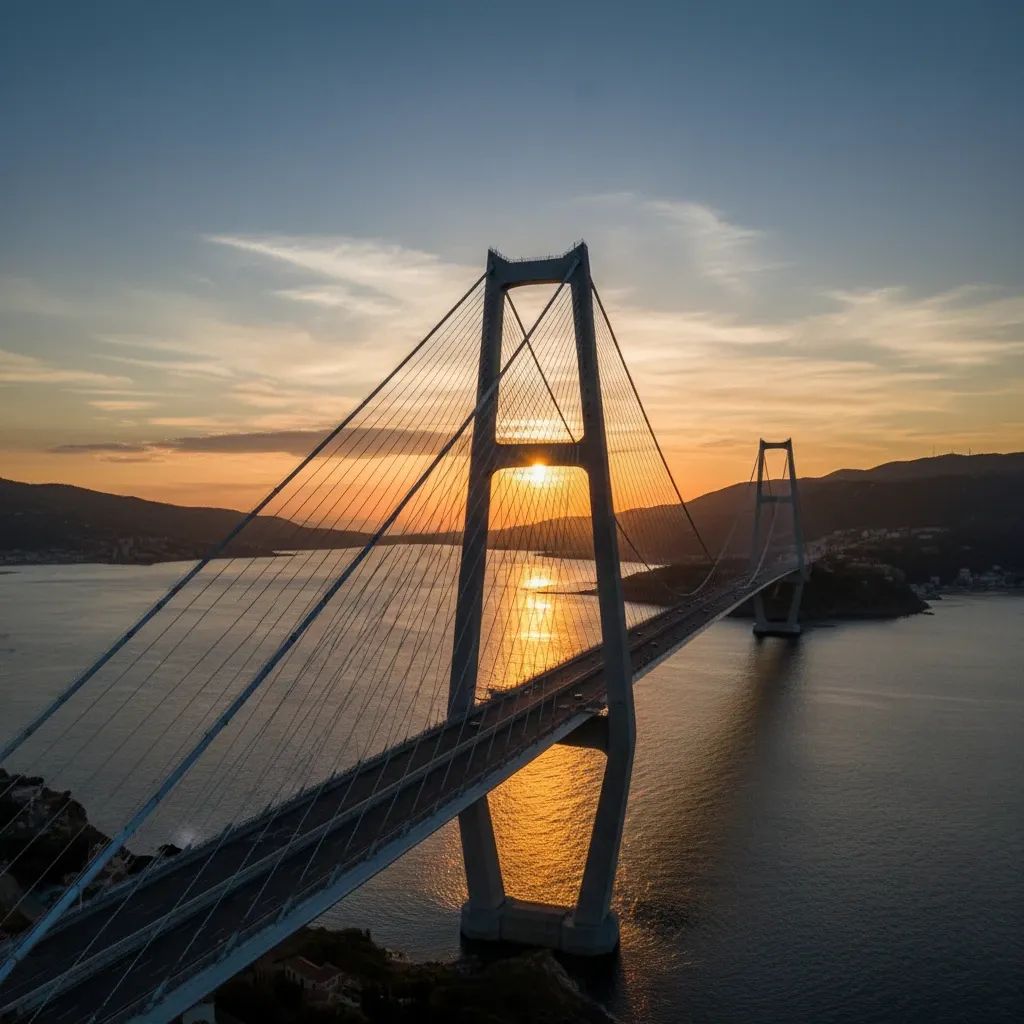
The Italy Ministry of Infrastructure and Transport has cleared a critical bureaucratic hurdle for the Strait of Messina Bridge, with the Superior Council of Public Works voting unanimously to advance the project to its executive design phase—a procedural milestone that moves the €13.5B megaproject closer to physical construction, though legal and environmental battles remain unresolved.
Why This Matters
• Construction timeline: The government aims to break ground by September 2026, with completion targeted for 2033 and operations beginning in 2034.
• Financial scale: The entire €13.5B budget is publicly financed, making this one of the largest infrastructure commitments in Italy's post-pandemic era.
• Legal uncertainty: The Italy National Anti-Corruption Authority (ANAC) has flagged potential conflicts with EU public procurement law, and environmental groups have filed complaints with Brussels over protected habitats.
What the Council Approved
The Superior Council of Public Works—the technical body that scrutinizes large infrastructure proposals—wrapped its general assembly session with a green light accompanied by binding conditions. The vote does not constitute final approval, but rather a technical endorsement that allows the project's promoters to prepare detailed executive design plans, which will require subsequent approval before construction can commence.
Pietro Ciucci, CEO of Stretto di Messina S.p.A., the state-controlled company managing the bridge, welcomed the ruling. "We will now review the accompanying technical observations with our designers and consultants to provide prompt responses," Ciucci said, noting that the ministry must next forward the dossier to the Department of Economic Programming (DIPE) within the Prime Minister's office, which will place it on the agenda of CIPESS, the interministerial committee responsible for final budget authorization.
Ciucci thanked Massimo Sessa, president of the council, and acknowledged contributions from Eurolink (the general contractor), Parsons Transportation Group (project management consultant), and the project's expert advisory panel. The council's review involved progressive, specialized examination of all major engineering aspects, including seismic resilience, aerodynamic stability, and cable integrity—issues that have drawn skepticism from independent engineers.
The Controversial Environmental Bypass
In parallel, the Italy Council of Ministers approved an IROPI declaration—shorthand for "Imperative Reasons of Overriding Public Interest"—a legal mechanism under the EU Habitat Directive that permits infrastructure projects to override protections for Natura 2000 sites if compensatory environmental measures are enacted.
Three protected sites fall within the bridge's footprint, including marine habitats along the Costa Viola and the Capo Peloro-Ganzirri lagoon complex. The cabinet resolution commits the government to "compensation measures suitable to guarantee the overall coherence of the network," but crucially, these interventions need not occur in the same location where damage is inflicted.
Environmental groups including WWF Italy, Greenpeace, Legambiente, and LIPU have filed formal complaints with the European Commission, arguing that the IROPI procedure was invoked without adequate ecological assessment. They point out that the Strait of Messina is one of Europe's busiest migratory bird corridors between Eurasia and Africa, and that collision risk and habitat destruction have not been sufficiently mitigated.
Proposed compensations include reforestation in the Sila National Park, wetland restoration near construction zones, and protection measures for marine species such as the Laminaria ochroleuca forest (a protected kelp) and Caretta caretta nesting sites. Critics describe these as "gravely insufficient" and geographically disconnected from the actual damage.
Political Tensions and Conflict-of-Interest Claims
Transport Minister Matteo Salvini used a parliamentary question time session in the Chamber of Deputies to address allegations of bias within the Superior Council. Two council members—Mauro Dolce and Giuseppe Roberto Tomasicchio—hold positions either on the scientific committee of Stretto di Messina S.p.A. or in the advocacy group Ponte Subito ("Bridge Now").
Salvini confirmed that neither professor participated in the assembly vote, and insisted that their appointments, originally made under the Draghi government, met all legal requirements. "There is no basis to consider the advisory body's impartiality compromised," he said, noting that left-leaning parties were in that earlier coalition.
The defense did little to quell opposition concerns. Legal scholars have pointed out that while formal recusal during a vote addresses procedural optics, the broader question is whether the council's multi-year review was conducted with structural independence.
What This Means for Residents
For Sicilians, the bridge represents a potential end to insular cost penalties estimated at €6.5B annually in logistics, health access, and trade friction. Proponents argue the span will slash travel times between Messina and Reggio Calabria to minutes, open year-round freight corridors unaffected by ferry cancellations, and inject €23B into GDP during construction.
For Calabrians on the mainland side, the bridge could attract logistics hubs, but local mayors have expressed concern about land expropriation and inadequate compensation for communities near the tower footings.
For Italian taxpayers nationwide, the question is risk exposure. The ANAC has warned that the contract structure—resurrected from a decades-old agreement with the Eurolink consortium—lacks explicit cost caps and shifts nearly all financial risk onto the public balance sheet. The original price tag was €3.9B; the current figure is €13.5B, with some estimates approaching €15B once ancillary rail and road links are included.
The Road Ahead
Assuming Ciucci's team satisfies the council's technical prescriptions, the project will return to CIPESS for a revised budget resolution. If that passes, detailed executive design work begins in earnest, followed by another approval cycle before construction can commence. This stage will be followed by procurement for specialized subcontractors.
The European Commission has yet to rule on ANAC's request for a legal opinion on procurement compliance. If Brussels determines that reviving a 1990s-era contract violates current EU tendering rules, the Italian government could face infringement proceedings or be forced to restart the bidding process—an outcome that would delay construction by years.
Environmental groups have also signaled intent to challenge the IROPI declaration in EU courts, arguing that Italy has not demonstrated that no viable alternatives exist, a requirement under Article 6(4) of the Habitat Directive.
Meanwhile, technical concerns linger. Independent structural engineers, including Professor Federico M. Mazzolani, have questioned the adequacy of seismic modeling for a 3,330-meter single-span suspension bridge straddling one of Europe's most active fault zones. The design includes a multi-box girder and aerodynamic damping screens, but critics warn that wind-induced oscillations and train derailment risk during seismic events have not been fully resolved.
Financial and Employment Projections
Supporters cite analyses by OpenEconomics and CityRailways, which project a positive net present value of €3.9B and the creation of 36,700 full-time-equivalent jobs during the construction phase. Tax revenues are estimated at €10.3B, and the economic internal rate of return stands at 4.51%, driven largely by fuel savings, emissions reductions, and time efficiencies.
Skeptics counter that these figures rely on optimistic traffic forecasts and do not account for opportunity cost—the alternative infrastructure projects that could be funded with the same €13.5B, such as rail electrification across southern Italy, port modernization, or digital connectivity in rural areas.
The bridge has also been framed as a dual-use military asset under the EU Military Mobility Action Plan, a designation that bolsters the IROPI argument but raises questions about whether civilian transport needs are the true driver of the project.
Context: A Century-Old Dream
The idea of bridging the Strait dates to the late 19th century, but serious design work began only in the 1970s. A 1986 study recommended a single-span suspension solution, and in 1997, the Superior Council of Public Works endorsed the concept's safety and functional reliability. Construction was set to begin in the early 2000s under the Berlusconi government, but the project was canceled in 2013 amid budget constraints and environmental opposition.
The current administration revived the plan in 2023 under Decree Law 32/2026, which fast-tracked approvals and reallocated funds from other transport programs. The decree was designed to address Italy Court of Auditors concerns and secure full registration of the project's budget authorization—a process still underway.
The bridge, if completed, would be the longest single-span suspension bridge in the world, surpassing Japan's Akashi Kaikyō Bridge by more than 300 meters. The design includes a 60-meter-wide deck carrying a dual-track railway, a four-lane highway, and pedestrian lanes. The towers would rise 382 meters above sea level, taller than the Eiffel Tower, and each anchored in seismic isolation systems intended to absorb lateral ground motion.
For now, the project remains a test case for Italy's ability to navigate the tension between national infrastructure ambition and EU regulatory frameworks—a dynamic that will shape not only the bridge's fate, but the feasibility of other large-scale public works across the continent.


