
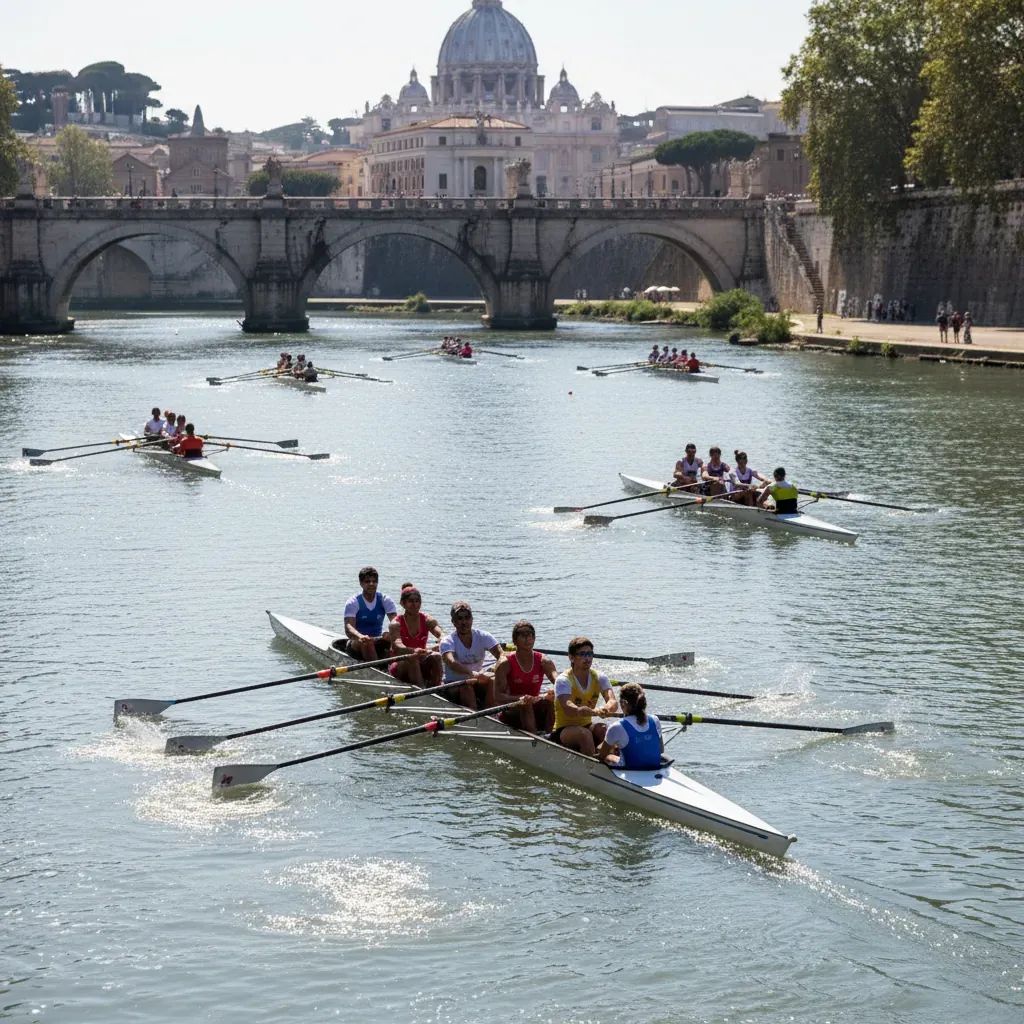
The Italian Rowing Federation closed the opening finals session of the European Rowing Championships in Varese with a five-medal haul that underscores the country's expanding reach across Olympic, Paralympic, and non-Olympic categories. The August 2026 competition delivered two gold medals, one silver, and two bronze — a result that positions Italy firmly among continental powers while raising fresh questions about the path to Los Angeles 2028.
Why This Matters
• Home advantage on display: Hosting the European Championships on Lake Varese has given Italian crews a psychological and logistical edge, especially in the lightweight and para categories where depth is critical.
• Lightweight gold performance: Both Italian lightweight double sculls crews — men's pair Tito Christoforakis and Giovanni Borgonovo, and women's duo Elena Sali and Melissa Schincariol — won gold. Lightweight rowing, a weight-class category requiring athletes to meet specific weight limits, remains one of Italy's areas of consistent medal production in international competition.
• Paralympic silver signals progress: The PR3 mixed coxed four claimed silver, a result that aligns with the Italian Rowing Federation's strategic investment in the para sector ahead of the 2028 Paralympic cycle.
• Sibling synergy: Alice and Giovanni Codato both won bronze in their respective coxless pairs, underlining the federation's grassroots development pipeline.
Lightweight Dominance Continues
Italy's reputation in the lightweight categories remains strong. Christoforakis and Borgonovo controlled their final from start to finish, extending a legacy that dates back to the historic Olympic gold in Tokyo 2020, when Valentina Rodini and Federica Cesarini delivered Italy's first-ever Olympic rowing gold in the women's lightweight double sculls. The men's crew has now given the federation a valuable baseline as it prepares for the 2027 World Championships in Lucerne, the primary qualifying event for Los Angeles.
The women's lightweight double of Sali and Schincariol mirrored that strong performance. Both crews are part of a younger cohort assembled under Director Antonio Colamonici, appointed in 2024 to oversee the Olympic quadrennium leading to Los Angeles 2028. Their performance in Varese suggests that Italy's lightweight program — historically a consistent source of medals at European and world level — is regenerating after the retirement of several Tokyo veterans.
Paralympic Rowing Gains Ground
The mixed coxed four PR3 crew — Martina Osualdini, Marco Frank, Carolina Foresti, Stanislau Litvinchuk, and cox Chiara Reto — finished second behind Great Britain, with France taking bronze. This silver is particularly significant given the Italian Rowing Federation's institutional push to expand para-rowing participation and competitiveness.
Since the discipline debuted at the Beijing 2008 Paralympics with an Italian gold, the federation has invested in integrated training programs aimed at developing para-rowing talent across the country. These efforts have contributed to Italy's growing strength in the para categories, though Britain and Romania remain the dominant forces in European para-rowing.
The Varese silver reflects a broader European trend: Britain and Romania dominate the para categories, but Italy is closing the gap. At the 2024 European Championships in Szeged, Italy finished third in the overall medal table with eight medals, trailing only Britain and Romania. The PR3 crew's performance suggests that ongoing investment is beginning to translate into podium consistency.
Olympic Categories: Bronze and Missed Opportunities
In the women's coxless pair, Laura Meriano and Alice Codato finished third behind Romania and the Czech Republic, missing silver by just 0.78 seconds. The race was a direct continuation of their momentum from the Henley Royal Regatta, where the pair secured a historic victory — a rare Italian success at the world's most prestigious club event.
The men's coxless pair of Matteo Lodo and Giovanni Codato also claimed bronze, finishing 3 seconds behind Romania and narrowly ahead of Lithuania and Greece. Lodo, a two-time Olympic bronze medalist (Rio 2016 and Tokyo 2020 in the coxless four), is one of the federation's most experienced athletes and is likely evaluating whether to extend his career to Los Angeles 2028. Giovanni Codato, meanwhile, is part of the younger generation that Colamonici is developing for the next Olympic cycle.
The awards ceremony for the men's pair included a ceremonial appearance by Italy's Economy Minister Giancarlo Giorgetti, reflecting the political visibility given to the Varese event as a showcase for Italian sporting infrastructure.
The Codato Siblings and the Federation's Youth Pipeline
The parallel bronze medals won by siblings Alice and Giovanni Codato — competing just 15 minutes apart — became one of the emotional highlights of the day. Both are products of the federation's youth development programs, which aim to expand participation in rowing among young athletes across Italy.
The federation's structured approach to youth development emphasizes the critical role of coaching, professional training standards, and club management strategies as it seeks to reduce dropout rates and deepen the talent pool for future Olympic cycles.
Strategic Context: Italy's European Standing
Italy's five-medal performance in Varese places it among the continent's top-tier rowing nations, though it continues to trail Britain, Romania, and the Netherlands in absolute medal counts. At the 2024 European Championships in Szeged, Britain topped the table with eight golds, while Italy finished third with two golds, three silvers, and three bronzes. At the Paris 2024 Olympics, the Netherlands led the rowing medal table with eight medals, followed by Britain and Romania, while Italy secured two silvers.
The federation's strategy for Los Angeles 2028 focuses on three pillars: consolidating strength in lightweight categories, expanding para-rowing competitiveness, and developing the coastal rowing (beach sprint) discipline, which will debut at the 2028 Games. Italy has already shown promise in coastal rowing, with recent competitive results at world and European level.
What This Means for Residents
For Italian rowing clubs, regional federations, and local governments, the Varese results validate ongoing investments in infrastructure and youth programs. The Lake Varese rowing venue — one of Italy's oldest and most prestigious — has undergone significant upgrades to host the European Championships, and the event is expected to generate renewed interest in the sport among young athletes in Lombardy and beyond.
The federation's focus on professional support services and structured athlete development reflects a broader professionalization of rowing that extends from elite training to grassroots accessibility.
For athletes currently in the development pipeline, the Varese results offer a clear roadmap: lightweight and para categories remain Italy's strongest areas, while Olympic heavyweight categories require continued technical and tactical refinement to compete with Britain, Romania, and the Netherlands.
Looking Ahead
The 2027 World Championships in Lucerne will determine the bulk of Olympic qualification spots for Los Angeles 2028, with continental regattas serving as a secondary pathway. The Italian Rowing Federation has assembled an expanded training group of athletes under Colamonici's direction, including veterans and younger prospects.
The federation's emphasis on integrated development — combining elite performance with youth engagement and para-rowing inclusion — positions Italy to maintain its status as a European rowing power, even as competition intensifies from emerging programs in other European nations. The Varese results are a strong opening chapter in that story, but the next three years will determine whether Italy can convert strong European performances into Olympic medals on the other side of the world.


