
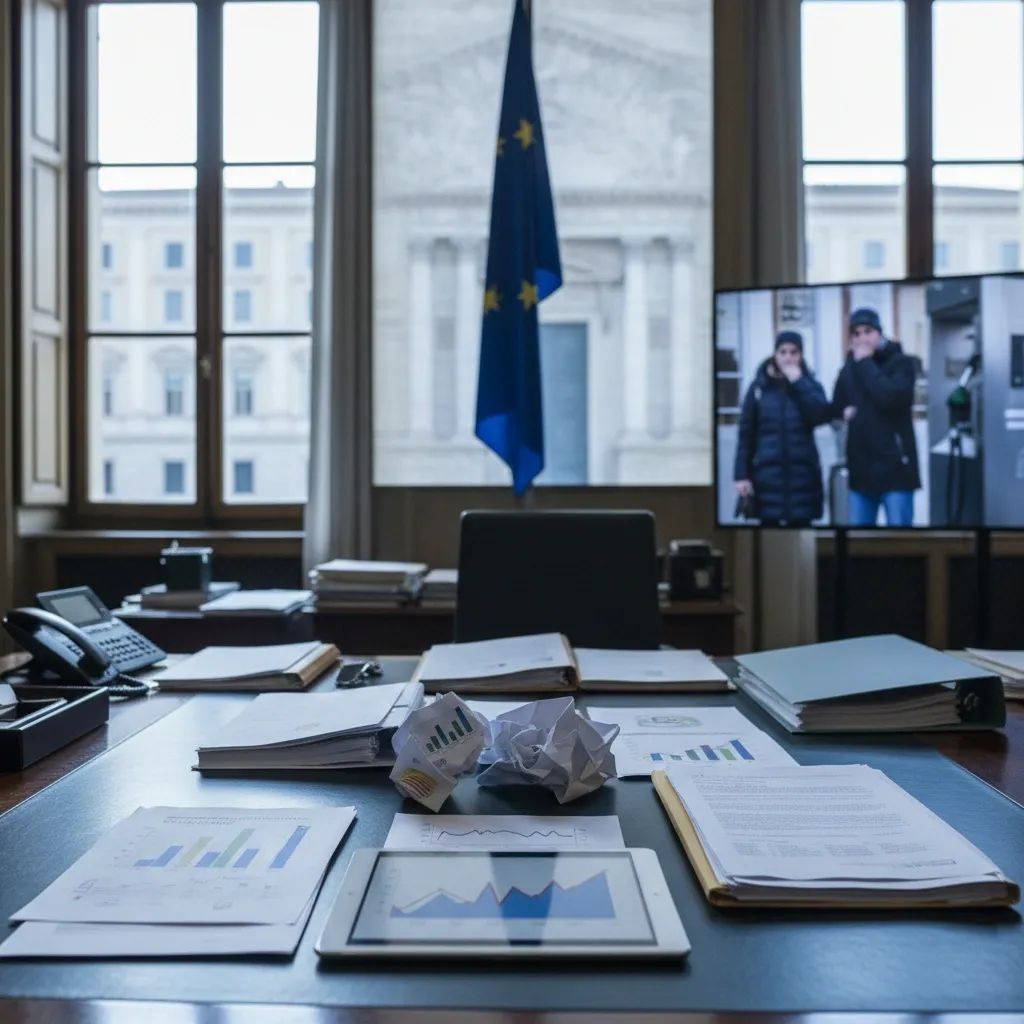
The Italian Government has issued a warning against military escalation in Iran that fails to distinguish between strategic targets and civilian populations, positioning Rome at a subtle but significant distance from Washington's hardline approach. The statement arrives as a 14-day ceasefire between the United States and Iran takes effect, brokered by Pakistan following weeks of escalating airstrikes and regional tensions.
Why This Matters for Italy
• Energy security monitoring: Italy imports over 90% of its gas and 95% of its oil, making it acutely vulnerable to potential Strait of Hormuz disruptions. The government is actively monitoring energy impacts but has declared "attention but no emergency."
• Potential economic scenarios: Government projections warn that if the conflict extends significantly, Italy could face stagnation or even a 0.7% GDP contraction, threatening manufacturing and employment. However, officials have ruled out austerity measures at this stage.
• Diplomatic positioning: Prime Minister Giorgia Meloni is expected to outline Italy's independent stance Thursday in a parliamentary address, emphasizing humanitarian considerations over alignment with Trump's approach.
• Fuel price trajectory: Italian fuel prices rose significantly in March — gasoline up 5.5% and diesel 9.8% — with projections of further potential increases if the ceasefire collapses. Current price trends are being closely monitored.
The Italian Position: Regime vs. Population
In a carefully worded statement released by Palazzo Chigi, the Italian executive made clear that "the Iranian civilian population cannot and must not pay the price for the faults of its rulers." The declaration condemned Tehran's destabilizing conduct — including missile attacks threatening Gulf nations, repeated intimidation aimed at compromising freedom of navigation through the Strait of Hormuz, and systematic internal repression — but drew a bright line between regime accountability and civilian welfare.
Notably, the statement never mentions the United States by name, yet the admonition is unmistakably directed at recent threats. The Italian Government shares the European Union's position on the necessity of preserving civilian infrastructure and population safety, expressing hope for a "negotiated solution to the crisis" — language that places Rome closer to Brussels than to Washington in this delicate moment.
Pope Francis reinforced this humanitarian angle from Castel Gandolfo, calling threats against the entire Iranian population "unacceptable" and describing potential harm to civilians as a moral question beyond international law.
What Happened: The Recent Escalation
The current crisis intensified on February 28, 2026, when coordinated airstrikes across Iran killed senior officials and struck critical infrastructure including petrochemical complexes, gas production facilities, and transportation hubs. Iran responded with hundreds of missiles and drones, hitting Israeli and American targets. Tehran also effectively closed the Strait of Hormuz — the narrow waterway through which roughly one-fifth of global oil transits — by making it uninsurable for commercial shipping, causing transit costs to skyrocket and tanker traffic to grind to a near-halt.
The human toll has been significant, with thousands dead across the region and millions displaced. The broader conflict destabilized energy markets globally.
The Fragile Truce and What Comes Next
On April 7-8, the United States and Iran agreed to a 14-day ceasefire, mediated by Pakistan. Trump conditioned it on the "COMPLETE, IMMEDIATE and SECURE OPENING" of the Strait of Hormuz. Iran confirmed acceptance and stated that passage through the strait would be permitted under Iranian military management during the two-week period.
Negotiations for a permanent agreement are scheduled to begin April 10 in Islamabad. The truce remains precarious, with Israeli operations continuing in Lebanon and regional tensions still elevated.
What's Actually Happened to Italian Energy Prices So Far
Italian residents experienced notable price increases in March: gasoline rose 5.5% and diesel increased 9.8% during the period of heightened conflict. Electricity costs also experienced pressure, though the severity of ongoing impacts depends on whether the ceasefire holds and negotiations progress.
What Could Happen If the Crisis Extends
If the conflict escalates or the ceasefire collapses, energy impacts could intensify significantly. Brent crude oil briefly approached $120 per barrel in March before settling around $92-95 following the ceasefire. Analysts predict potential peaks between $90-110 per barrel if the conflict remains contained, but warn prices could exceed $147 per barrel if the Strait of Hormuz remains blocked for an extended period.
For Italy, this could translate to cascading costs. The country's 47% reliance on gas for electricity generation — the highest share in the EU after Ireland and Malta — creates acute vulnerability. A sustained 10-15% increase in gas prices could push electricity costs significantly higher. Italian manufacturing enterprises face potential energy bill increases estimated at €7 billion for four months of conflict, climbing to €21 billion if hostilities continue through year-end.
Sectors most at risk include metallurgy, food processing, hotels, transport, logistics, and chemicals — all energy-intensive industries central to the Italian economy. Broader economic projections under worst-case scenarios include potential recession with a 0.7% contraction if fighting continues through 2026.
Government Response: Monitoring Without Panic
Senior officials have made clear there is currently "attention but no emergency," a message underscoring the government's measured approach. Officials have ruled out drastic austerity measures at this stage, dismissing recommendations such as mandatory remote work, fuel rationing, or reduced highway speed limits.
Italy's strategic reserves are estimated to cover approximately 90 days of net imports, providing a temporary cushion. The country has also diversified gas supplies, increasing procurement from Qatar and the United States and working with other suppliers including Algeria, Libya, and Azerbaijan.
The Ministry of Environment and Energy Security (MASE) is completing emergency monitoring based on Italy's natural gas system contingency plan, with ongoing briefings to the Prime Minister as the situation develops.
Meloni's Gulf Diplomacy and Thursday's Address
Prime Minister Meloni recently returned from a pre-Easter trip to the Gulf, visiting the United Arab Emirates, Saudi Arabia, and Qatar. Thursday's parliamentary informative session is expected to outline the government's position on the crisis, emphasizing Italy's independent diplomatic approach while navigating the complex triangle between Washington, Brussels, and Tehran.
The European Dilemma
The European Union has walked a diplomatic tightrope throughout the escalation. EU High Representative for Foreign Affairs Kaja Kallas welcomed the ceasefire on April 8 as "a step back from the brink." French President Emmanuel Macron echoed this sentiment while calling for Lebanon to be included in any final agreement.
Europe's leverage remains constrained by the legacy of Trump's 2018 withdrawal from the Joint Comprehensive Plan of Action (JCPOA), the 2015 nuclear deal. The EU continues to insist on the protection of Iranian civilians and infrastructure — the same balancing act Italy now performs.
What This Means for Italian Residents
For people living in Italy, the immediate reality is elevated fuel and energy costs from the March price increases. The 5.5% gasoline and 9.8% diesel increases recorded are tangible impacts on household budgets.
Looking forward, residents should understand that the government is monitoring the situation closely without declaring an emergency. If the ceasefire holds and negotiations progress, price pressures should stabilize. However, if the conflict resurfaces, significant additional cost increases are possible across energy bills and fuel prices.
The next two weeks will reveal whether the ceasefire creates genuine diplomatic openings or merely postpones deeper crises. For Italy, the situation underscores the importance of long-term energy diversification and renewable energy investment to reduce vulnerability to Middle East disruptions.


