
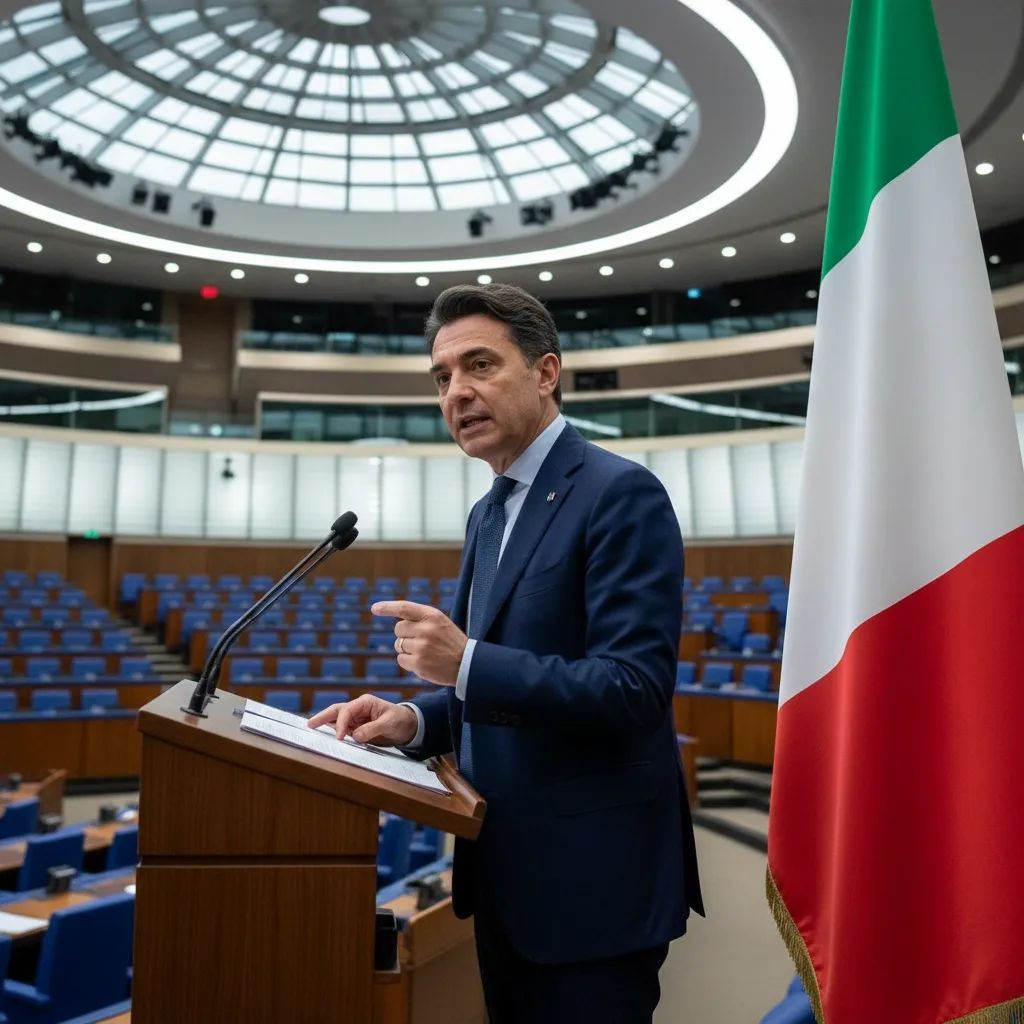
Rome's diplomatic posture toward Moscow just hardened further. After Russia's state television channel aired a cascade of obscene attacks on Prime Minister Meloni in mid-April, the Italy Foreign Ministry moved swiftly to lodge a formal protest, summoning the Russian ambassador and signaling that personal assaults on national leadership cross a line Rome will not tolerate quietly, regardless of geopolitical tensions.
Key Takeaways
• Formal diplomatic rebuke: The Farnesina summoned Russian Ambassador Paramonov to express institutional indignation over vulgar language directed at Italy's head of government.
• Kremlin propagandist refuses to retreat: State-aligned presenter Vladimir Solovyov doubled down on accusations rather than apologize, claiming Meloni backs "Nazi Ukraine" and shares Mussolini's fascism.
• Bipartisan unity emerged: Opposition and government politicians rallied behind Meloni, treating the attack as an assault on the entire nation rather than partisan ammunition.
The Escalation Timeline
On April 21-22, 2026, during his television program Polnyj Kontakt, Vladimir Solovyov unleashed a tirade of insults aimed directly at the Italian premier. His language—translated from Italian-language slurs—ranged from calling her a "shame of the human race" and a "natural beast" to more graphic epithets. The broadcast went beyond personal abuse; Solovyov accused Meloni of betraying Italian voters and former U.S. President Donald Trump, while framing her government as complicit in what Moscow falsely characterizes as "Nazi terrorism in Ukraine."
What distinguished this outburst from ordinary political invective was its relentlessness and its platform. Solovyov commands an audience within Russia's state-controlled media ecosystem, meaning his words carried implicit legitimacy from Moscow's propaganda apparatus. When asked the following day whether he would apologize, Solovyov refused outright, instead doubling down and insisting that Meloni herself must answer for allegedly adopting Mussolini's ideological framework and enabling Ukrainian "terrorist attacks" on Russian territory.
The Russian presenter also referenced alleged Ukrainian assassination plots targeting him personally—a claim designed to conflate his personal grievances with Kremlin foreign policy narratives.
What This Means for Italy's Standing
For residents and businesses operating in Italy, this episode crystallizes a harder reality: Rome's unambiguous backing for Ukraine places the country in direct opposition to Moscow, and the Kremlin increasingly relies on inflammatory messaging rather than diplomatic negotiation to express that frustration. This rhetorical warfare has concrete consequences. Italy participates in EU sanctions regimes affecting Russian financial transactions and energy arrangements, creating friction points in the broader Italian economy through supply chain disruptions and inflation pressures that ripple across multiple sectors. Residents experience this through energy costs, import prices, and the cascading effects on everyday consumption.
The diplomatic chill also complicates Italy's cybersecurity posture. The government has documented recurring cyberattacks attributed to Russia-linked actors, requiring ongoing investment in infrastructure protection and heightened vigilance from public institutions. For ordinary citizens, this translates into data security concerns and the normalcy of state-level digital threats that didn't characterize Italian life a decade ago.
Additionally, Rome's commitment to military and financial support for Ukraine means Italian tax revenue flows toward Kyiv assistance. The government approved participation in the 20th round of EU sanctions in April 2026 and has pledged ongoing aid through a drone production collaboration agreement negotiated between Meloni and Ukrainian President Zelensky during the same month. These are not abstract foreign policy gestures—they represent budgetary allocations that could fund domestic infrastructure or social programs.
Rome's Swift Response
Foreign Minister Antonio Tajani summoned Ambassador Alexey Paramonov to the Farnesina on the morning following the broadcasts. During the meeting, Tajani conveyed what officials described as "profound indignation" regarding the "unacceptable offenses" targeting the nation's chief executive. President Sergio Mattarella, who typically avoids public commentary on diplomatic incidents, also stepped forward to express personal indignation over Solovyov's "vulgar words"—a gesture underlining institutional solidarity and signaling that attacks on the premier are perceived as attacks on the state itself.
Paramonov attempted to create distance between the Russian government and Solovyov's remarks, claiming he had already disassociated the official state from the presenter's comments the prior evening and reiterated that position repeatedly during the Farnesina meeting. Yet the ambassador's distancing carries limited credibility. State-controlled Russian media operates within a carefully managed information ecosystem where such vitriol is tolerated by authorities, functioning as an extension of foreign policy messaging rather than as independent journalism. Solovyov's platform exists because state structures permit it; silence on controversial figures is itself a form of tacit approval.
Russian Foreign Ministry spokeswoman Maria Zakharova subsequently criticized Italy as well, accusing the nation of being "confused by Western propaganda for many years" and allowing foreign media narratives to mislead the population. This move—attacking not just Italy's leadership but its supposed epistemic vulnerability—represents a common Kremlin tactic: delegitimizing the opponent's ability to discern truth.
Historical Context of Kremlin Hostility Toward Italian Leadership
This April incident sits within a broader pattern of Russian hostility directed at Rome. President Mattarella was placed on a Kremlin "Russophobe" list in July 2025 after publicly comparing Russia's 2022 Ukraine invasion to Nazi Germany's military conquests and warning of Moscow's "dangerous nuclear rhetoric." Foreign Minister Tajani faced Russian criticism in February 2026 when he exposed cyberattacks linked to pro-Kremlin actors. In November 2025, Zakharova mocked Italy's economic struggles, implying the country would collapse entirely if it continued "wasting taxpayers' money" on Ukraine—a jab referencing the partial collapse of Rome's historic Torre dei Conti structure as a crude metaphor for national disintegration.
By January 2026, Russian Foreign Minister Sergei Lavrov formally declared that Italian-Russian bilateral relations had reached their "lowest point"—diplomatic language signaling complete breakdown of normal working relationships. The drumbeat of insults reflects Moscow's deep frustration with Rome's alignment with NATO and the EU's sustained support for Ukraine, a position that has placed Italy directly in the Kremlin's rhetorical crosshairs.
Unexpected Political Consensus
One unanticipated consequence of the Solovyov episode was the cross-party solidarity it generated across Italy's fragmented political landscape. Opposition figures and government allies alike condemned the remarks, framing them as an assault on national sovereignty rather than as ammunition for partisan advantage. This temporary cohesion suggested that foreign aggression and personal attacks on state leadership can still unite Italian politics, at least temporarily. For Moscow, the gambit of leveraging media proxies to exploit internal divisions appears to have backfired substantially.
The Personal Dimension Behind the Animus
Analysts have pointed to a financial motive underlying Solovyov's hostility. The presenter holds Italian property that has been frozen under EU sanctions targeting Kremlin-linked individuals. This asset seizure likely fuels his rhetorical attacks on Italian policymakers who enforce those measures. Personal grievance thus merges with state propaganda in ways that complicate the distinction between individual animosity and institutional messaging.
The Paradoxes of Italy's Russia Policy
Despite the diplomatic freeze, Italy remains economically entangled with Russia. The country continues importing Russian natural gas, as a full EU embargo has not yet materialized. This dependency constrains Rome's leverage in conflicts with Moscow. While Italy has accelerated efforts to diversify energy sources and reduce Russian reliance, the transition requires time measured in years rather than months. Russian Ambassador Paramonov has signaled Moscow's theoretical willingness to resume gas supplies "based on mutual respect"—a carrot dangled alongside diplomatic sticks.
The Venice Biennale controversy of 2026 exemplified this tension. European Greens criticized the Meloni government's decision to permit Russian participation in the 61st Biennale, set for May 2026, characterizing it as a "political choice" that risks normalizing Russian cultural presence while sanctions remain in force and the war continues. The decision revealed the strain between maintaining dialogue channels and avoiding symbolic compromises that could signal weakness or divided purpose.
Italy has maintained diplomatic infrastructure despite tensions. The government accredited a new ambassador to Moscow in January 2026, a gesture interpreted as an effort to preserve dialogue possibilities without signaling policy shifts. Yet Kremlin overtures about resumed cooperation continue to be undercut by the stream of hostile rhetoric aimed at Italian leaders—creating a relationship frozen in mutual mistrust where both sides speak of openness while actions contradict words.
Meloni's Response and Italy's Strategic Clarity
When confronted with Solovyov's tirade, Prime Minister Meloni responded tersely: "A diligent regime propagandist cannot offer lessons in either consistency or freedom." The quip encapsulates Rome's stance—dismissive of Moscow's moral authority, confident in its strategic trajectory. She has positioned Ukraine support as both a moral imperative and a strategic necessity for European security, positioning Italy within G7 and EU frameworks to push for intensified economic pressure on Russia through coordinated sanctions.
Meloni has also emphasized that Italy "has no masters, nor takes orders," but acts solely in its national interest, a rhetorical positioning designed to rebut claims that Rome follows foreign dictates. This framing attempts to transform what Moscow presents as subservience to the West into an assertion of autonomous decision-making grounded in Italian security priorities.
Looking Forward
As April 2026 transitions into the subsequent month, the Solovyov episode remains emblematic of a deeper incompatibility: Italy and Russia occupy irreconcilable positions on Ukraine, and Moscow has chosen to express that frustration through personal attacks on Italian leaders rather than substantive diplomatic engagement. For people living in Italy, the message is unambiguous—Rome's backing for Kyiv will not be coerced into reversal through rhetoric, regardless of how crude or provocative the language deployed against its leadership. The costs of that commitment—through energy arrangements, cybersecurity vigilance, budgetary allocations, and geopolitical isolation—will continue shaping the national context in which ordinary Italians navigate their lives.


