
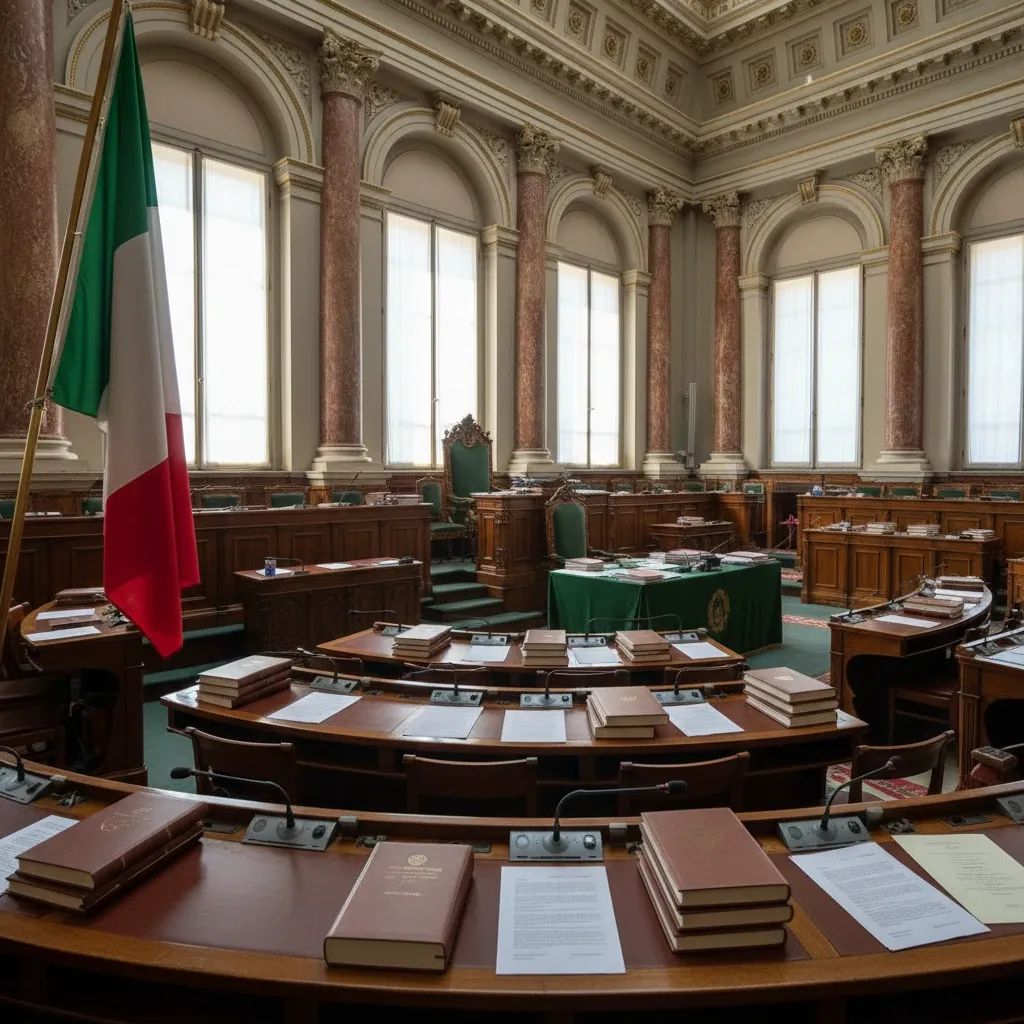
Italy formalized a long-delayed recognition on April 29, 2026, when the Senate unanimously enacted legislation creating an annual National Day of Memory for Slain Journalists to be observed every May 3rd. The passage marks a legislative conclusion that began in the Chamber of Deputies last July, yet it arrives against a paradox: while Italy honors its dead, it ranks 49th globally in press freedom—dropping from 46th place just two years prior—placing it among the European Union's weakest performers.
Why This Matters
• Calendar Obligation: Starting in 2026, May 3rd becomes an institutional commitment requiring state agencies, regional administrations, and local governments to stage ceremonies, educational programs, and public awareness campaigns tied to World Press Freedom Day.
• Educational Mandate: Schools and universities must integrate journalist martyrology into curricula, specifically anchored to Article 21 of the Italian Constitution, which guarantees freedom of expression and press freedom, ensuring younger generations understand both the profession's ideals and real costs.
• Broadcast Requirement: The state-controlled Radiotelevisione Italiana (RAI), Italy's state-owned national public broadcasting company, must allocate programming time—including prime-time slots—to profiles and documentaries about murdered journalists, guaranteeing visibility beyond academic and journalistic circles.
The Legislative Path and Political Consensus
The bill originated with Paolo Emilio Russo, a deputy from the Forza Italia party, a center-right party currently in the governing coalition, and traveled through both parliamentary chambers without substantive opposition. That unanimity signals a rare moment of cross-party agreement, though consensus around commemoration masks persistent disagreement over how to strengthen protections for living journalists. Alberto Barachini, the undersecretary to the Prime Minister responsible for information and publishing, framed the law as reinforcing the constitutional foundation that "information is essential to democratic governance." Premier Giorgia Meloni characterized it as "a recognition long overdue and anticipated for many years."
The timing mattered. Italy's Senate acted precisely as a coordinated international reckoning began: the Reporters Without Borders 2026 World Press Freedom Index, released on April 30, documented historic deterioration in global conditions, yet the Italian legislation had already passed. The optics suggested symbolic action ahead of uncomfortable data.
Naming the Dead: Memory as Specificity
Meloni's official statement listed 21 journalists by name, a deliberate strategy to force institutional recognition beyond abstraction. The roster spans geographies and decades. Peppino Impastato, murdered by the Sicilian mafia in 1978; Ilaria Alpi and cameraman Miran Hrovatin, killed by militants in Mogadishu in 1994 while investigating weapons trafficking; Maria Grazia Cutuli of Corriere della Sera, shot in Afghanistan in 2001; Giancarlo Siani, targeted by the Camorra in Naples in 1985; Enzo Baldoni, executed by insurgents in Iraq in 2004. The historical record demonstrates that Italian journalists have paid in blood for their work, though the violence spans decades past rather than recent years.
This distinction matters. No Italian journalist has been killed domestically for reporting in the past three years. The mafia's willingness to eliminate journalists has apparently diminished, whether through prosecution of crime bosses, cultural shifts, or altered risk calculations. International theaters—conflict zones, authoritarian states—remain far more lethal. Yet the principle driving the memorial day holds regardless: journalism as a deliberate vocation to bear witness on behalf of democratic accountability carries inherent danger, and democracies should formally acknowledge that sacrifice.
The Uncomfortable Gap Between Memorial and Protection
The law's practical scope extends beyond symbolic remembrance. State institutions are now required to coordinate campaigns against hate speech, digital harassment, threats, and Strategic Lawsuits Against Public Participation (SLAPPs) targeting journalists. SLAPPs are costly defamation suits filed not to win but to financially exhaust and intimidate journalists into silence. The Department for Information will oversee cross-jurisdictional implementation. Universities and journalism associations must design curricula addressing contemporary threats—a nod to accelerating online abuse, particularly targeting women reporters covering organized crime, politics, or corruption.
Yet implementation remains uncertain. Italy's track record on anti-SLAPP protections has been inconsistent. The European Union issued an Anti-SLAPP Directive in 2024, requiring member states to adopt protective legislation by 2025. Most deadlines have passed; transposition remains incomplete or partial across numerous countries, and Italy's formal compliance status entered 2026 ambiguous. Politicians and business figures continue filing costly defamation suits designed not to win but to intimidate—a tactic documented repeatedly by press freedom monitors. The new memorial law addresses awareness and education but does not systematically overhaul liability regimes or judicial timelines that make such suits weaponizable against journalists operating with limited institutional support.
Similarly unresolved: RAI's editorial autonomy. While the law mandates programming about fallen journalists, persistent concerns about political influence over Italy's state broadcaster circulate among media observers. The Media Freedom Rapid Response documented in March 2026 that RAI shifts programming based on government preferences and that editorial independence faces pressure from political appointees. The memorial law does not resolve these governance questions.
A Global Context of Historic Lethality
Italy's legislative moment gains perspective from global conditions tracked by the Committee to Protect Journalists (CPJ). The year 2025 became the deadliest on record for media workers: 129 journalists killed worldwide, surpassing any year since CPJ began systematic documentation in 1992. Approximately two-thirds of those deaths occurred in conflict zones, with Israel's operations in Gaza accounting for the majority—Palestinian journalists representing the highest casualty group by nationality. The CPJ additionally documented that armed drone strikes against journalists increased dramatically, with Israel responsible for roughly three-quarters of such attacks between 2023 and 2025, a weapon category scarcely documented a decade prior.
Imprisonment accompanied lethal violence. At year's end 2025, over 300 journalists were imprisoned globally—the fifth consecutive year exceeding that threshold—driven primarily by authoritarian regimes in China, Myanmar, Iran, and Belarus. United Nations data showed that investigations into journalist killings rarely produce transparent conclusions or accountability mechanisms, creating what researchers call a persistent culture of impunity. Perpetrators often face no consequences; the cycle perpetuates.
Italy avoided this trajectory domestically. No journalist has been prosecuted or imprisoned for reporting in recent memory. No sitting government has attempted mass media licensing revocations or broadcasting seizures. Italian democracy, for all its dysfunction, has not descended into the authoritarianism evident in Hungary, Turkey, or parts of Eastern Europe. Yet the deterioration in global press freedom rankings and the documented increase in violence against journalists abroad created urgency around formalizing protection and memory in Italy itself.
Memorial Iconography and Place-Based Remembrance
Alongside legislative action, Italy has embraced material commemoration. White benches bearing the Jacques Prévert quote "When truth is not free, truth is not true" now occupy public squares in Rome and the Friuli-Venezia Giulia municipality of Ronchi dei Legionari. These "Freedom of Press Benches" function as civic prompts—deliberate invitations to pause and reflect on journalism's role. The "Press Freedom and Expression Walking Trail" in Rome guides visitors through a curated path dedicated to 21 murdered journalists and media workers. The European Parliament in Brussels mounted an exhibition titled "Witnesses to Truth," curated by the Sicilian Order of Journalists, profiling reporters killed by organized crime.
Such initiatives reflect institutional recognition that memory without ongoing protection becomes ritualistic rather than consequential. The United Kingdom, by contrast, does not maintain a dedicated memorial day but has prioritized accountability mechanisms and international legal pursuit of perpetrators. Different strategies address the same tension: how democracies honor sacrifice while defending the living.
What This Means for Residents and Workers in Italy
For people living in Italy, the practical consequences crystallize in educational and cultural contexts. High school curricula will now systematically address journalist martyrology alongside Article 21 protections, contextualizing constitutional freedoms through lived tragedy. Journalism students will encounter structured teaching about contemporary threats—SLAPPs, harassment campaigns, doxxing—making workplace dangers part of professional socialization rather than hidden institutional knowledge.
Foreign correspondents and expatriate journalists working in Italian media will gain institutional recognition of professional risk, though that recognition remains distinct from expanded practical protections. The law creates frameworks; enforcement and vigor depend on how seriously state agencies pursue the mandated campaigns and how courts handle anti-SLAPP litigation.
For ordinary residents, May 3rd becomes an annual moment to confront what journalism demands. The broadcast programming requirement ensures stories of murdered journalists circulate beyond specialized publications, reaching evening-news audiences and shaping broader understanding of press freedom's stakes.
The Unresolved Questions Ahead
The legislation passes an important threshold—formal, institutionalized recognition that journalism is not merely commercial labor but a democratic practice with real costs. Italy's historical record of journalist murders, concentrated in prior decades rather than recent years, suggests improved security or changed calculus among would-be perpetrators. Yet the country's continued slide in global press freedom rankings indicates that dangers have transformed rather than vanished.
The coming months will test whether the government implements anti-harassment and anti-SLAPP provisions with institutional force, whether RAI's editorial autonomy strengthens, and whether media ownership transparency reforms follow. These answers will determine whether May 3rd becomes a genuine catalyst for protecting working journalists or remains a solemn symbolic observance. The law creates possibility; execution and political will remain to be demonstrated.


