
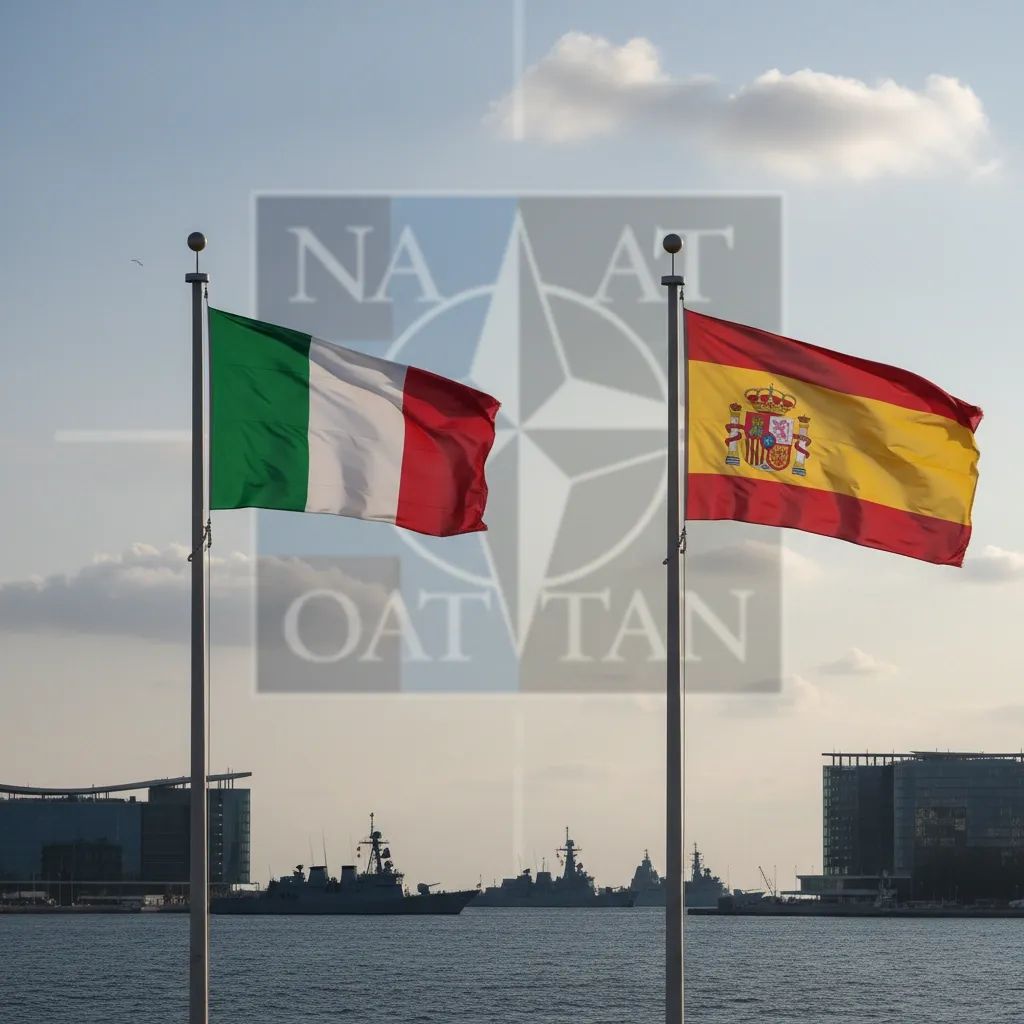
The United States President Donald Trump has publicly condemned Italy and Spain for their refusal to support American military operations against Iran, accusing both Mediterranean allies of effectively endorsing Tehran's pursuit of nuclear weapons. Speaking today, Trump declared he is "not happy" with either government and warned of potential troop withdrawals from both countries as tensions escalate over what he describes as Europe's inadequate response to the Iranian nuclear threat.
Why This Matters:
• Military posture at risk: U.S. troop presence in Italy and Spain could be reduced or eliminated, reshaping Mediterranean security architecture.
• NATO solidarity tested: The rift exposes deep fractures within the transatlantic alliance over Middle East policy and international law.
• Economic fallout possible: Trump has threatened to sever trade relations with Spain, potentially impacting bilateral commerce worth billions.
The Accusation
Trump's criticism centers on what he characterizes as a dangerous passivity toward Iran's nuclear ambitions. "They think it's acceptable for Iran to possess nuclear weapons," the president stated, singling out Rome and Madrid for declining to facilitate U.S. offensive operations from their territory. The remarks follow weeks of mounting friction as both European governments have reportedly refused American requests to use military installations for strikes targeting Iranian nuclear facilities.
The White House has framed the dispute as a litmus test of alliance commitment, with Trump asserting that Italy has been "of no help whatsoever" and characterizing Spain as "horrible, absolutely horrible" in relation to ongoing Middle East operations. His administration has suggested that European reluctance amounts to tacit acceptance of a nuclear-armed Iran—a scenario Trump has called "unprecedented problems" for global security.
Italy's Balancing Act
Prime Minister Giorgia Meloni's government has attempted to navigate a narrow path between transatlantic obligations and constitutional constraints on military engagement. According to reports, when the U.S. military requested use of military bases for aircraft carrying weapons destined for Iranian targets, Italian authorities declined participation. Defense Minister Guido Crosetto explained that Italy maintains it will not participate in offensive operations but remains committed to defensive NATO missions.
Palazzo Chigi, the seat of Italy's government, has stated that Rome will not participate in offensive operations and remains focused on defensive NATO commitments. Italian naval assets have been deployed to Cyprus as part of regional security assistance efforts, a move designed to demonstrate solidarity without crossing into offensive action.
Meloni has publicly stated that Italy "does not take part" in offensive military actions and "does not intend to enter" a war with Iran. Her office has called for negotiated solutions and insisted that Iranian civilians should not bear the cost of their regime's policies. Defense officials have reportedly expressed concern that prolonged conflict risks nuclear escalation and could undermine American global leadership.
Spain's Firmer Line
The Spanish government under Prime Minister Pedro Sánchez has adopted a more confrontational stance toward American pressure. Madrid has reportedly refused to allow U.S. forces to conduct Iran-related operations from joint military installations and has indicated restrictions on related military activities. Sánchez has repeatedly invoked the slogan "No a la guerra" (No to war) and condemned what he describes as unilateral military action violating international law.
Foreign Minister José Manuel Albares reportedly confirmed that Spain would not authorize activity beyond existing bilateral defense agreements or outside international legal frameworks. Sánchez has drawn parallels to the 2003 Iraq invasion, warning of similar destabilizing consequences, and insisted Spain will not be "complicit in something harmful to the world—and contrary to our values and interests—simply out of fear of retaliation."
Trump's threats have included possible sanctions and a complete severance of trade relations with Spain. He has also criticized Madrid for its defense spending levels. Spanish officials have dismissed suggestions that Washington might suspend Spain's NATO membership, with Sánchez defending the country's role as a faithful alliance partner.
What This Means for Residents
For people living in Italy, the situation raises questions about the country's security posture and economic exposure. Should U.S.-Italian military cooperation change significantly, the economic activity surrounding American installations could be affected. These bases support thousands of Italian civilian employees and generate substantial economic activity in surrounding communities.
The diplomatic rift also raises questions about intelligence-sharing and defense cooperation that underpin Italy's security framework. While Rome remains committed to NATO's Article 5 collective defense principle, tensions with Washington could complicate coordination on counterterrorism, cyber threats, and Mediterranean security challenges.
Economically, Italy could face complications if prolonged U.S.-European friction affects investment flows and business confidence. The Italian defense industry, which has partnerships with American contractors, may experience ripple effects in joint projects and procurement arrangements.
The Nuclear Sticking Point
At the heart of the dispute lies a fundamental disagreement over Iran's nuclear program and how to contain it. Trump withdrew the United States from the Joint Comprehensive Plan of Action (JCPOA) in 2018, calling it a "horrible, one-sided deal." Since then, Tehran has steadily expanded enrichment activities beyond the agreement's limits.
Both Italy and Spain view a nuclear-armed Iran as a direct threat to European security but have prioritized diplomatic engagement and sanctions over military action. As European Union members, both countries are aligned with the bloc's position that sanctions relief remains premature and requires "fundamental behavioral change" from Tehran. The EU has designated Iran's paramilitary forces as a terrorist organization and has imposed additional sanctions.
Trump has rejected Iran's latest peace proposal and maintains a naval blockade aimed at forcing Tehran to halt enrichment activities and freeze uranium stockpiles during negotiations. His administration insists that military pressure is essential to achieving a credible agreement, while European capitals argue that unilateral strikes risk regional conflagration and undermine multilateral nonproliferation efforts.
Alliance Under Strain
The public confrontation between Washington and two founding NATO members represents one of the sharpest intra-alliance disputes in recent memory. Trump has extended his criticism beyond Italy and Spain to include Germany, which hosts an even larger American troop contingent. The prospect of broad U.S. military retrenchment in Europe has alarmed defense planners across the continent and raised questions about the alliance's cohesion.
European officials have sought to distinguish between opposition to offensive military operations and commitment to collective defense. Defensive security deployments by both Italian and Spanish forces are intended to signal continued engagement in regional stability without endorsing strikes on Iranian territory.
The crisis has also exposed divergent interpretations of international law and alliance obligations. While Washington argues that European partners have a duty to support efforts to prevent nuclear proliferation by any means necessary, Rome and Madrid contend that offensive military action without UN Security Council authorization violates the legal frameworks that underpin the postwar order.
Looking Ahead
For now, both Italy and Spain appear prepared to maintain their positions rather than reverse course. Meloni has called it "unacceptable" for Trump to dictate Italian military participation, while Sánchez has framed Spanish resistance as a principled defense of international norms. Public opinion in both countries remains skeptical of Middle East military interventions.
The coming weeks will reveal whether Trump's threats translate into concrete policy changes or remain rhetorical tools for pressuring allies. Any actual reduction in U.S. troop levels would require extensive logistical planning and would likely face resistance from Pentagon officials concerned about strategic positioning in the Mediterranean.
The dispute underscores the broader challenge facing transatlantic relations as American and European threat perceptions and strategic cultures continue to diverge. For residents of Italy and Spain, the immediate takeaway is that their governments have chosen legal principle and diplomatic caution over reflexive alignment with Washington—a posture that carries both risks and a measure of sovereign assertion in an increasingly multipolar world.


