
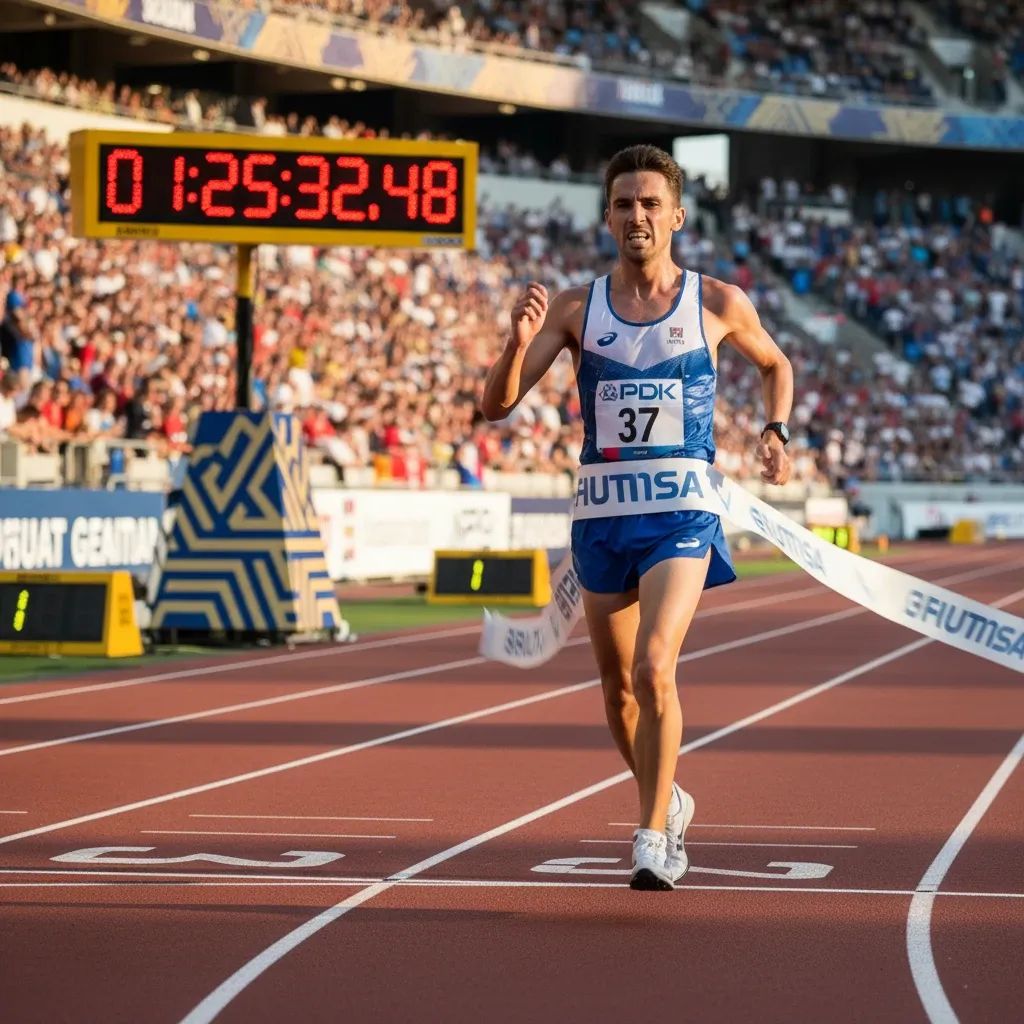
Italy's delegation at the European Athletics Championships has delivered a flood of medals, led by high jumper Gianmarco Tamberi's emotional return to form and complemented by gold and silver finishes in race walking—a discipline now facing an uncertain Olympic future that has sparked public frustration among Italian champions.
Why This Matters
• Tamberi's comeback: The Olympic champion cleared 2.32m to win his 4th European title, ending a two-year struggle with injuries and the fallout from Paris 2024.
• Race walking upheaval: Italian walkers dominated the new half marathon and marathon distances, but Antonella Palmisano and others openly criticized the format overhaul imposed by World Athletics.
• Olympic squeeze: Race walking will be reduced to just one event at Los Angeles 2028, down from multiple distances, threatening the discipline's visibility and Italy's medal pipeline.
Tamberi's Resurrection: A Father's Promise Fulfilled
Gianmarco Tamberi stood on the runway at the Alexander Stadium, half his beard shaved in trademark style, and delivered a performance that had seemed impossible just weeks earlier. The 34-year-old cleared 2.32m to claim European gold—his fourth continental crown—on the first birthday of his daughter Camilla, who watched from the stands with his wife Chiara.
"It was Camilla who gave me the strength to react after Paris," Tamberi said after the win, his voice cracking. "She couldn't keep seeing her 'babà'—that's what she calls me—take slaps left and right. I had to show her that if you keep investing in yourself, you win in the end."
The jump represents a dramatic reversal for an athlete who endured kidney stones and a hospital stay during the Paris Olympics, finishing 11th in a final he could barely complete. The months that followed were equally brutal: a knee surgery in 2025 left technical and psychological scars, and he arrived at these championships with a season-best of just 2.23m—far below his 2.37m European record from Rome 2024.
Yet Tamberi has built a career on peaking when it matters. After missing his opening attempt at 2.18m, he regained composure and outlasted Ukraine's Oleh Doroshchuk in a head-to-head duel. When Doroshchuk faltered at 2.32m, Tamberi sailed over, unleashing the roar that has become his signature.
"Behind my bib number I wrote 'Guess who's back,'" he revealed. "I knew tonight it would happen. My body was waiting for the moment that counts. It's as if everything I've done in this journey was worth it."
Impact on Italian Athletics: Gold Rush Amid Structural Questions
Italy's medal haul extends well beyond Tamberi. Middle-distance runner Nadia Battocletti swept both the 5,000m and 10,000m, becoming the first Italian woman to achieve the distance double at a European Championships. The 25-year-old from Trentino, coached by her father, credited family support and a month of intensive preparation for her breakthrough.
"I should tell myself, 'Nadia, you're really strong,'" she said, smiling. "I don't say I don't believe it, but I should believe it even more."
In the pool, swimmer Simona Quadarella also doubled up with golds in the 800m and 1,500m freestyle at the concurrent European Aquatics Championships, while sprinter Eseosa Desalu took bronze in the 200m and Italy's 4x100m mixed medley relay claimed bronze with a national record.
But Italy's success in race walking carried a bittersweet edge. Sofia Fiorini, 22, set a world record of 3:15:11 in the marathon walk, lapping nearly all competitors in the final kilometers. Massimo Stano took men's marathon gold, while Francesco Fortunato and Andrea Cosi secured silver and bronze in the men's half marathon. Alexandrina Mihai won silver in the women's half marathon.
Yet the event that produced these medals is itself under siege.
What This Means for Residents: A Discipline in Crisis
Race walking has long been a strength for Italian athletics, producing Olympic and world champions. But World Athletics' decision to replace the traditional 20km and 35km distances with half marathon and marathon formats—and the International Olympic Committee's move to allow only one race walk event at Los Angeles 2028—has left athletes and officials reeling.
Antonella Palmisano, the Tokyo Olympic champion and a recent European gold medalist, did not mince words after disappointing results in recent race walking competition. "Race walking is experiencing an upheaval of distances and formats," she said. "We're wandering without a destination. These changes make it seem like they want to exclude us, reducing the time dedicated to race walking."
The 32-year-old criticized the new format's logistical challenges: "Competing together on the same course, on a 1km loop, reduces the chances of overtaking. I don't like sudden changes of pace." She added that while her career may be nearing its end, the uncertainty threatens the entire pipeline of young walkers.
Stefano Mei, president of the Italian Athletics Federation (FIDAL), echoed the concern. "Race walking is part of the history of athletics and deserves greater respect," he said. "World Athletics is probably looking for a system more appealing to TV audiences. As a former athlete, I lived through a golden period of Italian race walking—now we may be even further ahead, but the sport's future is in jeopardy."
The issue is not abstract: Italy has historically dominated race walking at international competitions, and the reduction in Olympic slots directly affects medal prospects and funding pipelines. For sports professionals and athletics enthusiasts in Italy, the controversy highlights how international sports governance decisions—often driven by broadcast revenue and audience metrics—can reshape national athletic priorities and youth development programs.
The Resilience Narrative: Sports Psychology and Parenthood
Tamberi's comeback offers a case study in the psychology of elite sports recovery. Research on athletic motivation increasingly points to family roles as pivotal in sustaining resilience during career adversity. While genetic and epigenetic factors (such as paternal exercise habits influencing offspring physiology through sperm microRNA) contribute to athletic potential, the emotional scaffolding provided by partners and children often determines whether an athlete continues competing after setbacks.
Tamberi's public dedication to Camilla—posted on Instagram before the final—fits a pattern observed among parent-athletes: the shift from individual ambition to legacy motivation. "In one year you've turned our lives upside down," he wrote. "You gave me the strength to react in one of my hardest moments. Today your babà will show you what he does best."
This narrative resonates in Italy, where family structure and intergenerational identity remain central to cultural values. Tamberi's victory is framed not just as personal redemption but as paternal duty fulfilled—a message that extends beyond sports into broader Italian society.
Looking Ahead: Los Angeles 2028 and the Uncertain Path
For Italian athletics, these championships represent both validation and warning. The medal count demonstrates depth across disciplines, but the structural threats to race walking and the aging of key stars like Tamberi (who will be 36 at the next Olympics) raise questions about sustainability.
The Los Angeles 2028 Olympics will feature only a single race walk event per gender—the half marathon—eliminating the mixed relay introduced in Paris 2024. World Athletics has framed the change as modernization; critics call it marginalization. For a nation that has built training infrastructure and youth academies around race walking, the reduction threatens to undermine decades of investment.
Meanwhile, Tamberi's gold underscores the unpredictable alchemy of championship performance. Despite a mediocre season, he produced his best jump when it mattered most—a reminder that form curves and injury timelines rarely align neatly with competition calendars. Whether he can sustain this peak through another Olympic cycle remains an open question, but for now, the man who wrote "Guess who's back" on his bib has answered definitively.


