
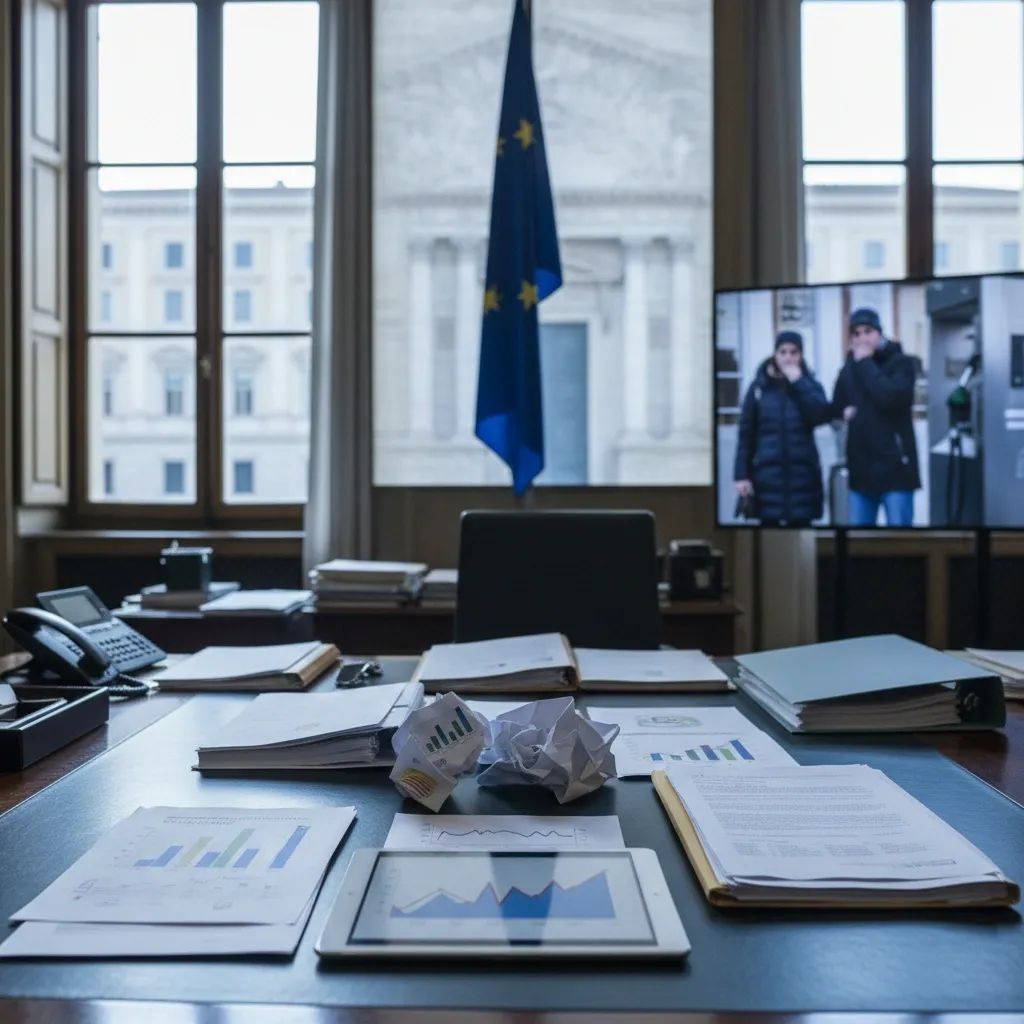
Why Italy Is Bracing for Economic Shock This Week
Italy's government is preparing the public for hard truths about the Middle East conflict. Prime Minister Giorgia Meloni will address Parliament this week following an emergency Cabinet meeting dedicated entirely to the Iran crisis—a situation that has upended energy markets, stranded tens of thousands of Italians abroad, and forced Rome to confront the limits of its diplomatic leverage in a destabilized region.
Key Takeaways:
• Parliamentary testimony imminent: Meloni delivers a formal government position on economic countermeasures, evacuation operations, and Italy's diplomatic stance within days.
• Energy prices under pressure: The disruption of shipping through the Strait of Hormuz threatens immediate cost increases—fuel at the pump could rise 30-40 cents per liter, while household gas bills face 30-40% hikes.
• Broader economic fallout: Manufacturing sectors dependent on Gulf supplies face potential production cuts of up to 20%, jeopardizing roughly 200,000 jobs in steel, ceramics, chemicals, and automotive.
• Citizen evacuation active: The Italy Ministry of Foreign Affairs is coordinating repatriation flights for Italian nationals trapped in Gulf countries as airspace closures and flight cancellations persist.
The Crisis Takes Shape: What Led Us Here
What started as popular anger over economic collapse in late December 2025 has morphed into a full-scale regional confrontation. Mass protests erupted across Iran—more than 100 cities—as citizens protested soaring inflation, currency devaluation, and authoritarian crackdowns. By late February, the situation had escalated beyond civil unrest when the United States and Israel launched coordinated military strikes on February 28 against Iranian command centers, nuclear facilities, and military installations.
The operational scope was extensive. Iranian leadership was decimated, including Supreme Leader Ayatollah Ali Khamenei, whose death was confirmed by Tehran's own state media on March 1. In retaliation, Iran deployed missiles and drone swarms targeting Israel, the United Arab Emirates, Qatar, Kuwait, Bahrain, Jordan, and Saudi Arabia, alongside U.S. military bases scattered across the Persian Gulf.
The humanitarian toll mounted rapidly. By March 3, the United Nations documented at least 555 Iranian civilians killed in coalition airstrikes, with particular attention to a March 3 strike on an elementary school in Minab that claimed dozens of young lives. The Iranian Red Crescent Society reports hundreds more injured, and mass displacement has overwhelmed aid organizations attempting to maintain supply chains for basic necessities.
The Strait of Hormuz: Why Energy Markets Are Panicking
The Strait of Hormuz is not just geography—it is the lifeline for roughly one-fifth of global crude oil production and more than 30% of liquefied natural gas moving internationally. When shipping lanes through the strait become unreliable due to conflict, companies reroute around Africa, adding weeks to transit times and exponentially increasing transportation costs.
Analysts are already factoring in the worst-case scenario: a sustained bottleneck in the strait, mirroring or exceeding the 1973 oil embargo in severity. For Italy specifically, energy insecurity translates directly into household expenses and industrial viability.
The household impact matters immediately. A typical Italian family will face approximately €100 in additional monthly costs—combining rising electricity, heating fuel, and food prices driven by transportation expenses. This represents a 7% reduction in disposable income for those already managing post-pandemic recovery. Inflation is forecast to accelerate to 3.5-4% in coming months, a figure that compounds when energy is the primary driver.
The industrial picture is starker. Italy's energy-intensive sectors—glass, steel, ceramics, chemicals, paper manufacturing—collectively employ hundreds of thousands of workers. A sustained 20% production reduction due to energy scarcity would ripple through supply chains, layoffs, and reduced export capacity. The automotive and machinery sectors, which depend heavily on just-in-time delivery networks, face compounding delays as container ships take costlier, longer routes and logistics firms absorb the surcharges.
Rome's Dilemma: Loyalty, Self-Interest, and Diplomatic Distance
Italy occupies an awkward position. Rome was briefed on the U.S.-Israel operation only after the strikes commenced—alongside Germany and Poland—rather than being consulted beforehand. Publicly, the Italian government has aligned with the Atlantic narrative, condemning Iran's "totally unjustified" attacks and endorsing the defensive framing of the initial strikes.
But behind closed doors, Meloni's administration recognizes Italy's vulnerability. Unlike nations with energy independence or diversified supplier portfolios, Italy remains structurally dependent on Persian Gulf exports. The government has already learned this lesson painfully; during the Ukraine conflict, energy prices surged when Russian supplies were interrupted, forcing rapid diversification toward Algeria, Azerbaijan, and North African sources. That crisis taught Rome to expand LNG regasification capacity and establish strategic reserves—measures that provide some cushion now, but insufficient to weather an extended Hormuz closure.
In her televised statement on March 2, Meloni connected the Iran conflict to broader international law violations, specifically referencing Russia's 2022 invasion of Ukraine. "When a UN Security Council member deliberately attacks its neighbor, chaos inevitably follows," she stated, essentially arguing that the world has already entered an era of great-power lawlessness and that de-escalation is the only rational course.
Deputy Prime Minister and Foreign Minister Antonio Tajani has publicly coordinated with EU counterparts and the G7, emphasizing the need to "contain the crisis" and prevent regional spread. Italy has also activated what amounts to a permanent crisis cell at Palazzo Chigi (the prime minister's office), bringing together both deputy premiers, the Defense Minister Guido Crosetto, and intelligence leadership to monitor developments in real time and coordinate policy responses.
Italy's "Special Relationship" With Iran Now Complicated
Historically, Italy maintained what officials privately call a "special relationship" with Iran—rooted in cultural and commercial ties spanning centuries. Rome was one of the few Western capitals that refused to sever diplomatic and trade relations even after the 1979 revolution. Italian firms invested in Iranian ports, energy infrastructure, and manufacturing.
That pragmatism has increasingly collided with European alignment on human rights and nuclear non-proliferation since 2022. When the EU's Foreign Affairs Council reached a political agreement on January 29 to designate Iran's Islamic Revolutionary Guard Corps (IRGC) as a terrorist organization, Italy signed on—a symbolic but meaningful break with Tehran. The designation was framed as punishment for the regime's "violence, arbitrary detention, and intimidation tactics" against its own citizens during the December protests.
The EU has compounded that pressure with individual sanctions targeting over 290 officials and entities, including Iran's Interior Minister and senior IRGC commanders. EU High Representative Kaja Kallas has declared "zero tolerance" for Iranian human rights abuses while technically keeping diplomatic channels open to "safeguard critical EU interests"—diplomatic double-speak for: we condemn you but we're still talking.
Italy, bound by EU consensus on sanctions and condemnations, finds itself unable to capitalize on its historical relationship with Tehran. The leadership vacuum created by Khamenei's death and other senior officials' deaths has introduced profound uncertainty about who will actually control Iran's foreign policy in weeks ahead.
A Divided European Front
Europe does not speak with one voice on Iran. France, Germany, and the United Kingdom have signaled conditional readiness to support "proportionate defensive actions" against Tehran—a formulation that provides diplomatic cover for the U.S.-Israel strikes. Spain, however, explicitly rejected military support for the operation, breaking from the transatlantic consensus and underscoring persistent divisions within the 27-member bloc on Middle Eastern intervention.
The European Commission has called for "maximum restraint" and strict adherence to international law, while simultaneously maintaining a posture of heightened internal security vigilance. This reflects the delicate balance Brussels attempts: condemning aggression while avoiding entanglement in regional wars.
For Italy, these divisions matter because unified EU policy carries more weight in international negotiations. Fragmented positions reduce Europe's leverage and force individual capitals like Rome to navigate alone.
What Parliament Will Hear This Week
Meloni's parliamentary address will likely focus on three core objectives: citizen safety, economic stabilization, and diplomatic positioning. The prime minister will likely outline the status of evacuation operations for Italians stranded in Gulf states, present economic contingency plans (possibly including emergency draws from strategic petroleum reserves and accelerated renewable energy timelines), and explain Italy's vote alignments within EU and NATO forums.
Opposition lawmakers will press for specifics on energy rationing protocols, timeline for repatriations, and whether Italy lobbied for de-escalation with Washington before the strikes. The ruling coalition, meanwhile, will likely emphasize government responsiveness and the necessity of Atlantic solidarity in an anarchic international environment.
The fundamental challenge Meloni faces is messaging: how to assure Italians that the government has a plan while honestly acknowledging that much remains outside Rome's control. A prolonged conflict, leadership succession battles in Tehran, or further escalation could obliterate even carefully designed contingency plans.
The death of Khamenei and other Iranian commanders creates a vacuum that succession bodies are now fighting to fill behind closed doors in Tehran. Whether the new regime, whenever it crystallizes, will seek negotiation or double down on confrontation remains unknown—a strategic uncertainty that makes contingency planning extraordinarily difficult.
For now, Italy braces. Families and businesses will absorb the cost shock in coming weeks. Diplomats will speak of containment while intelligence services monitor Persian Gulf developments. Parliament will hear cautious optimism paired with sober realism. And citizens will simply hope that the premium they pay at the pump and on their utility bills purchases, at minimum, diplomatic wisdom sufficient to prevent an even worse outcome.


