
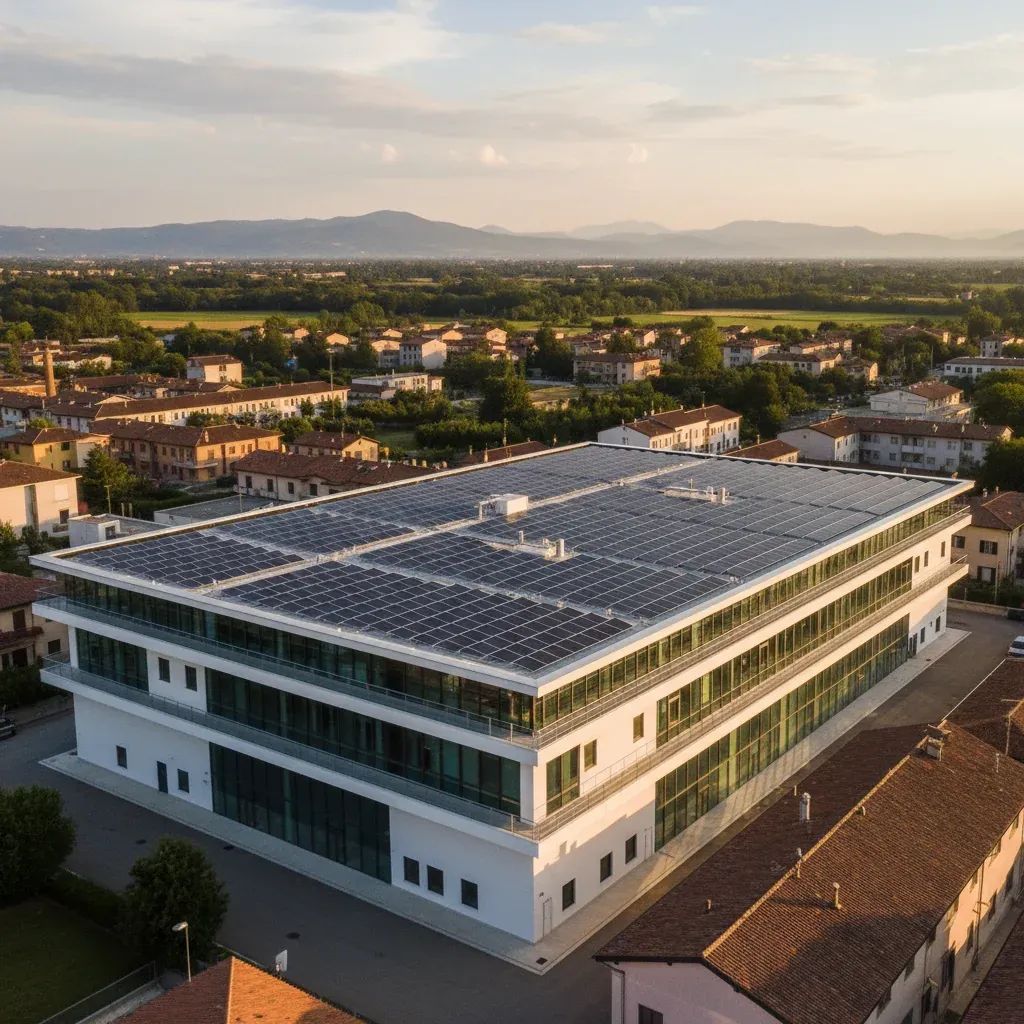
The Italian fitness equipment giant Technogym has switched on a powerful new solar array at its Cesena headquarters, a 2 MW installation that can now power the entire Wellness Campus with renewable energy during peak sunlight hours.
Why This Matters
• 40% average coverage: The system meets close to half of the campus's total electricity demand year-round, reducing reliance on the grid.
• 100% self-sufficiency in summer: During peak solar months, the facility runs entirely on sun-generated power.
• 1,617 tons of CO2 avoided annually: The installation prevents emissions equivalent to removing hundreds of cars from Italian roads each year.
Inside the Technogym Village Solar Project
Spanning roughly 17,000 square meters of rooftop space at the Technogym Village in Cesena, the photovoltaic system became operational in April 2026. The facility houses more than 4,000 solar panels with a combined capacity exceeding 2 MW, making it one of the most significant energy autonomy projects undertaken by a major Italian manufacturer in the sports equipment sector.
The installation directly serves both the company's production lines and administrative offices, a dual load profile that typically makes energy self-sufficiency challenging. Yet Technogym's engineers report the array can meet 40% of the campus's electricity needs on average across the calendar year, with consumption dipping below generation during high-irradiance periods. In practical terms, this translates to the Wellness Campus running on 100% renewable energy for stretches of time when solar output peaks, effectively decoupling the site from fossil-fuel-backed grid supply during those windows.
From a financial standpoint, the system strengthens direct energy self-consumption, reducing the volume of electricity Technogym must purchase from external suppliers. While the company has not disclosed the upfront capital expenditure or the payback timeline, industry analysts note that installations of this scale in the Emilia-Romagna region typically recover costs within seven to ten years, factoring in Italy's feed-in tariff adjustments and corporate electricity rates.
Decarbonization Goals Take Shape
Technogym had already switched its production facilities to 100% renewable electricity by 2024, sourcing certified green power through the grid. The new on-site solar array marks the next stage: generating renewable capacity in-house rather than simply purchasing it. This pivot aligns with the company's stated intention to formalize a comprehensive energy transition plan during 2026, a roadmap that will set hard targets for emissions reduction over the next decade.
The 1,617-ton annual CO2 saving attributed to the solar system represents a tangible contribution to Italy's national decarbonization trajectory under the European Union's Fit for 55 package, which mandates a 55% cut in net greenhouse gas emissions by 2030 relative to 1990 levels. For context, 1,617 tons of avoided CO2 is roughly equivalent to the annual emissions of 350 passenger vehicles operating under typical European driving patterns.
Technogym's broader sustainability posture has earned external validation: the firm secured an "A" rating from MSCI ESG Research and a Gold Medal from EcoVadis in 2024, placing it in the top tier of manufacturers assessed on environmental, social, and governance criteria. The company also holds certification under ISO 14001 for environmental management and ISO 50001 for energy performance, voluntary standards that require systematic measurement and continuous improvement of resource efficiency.
What This Means for Residents and Investors
For employees and contractors working at the Technogym Village, the solar installation translates to a more stable on-site power supply and reduced exposure to grid outages, a non-trivial benefit as Italy's energy infrastructure undergoes modernization. The campus operates as a self-contained "wellness hub," and the renewable power supply reinforces the company's brand identity among health-conscious clients and partners.
For investors and shareholders, the project signals capital allocation toward long-term operational resilience rather than short-term cost-cutting. Energy autonomy insulates the business from volatile wholesale electricity prices, which spiked sharply across Europe in 2022 and remain subject to geopolitical risk. By locking in a portion of supply through owned generation, Technogym reduces earnings volatility tied to utility costs.
From a regulatory compliance perspective, the installation positions Technogym ahead of tightening EU disclosure requirements. The Corporate Sustainability Reporting Directive (CSRD), which took effect in phases starting 2024, mandates granular energy and emissions reporting for large enterprises. Technogym's ability to demonstrate measurable decarbonization through physical infrastructure—rather than purchased offsets—strengthens its compliance profile and may reduce audit scrutiny.
Beyond Solar: Milano Cortina 2026 and Circular Economy Push
The solar array is only one thread in a broader sustainability agenda. As an official supplier for the Milano Cortina 2026 Olympic and Paralympic Games, Technogym is collaborating with the Wellness Foundation on two place-based projects: "Milano Wellness City" and "Cortina in Wellness." Both initiatives aim to embed healthy, active lifestyles into urban and mountain communities, leveraging the visibility of the Winter Games to drive behavior change.
On the product side, Technogym has doubled down on circular economy principles. The company now refurbishes 50% of its equipment portfolio, extending product lifecycles and diverting units from landfill. Packaging materials are 90% FSC and PEFC certified, ensuring responsibly sourced paper and wood. The firm has also digitized user manuals to eliminate printed copies, a small but symbolically important shift in a sector historically reliant on paper documentation.
Its "Human Powered" product line—gym machines that generate electricity during use—represents an intriguing inversion of the energy equation. While the power output per machine remains modest, the concept appeals to commercial gym operators seeking to market sustainability credentials to eco-conscious members. Technogym's Reform product recently won the iF Design Award 2026 for its integration of sustainable materials and elegant industrial design, underscoring that environmental performance need not compromise aesthetics.
Sector Leadership in a Regulated Market
Technogym's moves reflect broader pressure on European manufacturers to align with Science Based Targets initiative (SBTi) guidelines and the goals of the Paris Agreement. The company is actively participating in the World Economic Forum's Workplace Wellness Alliance, advocating for workplace health as a lever for systemic sustainability. This public advocacy complements private operational changes, positioning Technogym as a policy influencer in addition to a product vendor.
For Italian firms watching from adjacent sectors—furniture, machinery, food processing—Technogym's playbook offers a replicable model: secure renewable supply, formalize transition plans, engage in circular refurbishment, and leverage high-profile events (like the Olympics) to amplify messaging. The lesson is not that solar panels alone guarantee sustainability leadership, but that a multi-lever strategy, publicly disclosed and externally validated, builds credibility with regulators, investors, and clients alike.
As the Italy Ministry of Environment and Energy Security finalizes the national energy and climate plan update mandated by Brussels, corporate initiatives like Technogym's solar installation will feature prominently in aggregate progress reports. The private sector's ability to self-fund decarbonization infrastructure reduces the fiscal burden on public budgets and accelerates the timeline for hitting collective targets.
The Road Ahead
Technogym has signaled that the Technogym Village may evolve into a local energy hub, potentially exporting surplus solar generation to neighboring industrial sites or the municipal grid. Such "behind-the-meter" microgrids are gaining traction across Italy as Distributed Energy Resources (DER) regulations mature. If the company moves forward with this model, it would represent a shift from passive consumer to active grid participant, a role that carries both technical complexity and revenue opportunity through energy arbitrage.
In the near term, the formal energy transition plan due later in 2026 will clarify whether Technogym intends to replicate the solar model at other facilities—the company operates manufacturing and logistics sites beyond Cesena—and whether it will pursue battery storage to smooth output variability. The plan is also expected to address Scope 3 emissions embedded in the supply chain, a far larger and harder-to-control emissions source than on-site electricity use.
For now, the Cesena solar array stands as a visible, quantifiable commitment: 2 MW of capacity, 4,000 panels, 1,617 tons of CO2 avoided annually. In an era when corporate sustainability claims often lack physical substance, Technogym has built something you can walk under and measure with a voltmeter.


