
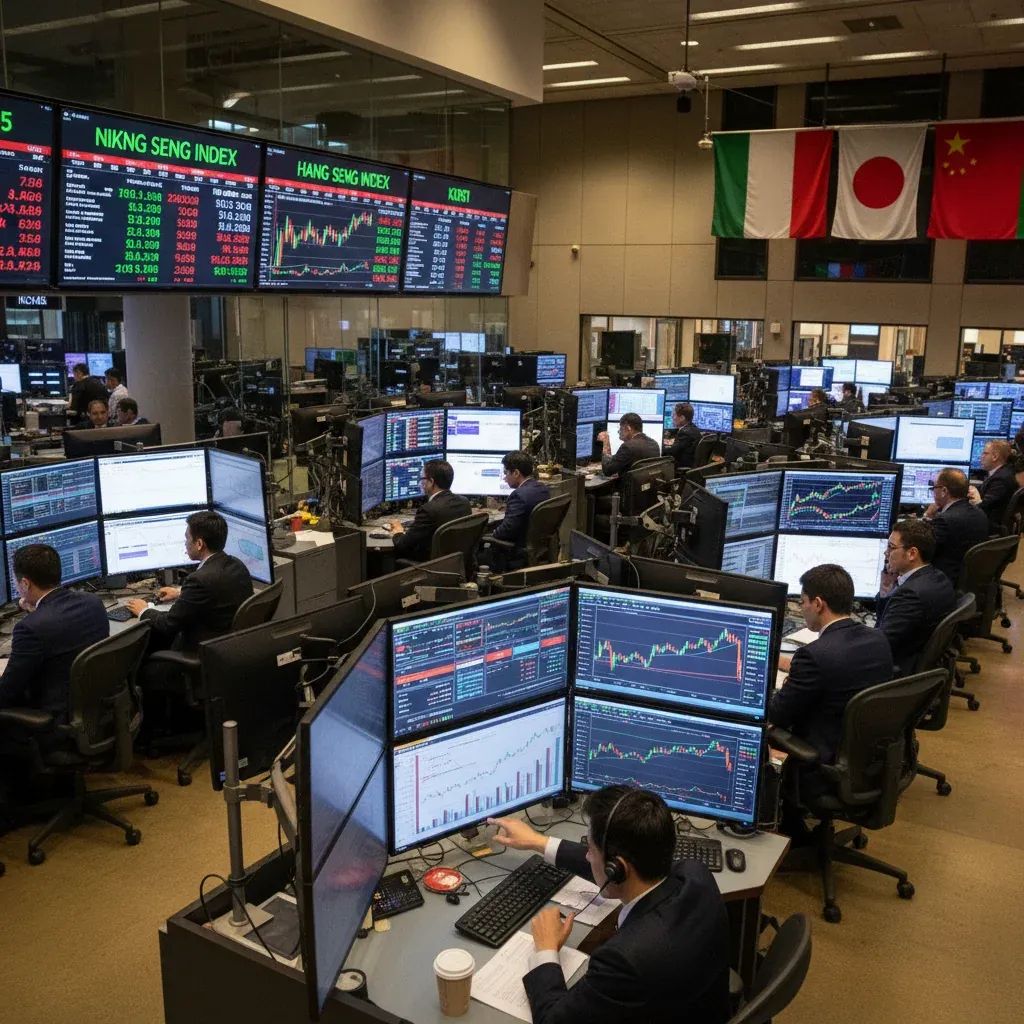
The Milan Stock Exchange closed on Monday, August 17, 2026, with a marginal 0.05% gain as investor optimism evaporated in late trading, dragged down by a diplomatic stalemate over the Strait of Hormuz that continues to choke global energy flows and spook financial markets. The muted performance reflects broader jitters across Europe, where most major bourses ended in negative territory despite early-session strength.
Why This Matters
• Energy transit paralysis: The Hormuz standoff has severely disrupted shipping routes, keeping oil and gas prices volatile.
• Borrowing costs inch up: Italy's 10-year bond yield rose 2.3 basis points to 4%, with the spread over German Bunds widening to 78.9 points.
• Tech semiconductors surge: Chip manufacturers rallied on fresh AI infrastructure spending projections.
• Luxury sector bleeds: European fashion and accessories stocks tumbled as weak local demand and pricing fatigue hit high-end brands.
Hormuz Standoff Sours Late-Session Sentiment
European equity indexes had climbed through the morning but reversed sharply as negotiators failed to break the impasse between Washington and Tehran over reopening the Strait of Hormuz, the narrow waterway that typically channels one-fifth of global oil supplies. A 60-day truce signed in June expired without extension, and Iran has rejected further direct talks with the United States unless the naval blockade and sanctions are lifted.
Iranian Foreign Minister Abbas Araqchi declared that the strait "will not be conquered by a tweet, a carrier group, or an electoral speech," while the Trump administration maintains its naval cordon and threatens unilateral control. Oman and Pakistan are attempting to mediate, with reports earlier this month of a separate Iran-Oman corridor agreement involving dedicated shipping lanes and a joint management body. Yet maritime traffic remains at a standstill, pushing Brent crude above $88 per barrel and keeping European energy-import costs elevated.
The uncertainty rippled through Wall Street: the Dow Jones shed 0.42% while the Nasdaq Composite edged up 0.17%, buoyed by tech gains. In Europe, Frankfurt's DAX fell 0.22%, London's FTSE 100 dropped 0.3%, Madrid's IBEX 35 declined 0.75%, and Paris's CAC 40 lost 0.67%. Milan managed to eke out a fractional advance, underscoring Italy's relatively insulated position within the continental sell-off.
Semiconductor Stocks Rally on AI Spending Wave
Investors poured into chip and infrastructure plays after fresh data confirmed strong capital expenditure commitments from hyperscale data-center operators for artificial intelligence computing capacity expansion. Industry forecasts see semiconductor revenue climbing substantially in 2026, with analysts predicting significant growth through 2027.
STMicroelectronics, the Geneva-based chipmaker with significant operations in Italy, jumped 4.8% in Milan. French substrate specialist Soitec climbed 4.06%, and Dutch lithography monopoly ASML—whose machines are indispensable for cutting-edge chip production—rose 2.6%. The rally extended to cable and connectivity suppliers: Prysmian, the Italian fiber-optics and power-cable giant, added 2.3% on expectations that advanced data centers will require massive grid and networking upgrades.
Market Context: Geopolitical factors are reshaping the supply chain. The United States CHIPS and Science Act and the EU Chips Act are funneling subsidies into domestic foundries, aiming to reduce reliance on Taiwan and South Korea.
Luxury Brands Sink Across the Continent
The session's sharpest losses came from the high-end fashion and accessories sector, where a confluence of weak European consumer spending, pricing fatigue, and softening tourist flows has eroded confidence. Kering—owner of Gucci and Saint Laurent—plunged 4.38%, Swiss jewelry and watch group Richemont fell 3.45%, Italian outerwear maker Moncler dropped 3.35%, and French conglomerate LVMH declined 2.65%. Salvatore Ferragamo lost 2.55%, and Brunello Cucinelli shed 1.7%.
Market Context: Analysts attribute the weakness to years of aggressive price increases that have alienated aspirational buyers, combined with fragile European consumption and contracting tourist spending. The sector is experiencing polarization: ultra-premium brands continue to gain ground, while mid-tier and accessible brands face headwinds as consumers shift spending toward luxury experiences.
What This Means for Residents and Investors
For Italy-based investors and savers, Monday's session underscores three critical trends. First, the Hormuz standstill is a persistent tail risk that will keep energy costs elevated and weigh on corporate margins, particularly for manufacturers and logistics firms. Monitoring any breakthrough in negotiations will be essential for anticipating relief in fuel and electricity bills.
Second, the semiconductor rally points to long-term structural growth in technology infrastructure, but also highlights potential supply-chain bottlenecks that could pinch industries reliant on affordable chips—automotive, appliances, medical devices. Italian companies embedded in these ecosystems may face margin pressure or delivery delays unless they secure multi-year supply agreements.
Third, the luxury downturn is a red flag for Italy's sizeable fashion, leather goods, and accessories sector, which employs tens of thousands and anchors regional economies from Tuscany to Veneto. Brands that fail to adapt to evolving consumer preferences or that rely on volume rather than creativity may see layoffs and store closures in the coming quarters. Policymakers and industry associations are likely to intensify calls for tax relief and export support to cushion the blow.
Bond Yields Climb, Euro Firms
Italian government bonds sold off modestly, pushing the 10-year BTP yield up 2.3 basis points to 4%, while the spread over German Bunds widened to 78.9 basis points. Germany's 10-year yield rose 1.4 basis points to 3.21%, and France's climbed 1.7 basis points to 4.06%. The moves reflect modest risk-off sentiment rather than acute fiscal concerns, but they serve as a reminder that borrowing costs remain sensitive to geopolitical shocks.
The euro strengthened to $1.16 against the dollar and £1.35 versus the pound sterling, as expectations for Federal Reserve policy easing offset safe-haven demand for the greenback. Gold gained 0.5% to $4,420 per ounce, a fresh nominal high driven by inflation hedging and central-bank purchases.
West Texas Intermediate crude was nearly flat at $82.36 per barrel (–0.04%), while European natural gas ticked up 0.67% to €61.79 per megawatt-hour, reflecting lingering supply-route uncertainty.
Pharma, Energy, and Banking in Focus
Pharmaceutical stocks provided scattered bright spots. Belgian biotech Argenx soared 17.04% after releasing positive trial data for a new treatment, while Sandoz—the Swiss generics specialist—rose 3% on news of collaboration agreements.
Energy names were mixed. Italian major Eni advanced 0.65%, Shell gained 0.4%, and TotalEnergies added 0.25%, benefiting from elevated crude prices. BP bucked the trend, falling 0.54% on profit-taking.
Automakers diverged sharply: Ferrari edged up 1.22%, supported by its ultra-luxury positioning and order backlog, while mass-market peer Stellantis—parent of Fiat, Peugeot, and Chrysler—slumped 4% amid concerns over transition costs and weak European demand.
Italian banks traded in a narrow range: BPER Banca rose 0.81%, Banco BPM fell 0.73%, UniCredit dropped 0.57%, and Intesa Sanpaolo dipped 0.22%. Spanish lender Sabadell added 0.4%, while German Commerzbank slipped 0.4%. The sector remains caught between rising yields—which support net interest margins—and fears that a prolonged energy standoff will crimp loan demand and asset quality.


