
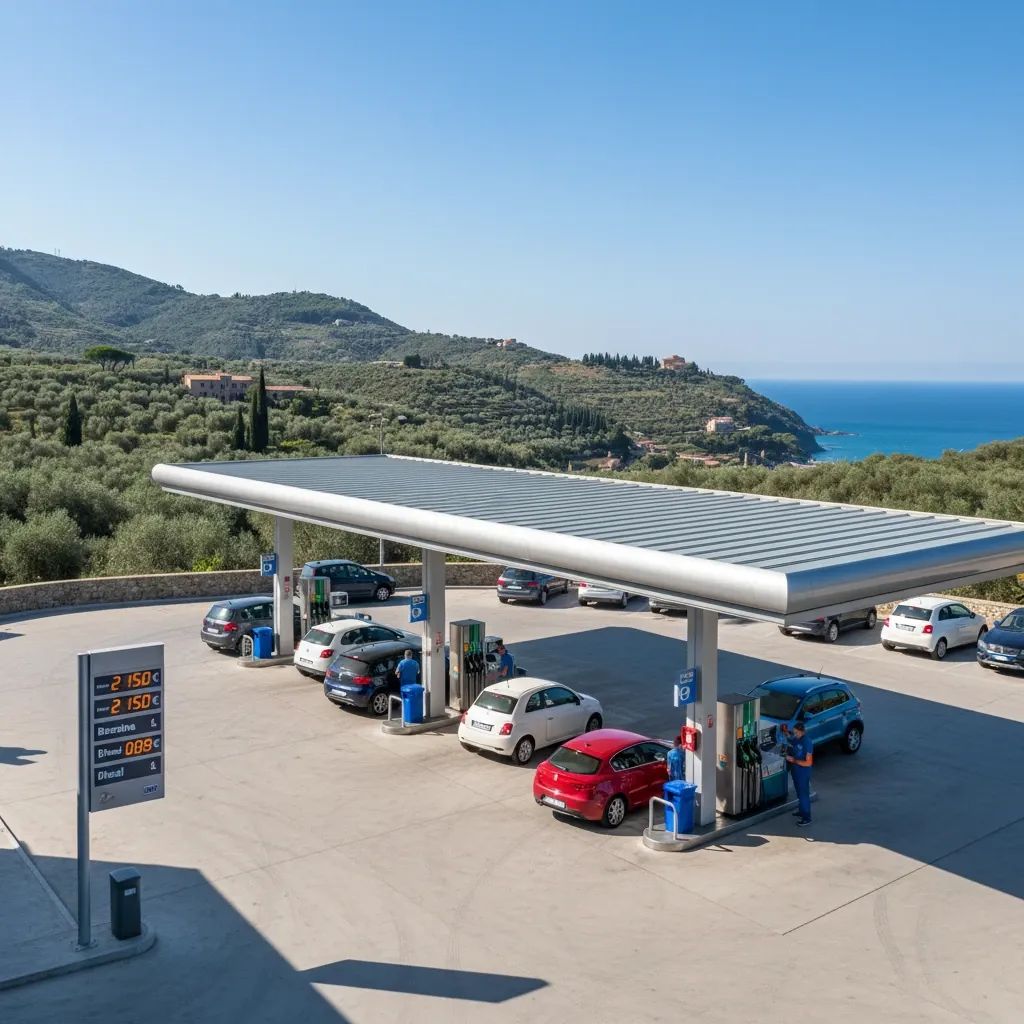
The Italy Cabinet convened today to approve emergency measures targeting diesel prices, as fuel costs reach levels not seen since the immediate aftermath of Russia's invasion of Ukraine in 2022. The move comes as pump prices threaten to disrupt the peak vacation travel period beginning in early August.
Why This Matters
• Diesel now costs €2.18 per liter on average, up 30 cents since early July—equivalent to a €15 increase per tank.
• The Cabinet's emergency session focuses on short-term relief for diesel, with broader intervention via "mobile excise taxes" planned for August once July VAT surplus data is finalized.
• Mobile excise taxes: This mechanism allows the government to automatically cut fuel excise duties when fuel prices rise, reinvesting the extra VAT revenue the state collects into tax reductions. It creates a self-financing stabilizer introduced in 2023 that activates in real time without requiring new legislation.
• Families and small businesses face immediate cost pressures, while the government has already spent €1.8 billion on fuel subsidies since March.
• The government is requesting €14 billion in fiscal flexibility from the European Union—temporary budget deviation allowances that permit emergency spending outside normal deficit limits—to address energy costs through September.
Record-Breaking Prices and What's Driving Them
Self-service diesel hit €2.185 per liter today along Italy's national road network, according to data from the Italy Ministry of Business and Made in Italy. Gasoline reached €1.982 per liter. On highways, prices climb higher still:
• €2.255 for diesel
• €2.071 for gasoline
The spike in diesel is particularly severe—it now sits just 4 cents below the all-time high of €2.229 recorded on March 17, 2022, when geopolitical turmoil forced the Draghi government to slash excise duties. Diesel prices have surged 16% since July 3, when the last round of excise cuts expired. Gasoline, by comparison, rose just under 18 cents in the same window.
Financial Impact for Consumers:
• A standard 50-liter diesel fill-up now costs €15.15 more than three weeks ago
• Gasoline drivers pay an extra €8.95 per tank in the same period
• In Milan, prices have breached €2.60 per liter at some stations, according to consumer advocacy group Codacons
Codacons projects that rising fuel costs will extract €10.8 billion from Italian households in July and August combined, though this represents their calculation based on price trends rather than official government data. The government alone will collect nearly €3 billion in VAT and excise revenue this month from elevated pump prices.
The Government's Two-Stage Strategy
Prime Minister Giorgia Meloni and Economy Minister Giancarlo Giorgetti met extensively last Friday to hash out a response. The resulting plan unfolds in two phases.
Phase One involves an immediate "bridge intervention" approved today, concentrated on diesel. Industry Minister Adolfo Urso explained that the government is prioritizing diesel because it has risen more sharply than gasoline and directly affects freight transport costs, which cascade through the broader economy. The decree targets relief measures that can be deployed within days, ahead of the August vacation exodus when millions of Italians take to the roads.
Phase Two hinges on a more sophisticated mechanism called "mobile excise taxes," which will activate once the Italy Treasury Department completes calculations on July's VAT surplus. When fuel prices rise, the government collects additional VAT revenue on each liter sold. The mobile excise system, introduced in 2023, allows authorities to reinvest that windfall by cutting excise duties in real time, creating a self-financing stabilizer. Urso confirmed that a second intervention using this tool is expected in the first week of August, following a Cabinet session scheduled for August 4.
"If the resources are found," Urso added, "we could also take targeted measures, as we've already done for road haulage with tax credits."
Impact on Residents and Businesses
For Italy-based trucking companies, diesel volatility poses a direct threat to operating margins. The government has already extended a 70% tax credit for heavy freight operators (vehicles over 7.5 tons, Euro 5 or higher) to offset excess diesel costs incurred between March and June 2026, compared to February baseline prices. That program drew €300 million in allocated funds and remains available for claims through year-end.
However, small businesses and individuals driving diesel vehicles under 7.5 tons—common among tradespeople, delivery services, and rural residents—have fewer safety nets. Many fall outside the scope of the quarterly excise rebates reserved for registered hauliers. The Cabinet's diesel-focused intervention today could provide broader relief, though the exact discount remains unconfirmed.
Codacons modeled several scenarios:
• An 8-cent excise cut (including VAT effects) would save just €4.88 per tank, bringing diesel to €2.087 per liter.
• A 10-cent reduction would save €6.10 per tank, lowering prices to €2.063 per liter.
• A 15-cent cut yields €9.15 savings per tank, with diesel at €2.002 per liter.
• A 24-cent slash—circulating as a rumor—would save €14.64 per tank, bringing diesel down to €1.892 per liter, assuming retailers pass through the full discount.
The advocacy group endorsed differentiated cuts, noting that diesel has climbed far steeper than gasoline and disproportionately penalizes households and small operators reliant on diesel vehicles.
Political Pressure and Opposition Criticism
Within the governing coalition, calls for action have intensified. Luca Squeri, head of energy policy for Forza Italia, stated bluntly: "At a minimum, we are obliged to deploy mobile excise taxes, sterilizing the incremental VAT portion. Beyond that, it depends on available resources, which falls to the Treasury."
Maurizio Lupi, president of the center-right Noi Moderati party, framed fuel relief as a top priority: "For the government and majority, combating high energy costs is paramount. We've decided to activate the €14 billion in flexibility granted by the EU as quickly as possible to support families and businesses."
That flexibility depends on parliamentary approval of budget deviation resolutions expected in the coming weeks, unlocking funds by September.
Opposition parties, meanwhile, have escalated their attacks. The Five Star Movement dismissed mobile excise taxes as a "band-aid solution," calling instead for a targeted fuel voucher program for low-income households. Angelo Bonelli of the Green and Left Alliance argued: "Mobile excise taxes don't solve the problem—they're a temporary fix paid for by taxpayers. The real answer is a windfall tax on oil companies' excess profits and a plan to accelerate electrification nationwide."
The center-left coalition filed a motion in the Senate demanding "urgent measures to contain the impact of the current fuel price crisis on household purchasing power and business costs," requesting a vote beginning Tuesday.
What Comes Next
The government has already deployed approximately €1.8 billion in excise cuts between March and early July. With the July VAT surplus calculation underway, officials anticipate unlocking additional revenue to fund the second wave of relief in August. However, the fiscal balancing act remains delicate: every cent of excise reduction costs the Treasury tens of millions in foregone revenue, even as higher VAT collection partially offsets the loss.
For now, residents should monitor announcements from the Italy Ministry of Business following today's Cabinet session. If the bridge measure delivers a meaningful discount on diesel, pump prices could stabilize by midweek—just in time for the holiday travel season. Gasoline drivers will likely wait until August for broader relief under the mobile excise mechanism.
Economists and policy analysts have questioned the efficiency of broad-based excise cuts, noting they disproportionately benefit higher-income households with multiple vehicles while offering no assistance to non-drivers or those reliant on public transit. Some experts advocate for direct cash transfers to vulnerable groups or deeper reforms to increase competition among fuel retailers, which could ensure tax cuts translate fully into lower pump prices rather than being absorbed as margin by distributors.
In the meantime, the coming weeks will test whether Italy's two-stage intervention can ease the financial strain on drivers and businesses—or whether structural reforms to energy policy and taxation will ultimately be required to insulate the economy from volatile global fuel markets.


