
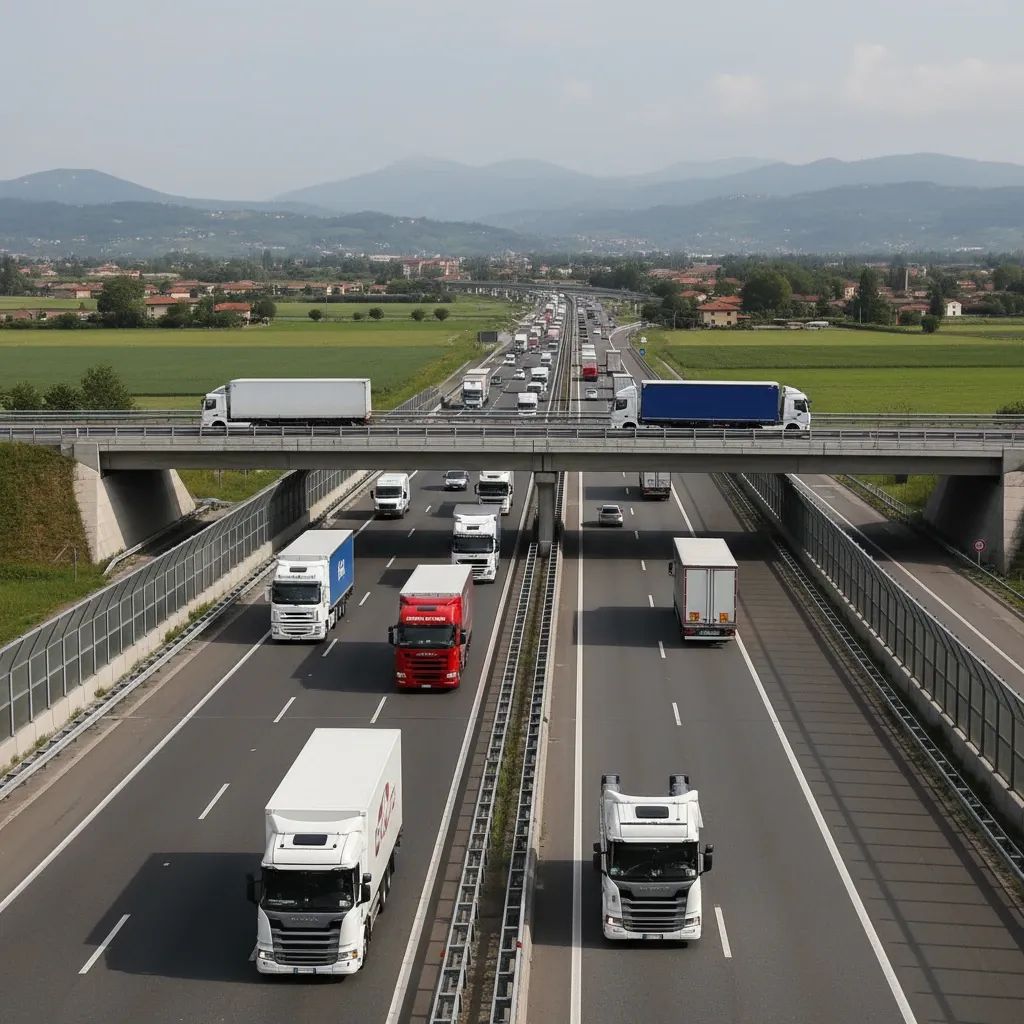
Italy's Transport Minister Matteo Salvini has drawn a line in the sand: unless the European Union suspends its fiscal constraints and reconsiders key Green Deal provisions within days, the country's logistics network will grind to a halt in May, leaving supermarket shelves empty and triggering economic chaos. His ultimatum, delivered in late April 2026, comes as diesel prices surge past €2 per liter and the nation's road haulage sector threatens a five-day nationwide shutdown starting May 25.
Why This Matters
• National strike imminent: Over 90% of Italy's trucking firms—represented by Unatras—will halt operations from May 25-29 if diesel costs and regulatory constraints aren't addressed.
• Price shock: Without a renewed fuel tax cut (set to expire April 30), diesel could hit €2.30-€2.36 per liter, making Italy's fuel the costliest in Europe despite having among the lowest pre-tax wholesale prices on the continent.
• Supply chain paralysis: More than 80% of Italian goods move by road; a five-day stoppage would empty retail shelves, spike food prices, and stall manufacturing.
• Budget straitjacket: Italy remains under an Excessive Deficit Procedure and must bring its deficit below 3% of GDP by year-end to satisfy Brussels—a target that Salvini argues prevents Rome from deploying billions in emergency aid.
The Diesel Crisis Fueling Discontent
Italy's fuel market is a paradox: the industrial price of diesel ranks among Europe's cheapest, yet drivers and hauliers pay the most at the pump. Roughly 59% of retail diesel cost is pure taxation—accise excise duties plus VAT—leaving consumers with a bill that towers over those in Spain (45%), Sweden (45%), or Bulgaria (43%). In mid-April, with a temporary 24.4-cent-per-liter excise cut still in place, diesel averaged €2.06 per liter at self-service stations. If that relief expires as scheduled on April 30, the price will leap to around €2.36, surpassing the Netherlands, Denmark, and Finland.
For Italy's 25,000-truck shortage-hit haulage sector—already operating on razor-thin margins of roughly 3% net profit—the math no longer works. Fuel, tolls, maintenance, and insurance absorb nearly all revenue, while payment terms stretch to 120 days even as diesel must be paid upfront. The result: a liquidity crunch that threatens mass bankruptcies. Unatras has demanded immediate tax credits retroactive to March increases, compensatory rebates of €200 per 1,000 liters, and a temporary freeze on tax remittances to preserve cash flow.
What Brussels Rules Prevent
Salvini's ire centers on two regulatory pillars: the reformed Stability and Growth Pact and the European Green Deal. Italy has been under an Excessive Deficit Procedure since 2024, obliging Rome to trim its deficit from 3.1% of GDP in 2025 to below the 3% threshold by the end of 2026. The government's medium-term fiscal plan caps net spending growth at 1.6% annually, leaving little room for emergency subsidies or fuel rebates without breaching EU ceilings.
Meanwhile, Green Deal mandates—including the Emissions Trading System for maritime and aviation sectors—impose fresh compliance costs on energy-intensive industries. Italy has lobbied for flexibility, securing a one-year postponement of the carbon tax on heating and transport from 2027 to 2028, and won recognition for international carbon credits. Yet Salvini contends these concessions fall short, arguing that "absurd European rules" block Italy from channeling state funds to struggling businesses in the way, say, France or Germany might through different fiscal headroom.
Prime Minister Giorgia Meloni has echoed the call for a suspension of deficit rules if geopolitical tensions—including concerns about energy transit routes—worsen further. Rome explored invoking a National Escape Clause to exempt defense spending (worth roughly €12 billion) from deficit calculations, but chose instead to prioritize fiscal credibility and focus pressure on energy prices and inflation.
Impact on Residents and Businesses
For Italian households and firms, the stakes are immediate and tangible. An Italian motorist driving 10,000 km annually in a diesel car pays approximately €533 in taxes alone—versus €494 in Germany, €480 in France, €364 in Sweden, and €341 in Spain. If the excise cut lapses, families face an additional €23 per tank, amounting to a collective €1.43 billion annual burden across all fuel users.
The haulage shutdown planned for May 25-29 would ripple through every aisle of every supermarket. Fresh produce, dairy, and packaged goods all depend on just-in-time road delivery; a five-day freeze means empty shelves, price spikes, and rationing. Manufacturing supply chains—already fragile after pandemic disruptions and geopolitical shocks—could face stoppages if component deliveries stall. Public transport services that rely on diesel buses may also curtail operations, compounding commuter woes.
Small and medium enterprises, which dominate Italy's logistics sector, are particularly vulnerable. With an average driver age above 50 and a shortfall of 25,000 qualified operators, the industry lacks the cushion to absorb prolonged disruption or further cost hikes. Many owner-operators report running at break-even or loss, sustained only by hope that policy relief will arrive before insolvency does.
Salvini's Ultimatum and EU Response
Salvini's language has been blunt, even inflammatory. He dismissed officials suggesting that talks could wait until June as either "living on Mars" or acting in bad faith, noting that factories close for summer holidays and any delay renders intervention moot. He framed the EU's fiscal orthodoxy as a greater threat to Italian pocketbooks than distant geopolitical concerns, asserting that "the first problem for Italians' wallets is in Brussels."
The Deputy Prime Minister and Italy's Minister of Infrastructure and Transport has called for the immediate suspension of the Stability Pact and a review of Green Deal timelines, warning that "Europe's second industrial power will be completely blocked in a few weeks" without a course correction. He stopped short of threatening unilateral Italian action but implied Rome reserves that right if ignored.
Brussels has so far offered only procedural replies. A meeting this week yielded no concrete commitments, prompting Salvini to declare the outcome unsatisfactory. The European Commission maintains that member states must adhere to agreed fiscal paths and that flexibility exists within the reformed Pact for investment and emergency spending—provided it aligns with medium-term consolidation targets. On Green Deal timelines, officials note that Italy has already secured significant concessions and that delaying decarbonization goals risks undermining the bloc's climate credibility.
The Road Ahead
Italy now faces a tight window. The April 30 deadline for renewing the fuel excise cut will test the government's willingness to defy Brussels or exhaust remaining fiscal space. If the cut expires, pump prices will spike just as truckers prepare their May 25 strike, creating a perfect storm of political, economic, and logistical pressure.
For residents, the message is clear: stock pantries, anticipate delivery delays, and brace for higher grocery bills. For businesses, contingency planning—advance orders, inventory buffers, alternative transport modes—becomes essential. And for policymakers in Rome and Brussels, the countdown has begun to either deliver fast relief or confront the spectacle of a G7 economy's supply chain seizing up in real time.


