
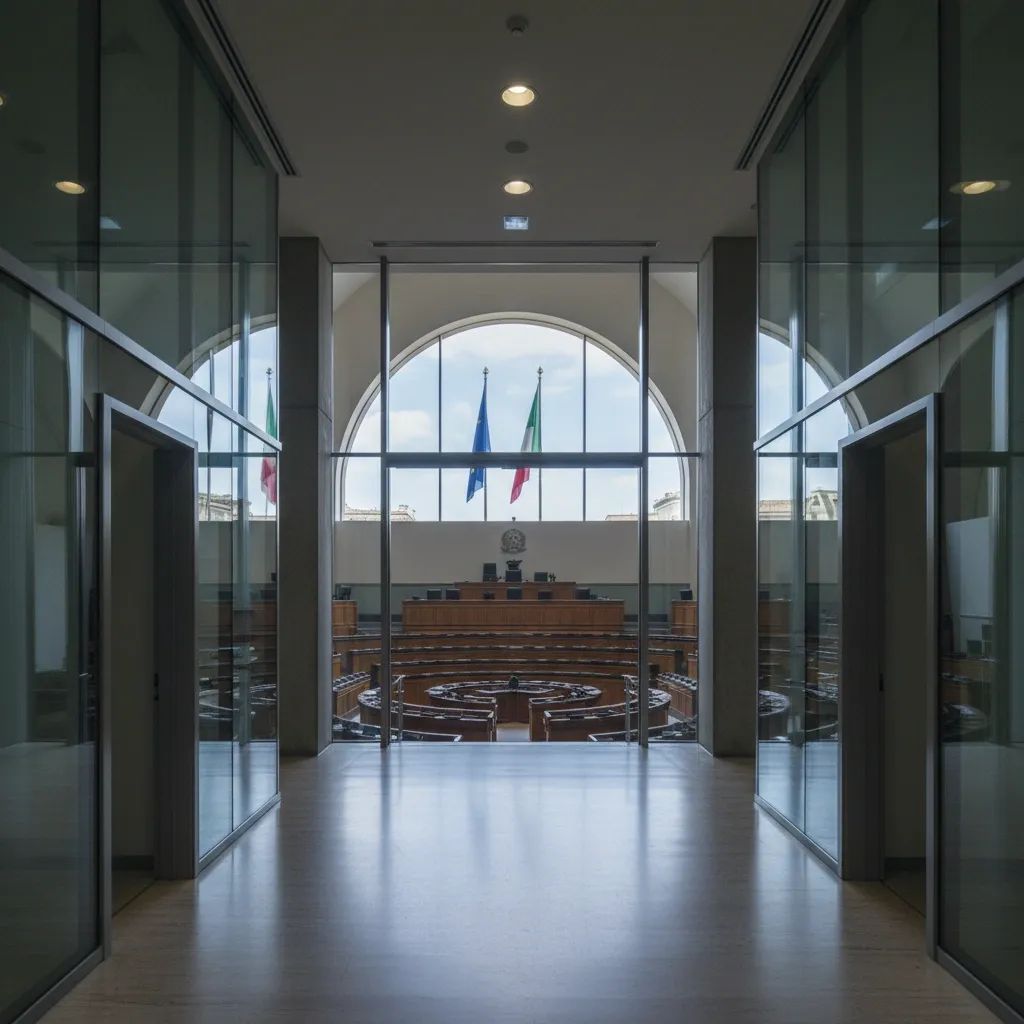
The Futuro Nazionale party led by Roberto Vannacci has opened its first national headquarters in central Rome, occupying office space on the same landing as Forza Italia in the historic via in Lucina building—a symbolic detail that underscores both the party's establishment ambitions and its complicated relationship with Italy's center-right coalition.
Vannacci, a former general and controversial political figure, inaugurated the offices with characteristic military flair, arriving with a backpack and describing the space as "a workshop, a laboratory for practical things, the heart and forge of ideas for Futuro Nazionale." The location places his nascent movement literally steps away from the party founded by Silvio Berlusconi, a proximity the general referenced repeatedly during the ribbon-cutting ceremony.
Why This Matters
• Coalition dynamics: Vannacci is positioning his party as a "natural interlocutor" for the center-right, potentially reshaping Italy's governing alliance.
• Party growth: Futuro Nazionale claims 18,000 registered members, with plans to absorb Gianni Alemanno's Movimento Indipendenza.
• Geographic symbolism: The headquarters sits within walking distance of the Chamber of Deputies and overlooks Palazzo Chigi, Italy's executive seat.
• Political timing: Vannacci stated his party is "ready" for early elections if called.
Awkward Neighbors in Italy's Political Landscape
The shared landing arrangement has created an unusual situation in Italian politics. Raffaele Nevi, spokesperson for Forza Italia, responded diplomatically but coolly when asked about the new neighbor, saying "as a landing neighbor, it's not a problem" with evident irony. The comment reflects the tension within the center-right coalition about whether to formally embrace Vannacci's movement.
Vannacci himself played up the neighborly angle with calculated charm, suggesting he'd be happy to share coffee with Antonio Tajani or Marina Berlusconi. "I've always had good relations with my roommates and neighbors, why wouldn't I have them with them? Once they'll make the coffee, once we will," he told reporters.
The lighthearted tone masks a serious strategic calculation. By establishing offices in the same building where Berlusconi once worked, Vannacci is signaling his intention to be taken seriously as part of Italy's center-right ecosystem, even as some coalition partners remain skeptical of his populist rhetoric and controversial statements.
Expansion Plans and Political Maneuvering
The headquarters inauguration coincided with announcements of significant organizational expansion. Vannacci confirmed that Gianni Alemanno's Movimento Indipendenza will merge into Futuro Nazionale, describing the absorption in characteristically confident terms: "Independence has recognized itself 100% in what we say and they are ready to follow the directions."
The general denied having contact with Daniela Santanché, the tourism minister who has faced legal troubles, but left the door open to other alliances. He emphasized that his party maintains "open dialogue with everyone" in the center-right spectrum, positioning Futuro Nazionale not as a "thorn in the side" but as "an opportunity to broaden the spectrum of the center-right."
With membership reportedly climbing to 18,000, the party is attempting to transform from a vehicle for a single personality into a structured political organization. The Rome headquarters, provided by Stefano Ruvolo of Confimprenditori, features minimalist décor punctuated by abstract paintings and crucifixes—the latter a deliberate choice, according to Vannacci, "for a question of identity."
What This Means for Italy's Political Stability
The establishment of a permanent Rome base for Futuro Nazionale raises practical questions about the durability of Prime Minister Giorgia Meloni's coalition. While Vannacci currently sits in the European Parliament as an independent after being expelled from the Lega party, his movement's growing organizational capacity could complicate coalition arithmetic if it decides to field candidates in national elections.
Asked about early elections, Vannacci employed a military metaphor: "We are ready, the ramp is open, we just need the green light." The statement suggests his party would welcome an opportunity to test its strength at the polls, though it remains unclear whether Futuro Nazionale would run independently or seek integration into the existing center-right alliance.
On immediate parliamentary matters, Vannacci offered characteristically oblique commentary. When asked about his confidence vote on a government energy decree, he compared it to "the trust you give a wife who cooks a dish you don't like, such as tripe"—a tortured analogy that left reporters puzzled but underscored his willingness to support the government conditionally.
The View from Palazzo Chigi
Perhaps the most revealing moment came when Vannacci stood in his new office, from which Palazzo Chigi is visible. "All realities start from a dream," he said, making no effort to hide his ambitions. When pressed on who might be the prime ministerial candidate for his party, he responded bluntly: "If the premier is one, I believe it's Vannacci and that's it, there's no doubt."
The comment reveals both the personality-driven nature of Futuro Nazionale and the general's ultimate political goals. Whether Italy's established center-right parties will accommodate these ambitions or resist them remains one of the open questions shaping the country's political landscape.
The general adopted a quasi-military posture about his commitment to the new space, joking that he would need to bring "a mat and a sleeping bag" and declaring "hic manebimus optime"—Latin for "here we shall remain most excellently." He also made a point of noting that the office walls were "white and not black," an apparent reference to criticism of his political positions.
Broader Implications for Center-Right Unity
The physical proximity of Futuro Nazionale and Forza Italia offices serves as a metaphor for Italy's broader political moment. The center-right coalition that governs Italy includes parties with divergent visions and competing ambitions, held together by electoral mathematics and opposition to the left.
Vannacci's growing profile and organizational capacity represent both an opportunity and a threat to that arrangement. His claim that Futuro Nazionale could "broaden the spectrum" of the center-right suggests he sees space to capture voters further right than the current coalition, potentially at the expense of Meloni's Fratelli d'Italia or Matteo Salvini's Lega.
For now, the general seems content to build his infrastructure, expand his membership rolls, and maintain a posture of readiness. The white-walled Rome headquarters, with its crucifixes and abstract art, its view of the prime minister's office, and its shared landing with Berlusconi's political heirs, embodies the ambiguity of his current position—simultaneously inside and outside the coalition, both neighbor and potential rival.
Whether that ambiguity resolves into full integration or open competition will depend on electoral calculations, coalition tensions, and Vannacci's ability to translate controversial celebrity into durable political organization. The coffee with Tajani and Berlusconi may or may not materialize, but the proximity ensures that Italy's center-right will have to reckon with the general's ambitions one way or another.


