
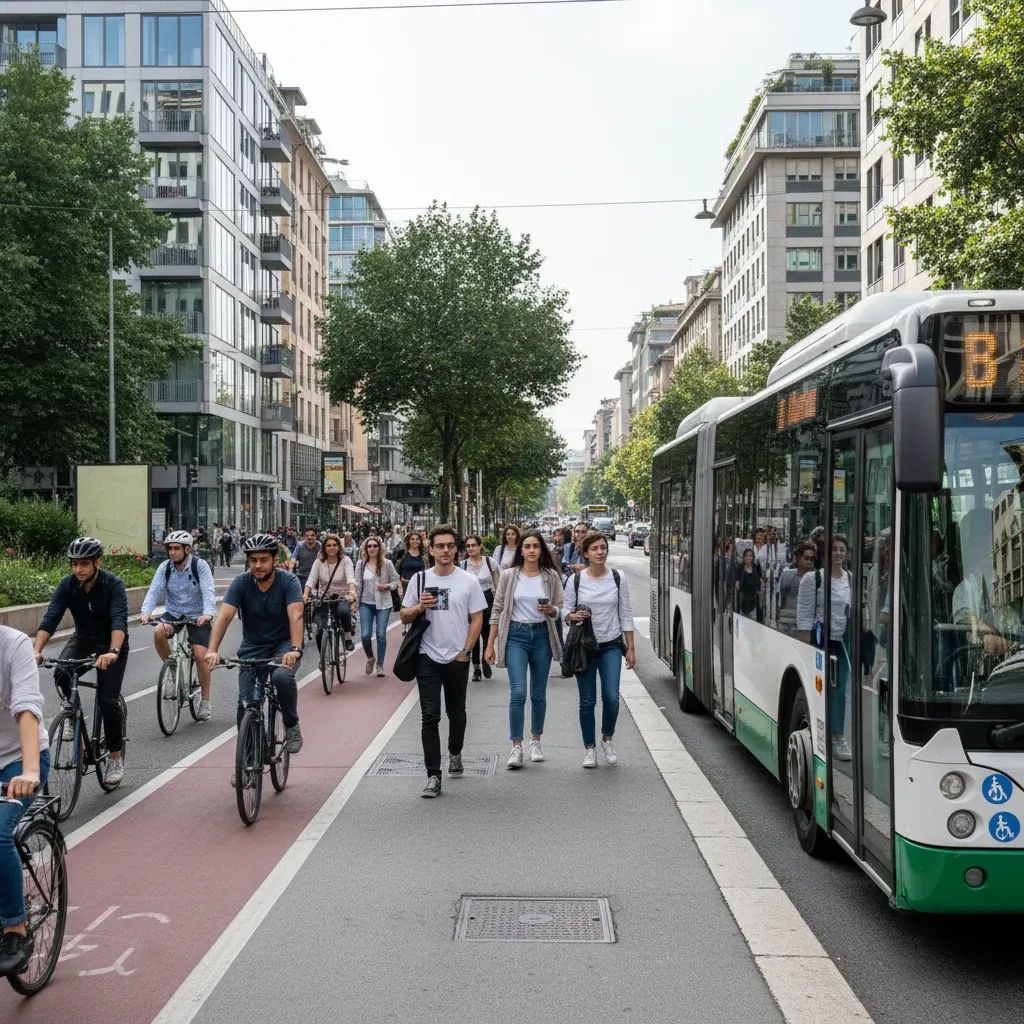
The European Commission is preparing to unveil a sweeping energy resilience package on April 22, a plan that could reshape how Italians work, commute, and consume energy if the country's government decides to adopt the recommendations. Dubbed "AccelerateEU," the proposal represents Brussels' response to escalating energy pressures tied to Middle Eastern conflict and renewed concerns over supply security—though its non-binding recommendations have already sparked significant political backlash in Rome.
Important Context:These are EU recommendations, not mandates. Italy's government has not committed to adopting these measures, and key political figures, including Deputy Prime Minister Matteo Salvini, have expressed strong opposition. The following measures represent what Brussels is proposing, not what will necessarily happen in Italy.
Why This Matters (If Italy Adopts These Recommendations):
• Proposed remote work guideline: At least one day of recommended remote work per week could become policy across Italy, though adoption remains uncertain.
• Transport discounts under consideration: Public transport fares may be subsidized if Italy adopts the recommendation, with free travel potentially offered to vulnerable groups.
• Jet fuel crisis looming: Europe's aviation fuel reserves could dwindle to just six weeks if Middle East supply routes remain disrupted—a critical concern for Italian travelers and airlines.
• State aid rules relaxed: Heavy industry may see up to 70% of wholesale power bills covered by government support through December 31, 2026, if Italy participates in expanded EU state aid provisions.
The Behavioral Economy Blueprint
The Italian Government, like all 27 EU member states, will face a choice: adopt Brussels' lifestyle recommendations or chart its own independent course through the energy squeeze. The Commission's approach hinges on five pillars—coordinated gas storage, targeted consumer support, demand reduction, electrification acceleration, and long-term clean energy investment—but it's the everyday behavioral nudges that have drawn the sharpest reactions from Rome.
At the core sits a one-day-per-week remote work guideline, framed not as labor policy but as energy conservation. The logic mirrors pandemic-era protocols: fewer commutes mean less fuel consumption and reduced pressure on transport infrastructure. Brussels insists this remains a recommendation for national governments to implement as they see fit, not a Europe-wide mandate. Still, the proposal has already become a flashpoint in Italian political discourse.
Deputy Prime Minister Matteo Salvini dismissed the package as disconnected from economic reality, stating: "If the solutions to high energy bills are turn off the heating, work less, travel less, and wash less, tell me if they are normal in Brussels." His criticism signals significant government resistance, with Confindustria, Italy's main employer federation, echoing calls to suspend EU fiscal rules under the Stability Pact. This opposition suggests that Italy may not adopt the telework recommendation, regardless of Brussels' intentions.
Beyond telework, the plan urges member states to slash public transport fares, extending subsidies to buses and metro systems and offering free passage for the most vulnerable. Cities would serve as testing grounds for expanded low-emission zones (ZTL), car-free days, and electric mobility incentives. The Commission also suggests shifting energy-intensive household tasks—laundry, dishwashing—outside peak hours, while public buildings should dim lights and close when feasible.
Even domestic heating comes under scrutiny: Brussels recommends capping home water heater temperatures at 50 degrees Celsius to trim consumption. For businesses, the message is clear: accelerate energy efficiency upgrades or risk falling behind in a tightening regulatory environment.
What This Could Mean for Residents—If Italy Adopts These Measures
For Italians, the practical implications depend entirely on how—and whether—Rome interprets and implements these guidelines. There is no guarantee Italy will adopt any of these recommendations.
If the remote work recommendation were adopted, it could mark a return to pandemic-style work arrangements, potentially easing congestion in Milan, Rome, and other urban centers but also raising questions about enforcement and exceptions for sectors like hospitality and manufacturing.
If the transport discount initiative is implemented, it could offer relief to commuters facing inflation-battered budgets. Free or heavily subsidized travel for pensioners, students, and low-income families would mirror existing local schemes in cities like Bologna but on a broader, nationally coordinated scale. However, eligibility criteria and funding mechanisms remain unclear, and Italy's regional transport authorities—often fragmented and cash-strapped—would face significant administrative challenges.
On the heating and consumption front, the 50-degree hot water cap is advisory at best and would only influence policy if Italy chose to incorporate it into future building codes or appliance standards. The emphasis on off-peak energy use aligns with Italy's existing time-of-use electricity tariffs, but any expansion would require government adoption of the recommendation.
More substantive are the industrial support measures. If Italy participates in expanded EU state aid provisions, Italy's energy-intensive sectors—steel, ceramics, chemicals—could benefit from relaxed state aid rules allowing governments to cover up to 70% of wholesale electricity costs through year-end 2026, up from the current 50% threshold. Agriculture, fisheries, and transport could see 100% fuel cost coverage via loans and guarantees, cushioning sectors hit hardest by diesel and marine fuel price spikes.
The Aviation Fuel Crisis: A More Immediate Concern
While household measures dominate Brussels' proposals, a more urgent and concrete crisis is unfolding in aviation. The International Energy Agency (IEA) has warned that Europe's jet fuel reserves could dwindle to a six-week supply if disruptions in the Strait of Hormuz persist. This represents an immediate threat independent of policy adoption. The bottleneck, critical to global oil flows, has seen tanker traffic collapse amid Middle Eastern military operations and Iranian transit restrictions.
Europe imports 25% to 30% of its jet fuel demand—or up to 75% of net imports—from the Persian Gulf. With U.S. suppliers only partially filling the gap, the Italy Civil Aviation Authority and counterparts across the continent are monitoring the situation alongside the IEA. Commission spokesperson Dan Jorgensen confirmed Brussels is exploring jet fuel reserve-sharing agreements among member states to prevent localized shortages.
For Italy's aviation sector, centered on Rome Fiumicino and Milan Malpensa, the summer travel season carries heightened risk. While the Commission insists there is "no indication of systemic fuel shortages" sufficient to trigger large-scale flight cancellations, airlines are bracing for potential disruptions. IEA Director Fatih Birol noted that even a formal reopening of the Strait would require months to rebuild refinery output and replenish stocks.
The Commission's call to reduce air travel where alternatives exist—favoring rail or virtual meetings—treads into politically sensitive territory, touching on mobility rights and economic competitiveness. Brussels has sought to soften the message, stressing that any flight restrictions remain the "exclusive competence" of airports and national authorities.
Five-Pillar Strategy Beyond the Headlines
Beneath the behavioral nudges, AccelerateEU outlines a medium-term strategy to insulate Europe from energy volatility. The plan prioritizes coordinated gas storage filling to prevent member states from bidding against each other in global markets, while accelerating oil reserve releases in tandem.
On taxation, legislative proposals due in May will aim to tax electricity below fossil fuels, simplify zero-rate applications for energy-intensive industries, and allow member states to strip non-energy charges from vulnerable household bills. A windfall profits tax on energy companies is also under consideration, redirecting excess earnings into consumer relief or infrastructure investment.
Long-term electrification targets are set to be announced before summer, backed by incentives for leasing green technology and replacing outdated appliances. The Commission plans to convene an Investment Conference to attract private capital into grid expansion, storage, and battery projects, while urging member states to tap underutilized Cohesion Funds.
A revised energy security framework, scheduled for May 19, will incorporate lessons from past crises and adapt to geopolitical instability and climate pressures. For Italy, this could mean faster permitting for renewable projects, expanded interconnectors with neighboring grids, and stronger emphasis on domestic nuclear or geothermal capacity.
The Rome-Brussels Tension: Uncertain Implementation
The tension between national sovereignty and supranational coordination sits at the heart of the debate. Italy's government, particularly Salvini's faction, views the crisis as justification to relax fiscal constraints and defend traditional energy sources. Brussels, meanwhile, frames the emergency as an opportunity to accelerate decarbonization and reduce fossil fuel dependency.
The non-binding nature of the April 22 package gives Rome complete room to maneuver. Opting out of recommended measures could limit access to expanded state aid or coordinated fuel-sharing mechanisms, but Italy's political leadership appears willing to accept this trade-off rather than impose unpopular measures on voters and industry.
For residents, the coming weeks will clarify whether Italy embraces, rejects, or selectively adopts the remote work guideline, transport discounts, and other recommendations. What remains certain is that the energy landscape of 2026 looks fundamentally different from the pre-crisis era, with both immediate lifestyle adjustments and structural transitions potentially ahead—but only if Italy chooses to participate in Brussels' proposed framework.


