
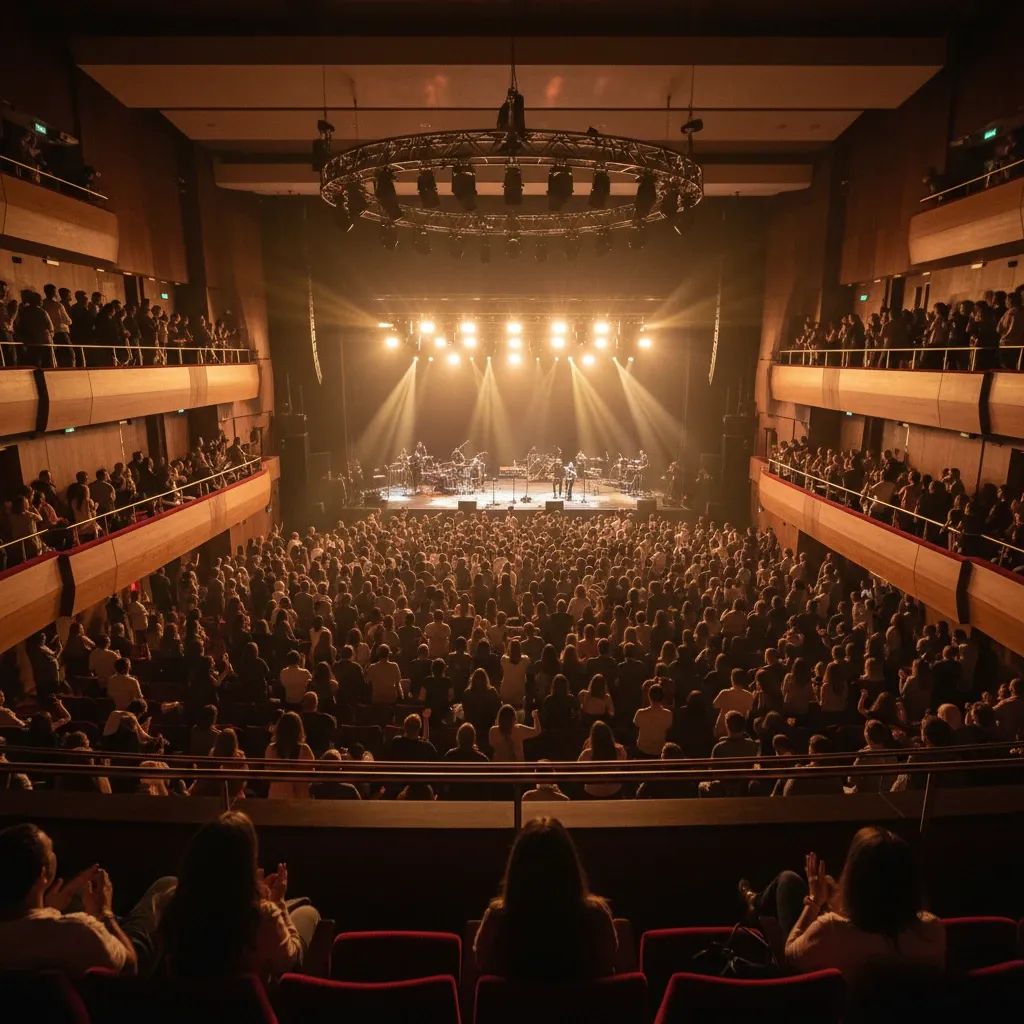
Italy's premier televised music competition, the 76th Sanremo Festival, opened Tuesday evening with 9.6 million viewers and a 58% audience share, marking a noticeable dip from the record-breaking momentum of recent years but still delivering one of the strongest opening nights since the late 1990s. For residents following the cultural calendar that dominates national conversation every February, the numbers signal both the enduring power of the festival and a potential shift in how Italian audiences engage with live broadcast entertainment.
Why This Matters
• Historic context: The 58% share ranks as the fourth-best opening night since 1997, trailing only the three previous editions that all topped 60%.
• Audience decline: Viewership dropped by roughly 3 million compared to 2024, when the previous festival attracted 12.63 million viewers and a 65.3% share.
• Commercial implications: Lower ratings may affect RAI1's advertising revenue projections, which had anticipated another record-breaking cycle.
• Cultural bellwether: Sanremo's performance often reflects broader trends in Italian media consumption, including the growing competition from streaming platforms and social media.
The Numbers in Context
The Italian public broadcaster RAI1 registered an average total audience—spanning traditional television, tablets, smartphones, and PCs—of 9.6 million for the opening ceremony hosted by Carlo Conti and Grammy-winning vocalist Laura Pausini. The evening's segments broke down as follows: "Sanremo Start" (8:41 PM to 9:37 PM) captured 13.158 million viewers with a 57.7% share, the main first segment (9:42 PM to 11:34 PM) held steady at the same figures, and the late-night second portion (11:38 PM to 1:32 AM) drew 6.045 million with a 58.7% share.
To put that in perspective, the 2024 edition—also helmed by Conti as artistic director—opened with 12.63 million viewers and 65.3% share. The 2023 festival, steered by Amadeus, logged 10.6 million and 65.1%, while 2022 saw 10.7 million and 62.5%. This 2025 Sanremo thus represents the lowest opening-night audience in five years, even as the share percentage remains historically robust when measured against pre-2021 benchmarks.
What Drove the Decline?
Several factors converge to explain the softer debut, according to industry analysts and audience research conducted in recent days.
Programming fatigue and format issues: The five-night festival format—now a fixture since Amadeus expanded the event—has been criticized for "monster duration" that stretches past 1:30 AM. Critics cite the high number of competing artists (30 this year) and frequent interruptions for external segments as rhythm-killers that exhaust viewers rather than build momentum. The Italian consumer advocacy group Codacons went further, blaming the inclusion of "artists unknown to the general public" and what it called a pandering approach to social media and streaming metrics, arguing this alienated core television audiences.
Calendar shift and external competition: Conti himself acknowledged that moving the festival two weeks later than usual—a scheduling maneuver to avoid overlap with the Milano-Cortina 2026 Winter Olympics—introduced new competitive pressure. Tuesday's opening coincided with a UEFA Champions League match (Inter vs. Bodo/Glimt), siphoning sports fans away. Longer daylight hours and milder late-February temperatures may also have reduced the "stay-at-home" factor that traditionally benefits winter telecasts.
Post-Amadeus era questions: Multiple commentators have suggested that the "spectacle effect" cultivated by Amadeus and comedian Fiorello during their five-year run has not been fully replicated. While Conti brings gravitas and deep festival expertise—he hosted in 2015, 2016, 2017, and 2024—his more restrained, tradition-focused approach may feel less electric to audiences conditioned to high-octane unpredictability. The absence of Fiorello's improvisational comedy and the shift toward a more formal, song-centric presentation have been framed by some as a necessary correction, by others as a loss of "event energy."
Artist lineup concerns: Social media chatter and early press reviews have highlighted a "fragile cast" perception, with fewer household names compared to years when the roster included multiple established stars alongside emerging talent. The opening night leaderboard—topped provisionally by Arisa, Fulminacci, Serena Brancale, Ditonellapiaga, and the Fedez-Masini collaboration based on press and online votes—features respected acts but lacks the cross-generational marquee power of previous cycles.
What This Means for Residents
For Italian viewers, the festival remains an entrenched annual ritual, but the viewership dip raises practical questions. RAI had positioned Sanremo 2025 as a revenue cornerstone, with advertising slots sold at premium rates on the assumption of sustained record audiences. A sustained decline across all five nights could prompt RAI executives to reconsider the festival's length, artist selection process, or evening structure for future editions.
The shift also underscores a broader reality: Italy's media landscape is fragmenting. Younger demographics increasingly watch clips on TikTok and YouTube rather than sitting through four-hour live broadcasts, while older cohorts who powered the 2023–2024 boom may be reaching saturation. The total audience metric—which aggregates linear TV, streaming, and mobile viewing—helps mask some of the erosion in traditional viewership, but it also signals that future festivals may need to prioritize digital-first formats and shorter, more viral-friendly segments.
Spotlight Moments and Cultural Notes
Tuesday's broadcast opened with a tribute to Pippo Baudo, the legendary presenter who died in August 2024 at age 89 after hosting the festival a record 13 times. Conti and Pausini—who launched her global career by winning Sanremo in 1993—anchored the evening with a blend of nostalgia and contemporary polish. Pausini previously co-hosted the Eurovision Song Contest in 2022, bringing Eurovision-scale production experience to the Ariston Theatre stage.
Standout performances included Olly, the previous year's champion, and Tiziano Ferro celebrating the 25th anniversary of his career debut. The competitive segment saw all 30 acts deliver their entries, with the press jury and online voting propelling Arisa and Ditonellapiaga to early frontrunner status.
Historical Benchmark
Despite the decline, a 58% opening-night share still ranks Sanremo among the most-watched single programs in Italy. Only three Sanremo opening nights have ever exceeded 60% share: Conti's 2024 edition (65.3%), Amadeus's 2023 edition (65.1%), and Amadeus's 2022 edition (62.5%). The last time a Sanremo debut approached 58% was Mike Bongiorno's 1997 festival, which averaged 58.74%.
The festival continues through Saturday, with RAI analysts watching closely to see whether subsequent nights stabilize or compound the opening dip. Industry insiders expect Thursday and Saturday—traditionally the highest-rated evenings—to surpass 60% share, which would position the overall festival average in line with historical norms even if it falls short of the Amadeus-era peaks.
Looking Ahead
For expatriates, foreign residents, and Italy-watchers, Sanremo functions as more than a song contest—it's a barometer of national mood, a showcase for linguistic trends, and a bellwether for the Italian entertainment industry's commercial health. This year's softer start may prompt soul-searching at RAI headquarters, but it also reflects the inevitable maturation of a format that cannot sustain infinite growth. Whether Conti can recapture the "Renaissance" he inaugurated a decade ago—or whether the festival settles into a new, slightly smaller equilibrium—will become clearer as the week unfolds and final audience tallies arrive.


