
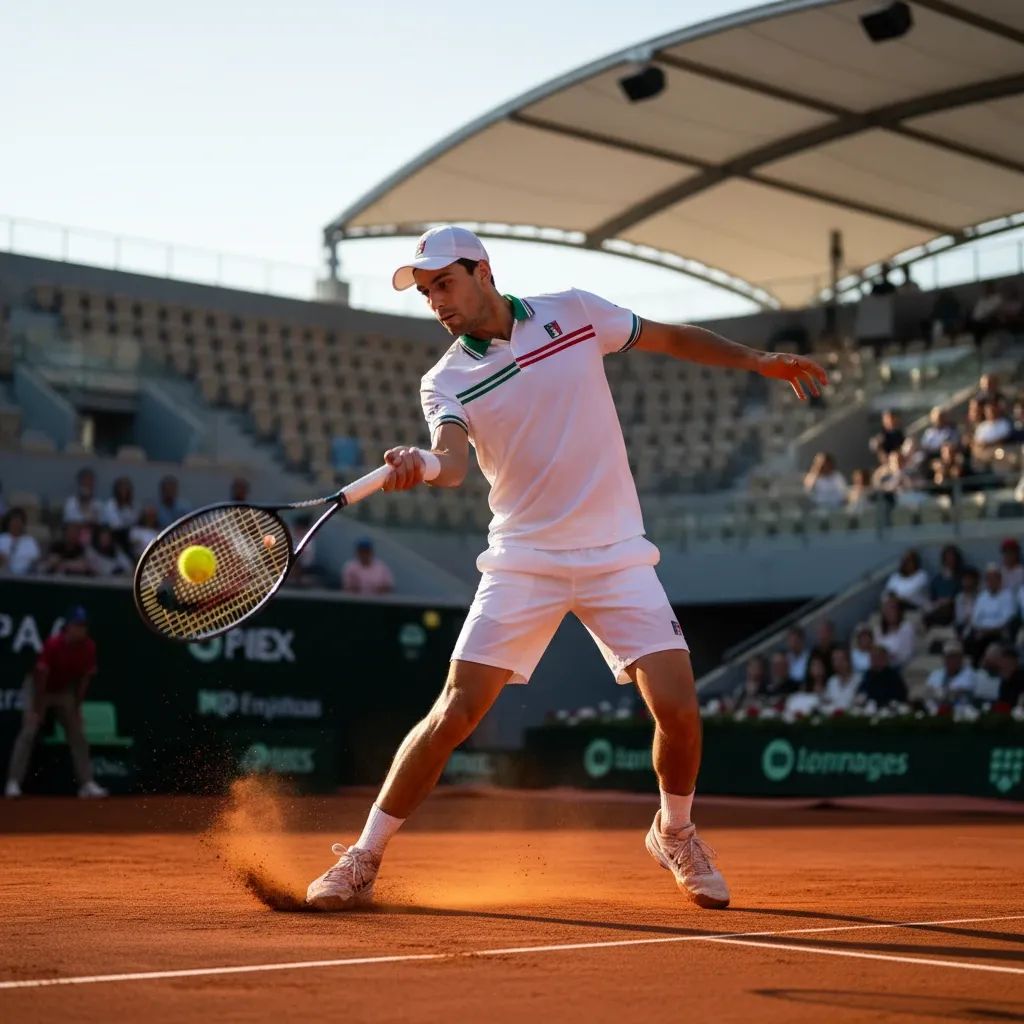
The Italian Breakthrough Moment: Sinner Steps Toward Tennis Immortality at Indian Wells
With just two matches standing between him and a place in history, Jannik Sinner has dismantled everything in his path through the California desert. The world number 2 punished American wildcard Learner Tien 6-1, 6-2 in Thursday's quarterfinal action, advancing to the semifinals and positioning himself to become only the third man ever to claim victories across all six hard-court Masters 1000 tournaments. For Italian tennis followers, this represents the defining moment of Sinner's career trajectory—one that could reshape how the nation is perceived within professional tennis's power structure.
Key Takeaways
• The missing crown: Sinner holds titles at Canada, Miami, Cincinnati, Shanghai, and Paris but has never won Indian Wells. Victory would complete the hard-court Masters circuit, matching Federer and Djokovic alone.
• Italian doubles alive: Errani and Paolini engineered an improbable comeback in women's doubles, erasing two-break deficits to reach the semifinals.
• Controversy clouds the draw: Medvedev's controversial hindrance call against Draper eliminated the defending champion and sparked fresh debate about subjective video review in professional tennis.
• Path set: Sinner faces Zverev; Alcaraz confronts Medvedev in the other semifinal pairing.
The Scale of Sinner's Achievement
Understanding what a hard-court Masters sweep means requires stepping back from quarterly statistics. Since the ATP introduced Masters 1000 events in the 1990s, only Roger Federer and Novak Djokovic have conquered the six cement-surface tournaments that dominate the professional calendar. That club remains painfully exclusive. Sinner already commands a 80.4% win rate on hard courts—262 victories across 326 matches—a percentage that rivals the sport's historical elite. When he dismantled Tien in a crisp 68 minutes on Thursday, he demonstrated the surgical baseline control and offensive precision that has defined his California campaign.
The missing trophy, Indian Wells, carries symbolic weight beyond its ranking. The tournament sits in that privileged tier where global media attention peaks and ranking points feel particularly consequential. Winning here would deliver Sinner a significant ATP-level title, but more significantly, it would position him alongside the two men who set tennis's highest standards over the past two decades. At 24 years old, Sinner would accomplish in seven years what took Djokovic and Federer substantially longer. Momentum, form, and the intangible quality of peaking at precisely the right moment matter enormously in professional sport, and Italian observers understand that such convergences rarely repeat.
Zverev: The Resilient Test Awaits
Standing between Sinner and the final will be Alexander Zverev, a German contemporary whose semifinal appearance itself marks a quiet achievement. Zverev has become only the fifth man in history to reach the final four of every ATP Masters 1000 event—a statistical oddity that speaks less to dominance than to consistency and strategic tournament planning. The German carries a powerful first serve and defensive range that creates problems for aggressive baseliners. Against Sinner's forehand-driven attack, Zverev typically employs high ball retrieval and first-serve offense to dictate pace and compress the court.
Their semifinal will likely unfold as a battle over who controls the opening four shots of each point. Sinner thrives when he can establish his baseline position and construct rallies. Zverev, by contrast, flourishes when he can shorten points and avoid extended exchanges where Sinner's consistency becomes overwhelming.
The Alcaraz-Medvedev Subplot: Controversy and Contention
On the opposite half of the draw, Carlos Alcaraz continues his Indian Wells mastery, extending to a fifth consecutive semifinal appearance after routing Norway's Casper Ruud 6-1, 7-6. The Spanish world number 1 has transformed the California event into something resembling his personal fiefdom. His opponent in the semifinals will be Daniil Medvedev, who defeated defending champion Jack Draper 6-1, 7-5 in a match now defined primarily by its controversy rather than its tennis.
The incident occurred with the second set locked at 5-5. During a rally at 0-15, Medvedev struck what he feared might sail long. Draper, the defending champion playing his first event back since US Open injury troubles, raised his arms in a reflexive gesture—the universal tennis signal for "out." The ball remained in play, however, and Medvedev's subsequent shot sailed into the net.
What happened next shifted the match's trajectory and eliminated the defending champion. Medvedev immediately signaled the chair umpire, claiming hindrance—the rule violation that penalizes a player for distracting their opponent during an active point. French umpire Aurélie Tourte called for video review, examined the footage, and ruled in Medvedev's favor. The decision awarded the Russian the point and shifted momentum fundamentally. Medvedev subsequently held serve, broke Draper in the following game, and closed the match.
The California crowd responded with sustained booing. Draper, visibly frustrated, did not shy away from expressing his perspective afterward. Speaking to BBC Sport, the British champion acknowledged that Medvedev "played the rules quite well" but characterized the umpire's decision as "pretty harsh." The controversial call proved decisive in ending Draper's tournament run.
Why This Matters for Italian Fans
For residents and tennis enthusiasts across Italy, Sinner's run toward history carries implications beyond the scoreboard. A victory would mark the first time an Italian male has claimed the Indian Wells crown—a tournament that carries disproportionate prestige within professional tennis's North American calendar. More broadly, it represents validation of Italian tennis's resurgence following decades of absence from the sport's elite tier.
But Sinner's potential achievement does not exist in isolation. The women's doubles pairing of Sara Errani and Jasmine Paolini engineered one of the tournament's most improbable comebacks, erasing a first-set loss and a two-break deficit against Chinese player Guo Hanyu and French player Kristina Mladenovic. The final score of 4-6, 7-5, 10-6 reflects a match that could have been surrendered at any point but never was. Now Errani and Paolini face American Taylor Townsend and Czech Katerina Siniakova in the semifinals, with a title still within reach.
Together, Sinner's individual pursuit and Errani-Paolini's doubles campaign suggest Italian tennis has evolved from occasional breakthrough into genuine competitive depth.
The Broader Djokovic Narrative: Decline or Strategic Pause?
Meanwhile, Novak Djokovic's exit via loss to Draper, 4-6, 6-4, 7-6, raises questions about the Serbian's trajectory heading into the back half of the season. Djokovic, who holds the all-time record for Masters 1000 titles and finalists appearances, did not lodge formal complaints about the arm discomfort that visibly affected his third-set movement. His withdrawal from the immediate conversation for the title here felt less like a shock and more like an acknowledgment that fitness, rather than competing intensity, increasingly constrains his calendar.
Draper's victory felt vindication for a player attempting his own comeback narrative—one cut short by Medvedev's controversial win two rounds later.
The Video Review Question: Tennis Fumbles Its Own Rulebook
The hindrance controversy has reignited a persistent critique of professional tennis's approach to subjective calls. Video review has become routine for line calls, double-bounce determinations, and technical violations like foot faults. But its application to behavioral judgments—gestures that may or may not constitute distraction—remains inconsistent and unsatisfying.
Novak Djokovic has previously advocated for more comprehensive video replay protocols across all disputed calls, following a separate Draper-related incident in 2024. The Indian Wells moment illustrates precisely why: umpires operating in real time, attempting to discern intent and distraction amid 100+ mph serves and near-instantaneous rallies, lack the perceptual bandwidth to render consistently fair decisions. Video review offers a partial remedy, yet its application to subjective determinations creates ambiguity of its own. Did Draper intentionally distract Medvedev, or did he perform the gesture reflexively, as thousands of players do daily? The distinction matters, but video footage cannot resolve it—only interpretation can, and interpretation remains the source of contention.
Looking Forward: What Victory Would Mean
If Sinner defeats Zverev and Alcaraz surmounts Medvedev, the final would pit two of tennis's three youngest Grand Slam champions in a title match. Both are reshaping men's tennis through aggressive baseline play and exceptional movement. A Sinner victory would secure him a place alongside Federer and Djokovic—not symbolically, but factually, in the record books that define the sport's historical hierarchy.
For Italian tennis, the stakes feel equally immense. A victory would signal that Sinner's success represents not an anomaly but the foundation of a new competitive era. Whether that moment arrives on Sunday remains uncertain, but the pieces are unmistakably aligned.


