
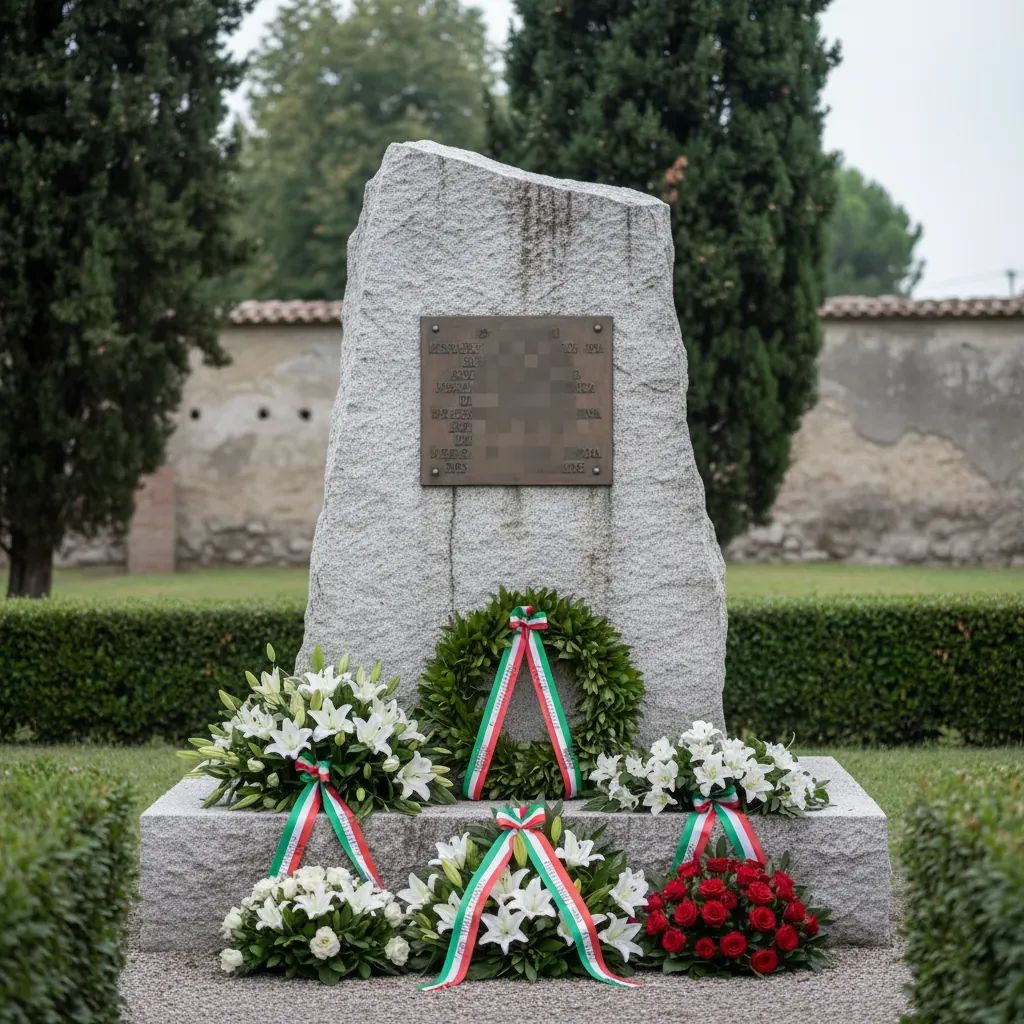
Senate President Ignazio La Russa said this week he will continue laying wreaths at monuments honoring both partisans and Italian Social Republic soldiers on Liberation Day—a practice that opposition parties say contradicts Italy's constitutional foundations and sends a troubling signal about institutional priorities.
April 25, Liberation Day, is a national public holiday marking Italy's 1945 liberation from fascism and Nazi occupation, traditionally celebrated with parades and ceremonies honoring the partisan Resistance. Yet this year's observance arrives amid sharp institutional tensions over what—and who—deserves state-level commemoration.
La Russa made his latest statements at Milan's design fair on April 21, reaffirming a personal ritual he has maintained for years: visits to Milan's municipal burial ground where he leaves wreaths at both the partisan monument and Campo 10, where Italian Social Republic soldiers lie buried. He characterizes this practice as "necessary reconciliation." Critics say it distorts the foundational principles upon which the Italian Republic rests.
Immediate Opposition Coalesces
The reaction was swift and direct. Federico Fornaro, a Democratic Party deputy, condemned the Senate President's position as "serious and unacceptable," particularly because it emanates from the second office of state on the eve of Liberation Day. Fornaro emphasized that equating partisans with "repubblichini"—the historical term for RSI supporters—constitutes "a historical and moral distortion that offends the memory of the Resistance and betrays the values upon which our Republic is founded."
Sandro Ruotolo, also from the center-left, characterized La Russa's framing not as reconciliation but as historical revision—an attempt to rewrite rather than reckon with the past. The Associazione Nazionale Partigiani d'Italia (ANPI), representing surviving Resistance fighters and their families, maintains an unambiguous position: authentic reconciliation cannot exist when one party fought for democracy and another fought to preserve occupation and dictatorship.
The Material Contradiction: Funding Cuts
A parallel development undercuts La Russa's rhetorical emphasis on inclusive remembrance. The Italian government has simultaneously contracted financial support for Resistance memorial infrastructure exactly as the Senate President has escalated his advocacy for RSI commemoration.
The Italy Ministry of Culture administers a dedicated fund for five primary Resistance sites: Marzabotto, Campo di Fossoli, Museo Cervi, Sant'Anna di Stazzema, and Risiera di San Sabba—locations that document atrocities, executions, and partisan operations central to Italian anti-fascist identity. In 2025, each received €500,000 annually. For 2026, allocations contracted to approximately €363,948 per site—a reduction of roughly 27% per location.
The mayor of Stazzema, speaking to the cut of approximately €90,000, called the reduction not "merely a budgetary matter but a grave political act" that undermines a fundamental democratic institution—the preservation of collective memory about where totalitarianism leads.
Democratic Party parliamentarians filed formal inquiries questioning whether these reductions reflect deliberate policy choices by the current governing coalition led by Premier Giorgia Meloni's Brothers of Italy party, of which La Russa is a senior member. Government officials have not provided detailed public justifications. The optics are difficult to ignore: the Senate President advocates for honoring fascist soldiers while funding for Resistance sites shrinks.
Why This Matters
• Institutional signal: When Italy's second-ranking official declares honoring both partisan and fascist soldiers "necessary," it normalizes a contested historical interpretation at the state's highest levels.
• Foundational contradiction: The Italian Republic was explicitly built on anti-fascism. Equating partisan fighters with RSI soldiers undermines that constitutional foundation.
• Material consequences: Symbolic rhetoric about commemoration diverges sharply from budget reductions affecting actual memorial sites residents might visit and learn from.
A Pattern of Historical Reinterpretation from Senior Leadership
La Russa's comments represent the latest iteration of a years-long challenge to how Italy understands its own liberation. In October 2022, he sparked outcry by stating he would not participate in Liberation Day parades, dismissing them as an "appanage of the left"—language suggesting that anti-fascism itself has been politically captured rather than constituting a shared democratic value.
More consequentially, in April 2023, he advanced a historical claim that contradicts mainstream Italian constitutional scholarship. He asserted that Italy's Constitution contains no explicit reference to anti-fascism, attributing this absence to moderate negotiators deliberately avoiding a "gift to the PCI and the Soviet Union." The argument functions as historical revisionism: if anti-fascism merely represents left-wing appropriation rather than a founding principle, then honoring Salò combatants becomes a corrective gesture toward balance.
In another widely reported incident, La Russa characterized Nazi soldiers killed by partisans in the Via Rasella attack (1944) as "a band of semi-pensioners"—a remark that combined historical inaccuracy with rhetorical belittlement of those killed in armed resistance. He has repeatedly stated he would "do it again," suggesting this practice will persist.
Understanding the Historical Distinction
The RSI, formally the Italian Social Republic, functioned between 1943 and 1945 as a German occupation authority in northern Italy. It was not an independent state but a puppet administration that enforced Nazi racial laws accelerating the deportation of Italian Jews, collaborated in the murder of civilians, and prosecuted a brutal counter-insurgency against the partisan movement.
Partisans fought to expel occupiers and restore democracy. RSI soldiers—many conscripted, some volunteers—served a dictatorship that kept their homeland under foreign military control. These roles were not symmetrical, a distinction that opponents of La Russa's position emphasize repeatedly.
Constitutional and Legal Context
Italy's founding documents embody a deliberate anti-fascist commitment. The Constitution was drafted in explicit reaction to fascism's devastation. The Scelba Law (1952) prohibits the reorganization of fascist parties. The Mancino Law (1993) criminalizes hate speech and incitement based on racial, ethnic, national, or religious grounds.
Cemetery commemorations occupy a gray legal zone. Italian courts have generally ruled that private or semi-private wreaths at burial sites constitute protected expression rather than illegal fascist apology, even when participants invoke contested historical interpretations. Yet the constitutional question persists: should the Senate President—a guardian of democratic institutions—use his position to normalize historical framings that contradict anti-fascist foundations?
International Perspective
Unlike Germany's systematic post-war denazification approach and Austria's eventual reckoning with complicity, Italy completed its transition from fascism to democracy through political compromise that left space for historical ambiguity. Few senior European officials explicitly advocate that soldiers serving fascist regimes deserve state-level commemorative parity with anti-fascist fighters. Italy's Senate President stands as a notable exception among developed democracies.
Unresolved Tensions Ahead of April 25
Italian historians describe the current moment using the term "battaglia delle memorie"—the battle of memories. It is not merely academic. Physical traces of fascism remain embedded across Italian cities: buildings, street names, monuments, and symbols that periodically mobilize political energy. When state officials deploy them for commemorative purposes, they signal whether certain historical narratives possess institutional legitimacy.
For residents and expats living in Italy, these tensions carry tangible weight. As April 25 approaches, Italians confront not merely historical debate but a question about whether their state institution will clarify or further obscure its foundational values. La Russa's declarations suggest that unsettledness remains official policy—a signal that contradicts the material investments being withdrawn from sites dedicated to remembering what anti-fascism cost and why it matters.


