
Why This Matters
The competitive landscape of international motorsport has permanently shifted. In late February 2026, Sandro Munari, the Italian champion who redefined rally racing through tactical brilliance and machine mastery, passed away at 85 after prolonged illness. His absence signals the end of a generational bridge—between an era when Italian drivers and machines ruled the world's toughest roads, and today's fragmented motorsport hierarchy where no Italian pilot currently competes for the sport's highest honors.
The "Dragon" and His Veneto Roots
Success in European motorsport rarely emerges from agricultural families, yet Munari's trajectory defied expectation from the start. Born in March 1940 in Cavarzere, a rural municipality near Venice, he grew up in farming country—terrain of flat fields and practical simplicity, far removed from the mountain passes and rocky terrain that would become his proving ground. Nothing in those early years suggested destiny for racing excellence.
His entry into competition arrived almost accidentally. In 1964, Munari took the role of co-driver (the navigator seat) alongside pilot Arnaldo Cavallari, steering their Alfa Romeo Giulia TI Super Quadrifoglio through Italy's domestic rally circuit. Operating under the Jolly Club Milan banner, the partnership produced instant results: victory at San Martino di Castrozza on their debut, another triumph in Portugal, and by season's end, the Italian Rally Championship trophy. Two triumphs came before he had ever sat in the driver's seat during competition.
Yet competitive ambition burned differently in Munari. He maneuvered his way into Mario Angiolini's Jolly Club racing operation—an organization enjoying privileged relationships with both Alfa Romeo and Lancia's factory racing division, the Squadra Corse HF. This institutional connection became the launchpad for his transformation from talented navigator to international champion.
Building Identity in the Fulvia
The machine that introduced Munari to racing immortality was elegant in its simplicity: the Lancia Fulvia, a compact front-wheel-drive machine that defied conventional rally car thinking. Starting with the Coupé variant in 1966 and transitioning to the even lighter Zagato bodywork, Munari extracted performance that surprised rivals accustomed to brute-force engineering.
His 1966 Pontedecimo-Giovi hillclimb victory in the Zagato announced that a technical innovator had emerged. By 1967, piloting the Fulvia HF alongside navigator Luciano Lombardini, his trajectory accelerated dramatically. Two Italian national championships followed (1967 and 1969), establishing him as the standout talent of his generation. Yet accolades within Italy's borders felt insufficient.
The 1972 Monte Carlo Rally altered everything. Operating in the depths of Alpine winter, Munari and Milan co-driver Mario Mannucci guided their diminutive Fulvia against a field of more mechanically powerful machinery from France and Germany. The victory was not marginal—it was overwhelming. Italy had never claimed this particular prize, and the psychological impact reverberated through European motorsport. The "Fulvietta," as enthusiasts nicknamed it, had conquered the sport's most prestigious test through driver skill, mechanical refinement, and tactical racing intelligence. The dragon had announced his arrival on the global stage.
The Stratos Partnership: Engineered Dominance
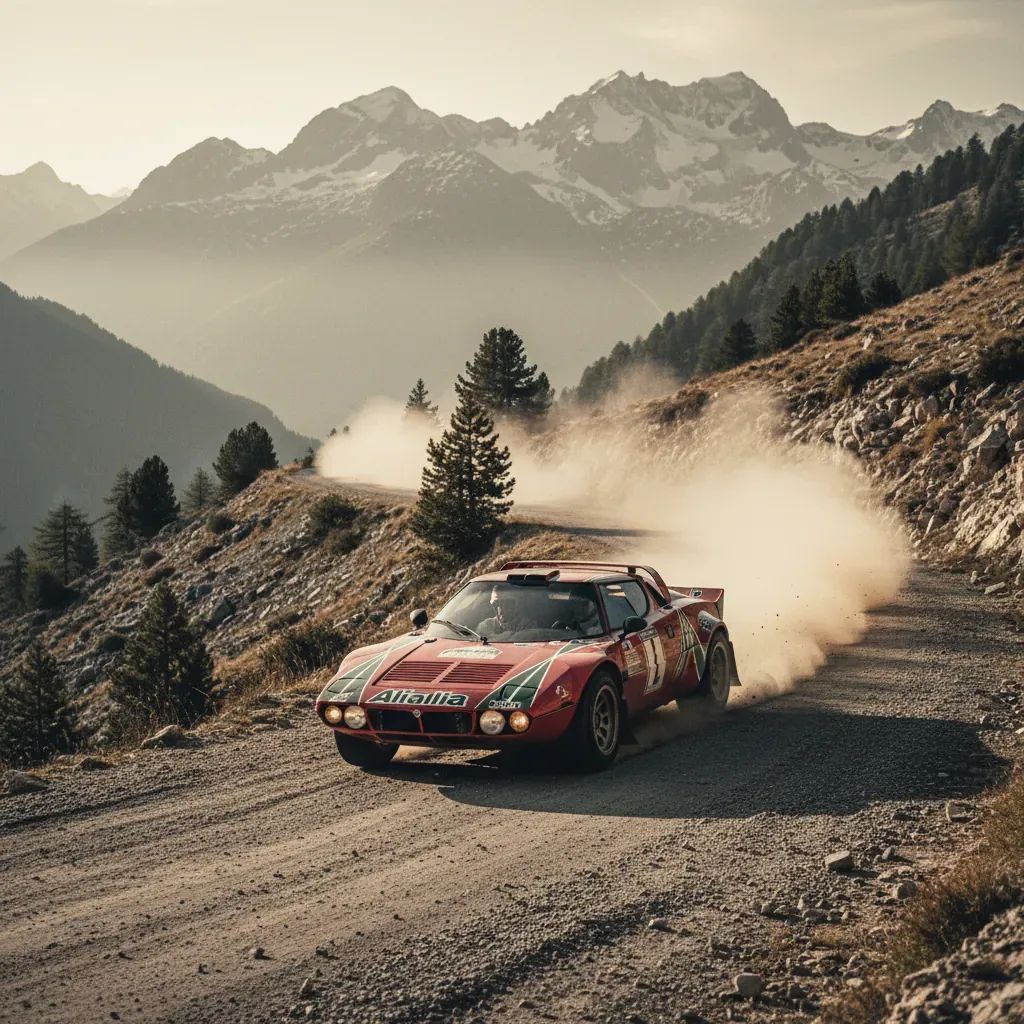
By the early 1970s, Lancia and its sports director Cesare Fiorio had embarked on an audacious engineering gamble: the first automobile designed exclusively for rally competition from conception. The Stratos HF, styled by Marcello Gandini at Bertone and powered by Ferrari's potent Dino V6 mounted behind the driver, represented a revolutionary departure. Its wedge profile, mid-engine packaging, and compact dimensions created handling characteristics that fundamentally altered rally competition.
Munari became the machine's primary development driver. In April 1973, he piloted an early Stratos prototype to victory in Spain's Rally Firestone—the car's international debut. September's Tour de France Automobile brought another triumph. The pairing of driver and machine proved symbiotic: Munari understood the Stratos's capabilities intuitively, while the car's engineering allowed him to exploit advantages that conventional rivals couldn't match.
Between 1974 and 1976, the Stratos claimed three consecutive World Rally Championships for manufacturers, acquiring the French sobriquet "bête à gagner" (the beast to beat). The car dominated Alpine passes, Scottish moors, and Portuguese mountain stages with an omnipresence that reshaped competitive rally strategy. Teams either built cars attempting to match the Stratos's handling, or they accepted subordinate positions.
Munari's personal achievements during this era transcended even the machine's capabilities. At Monte Carlo Rally, motorsport's winter crucible, he accumulated four victories total: the 1972 triumph in the Fulvia, followed by an extraordinary three-year sweep from 1975 through 1977 in the Stratos. This sequence—winning the world's most technically demanding winter rally four times, at a circuit where conditions vary unpredictably year to year—demonstrated an almost preternatural ability to master ice, snow, and mechanical precision simultaneously.
In 1977, Munari secured the FIA Drivers' Cup for Rally, an honor that preceded the modern WRC world championship structure established in 1979. He became the first Italian pilot to claim this distinction. Across his World Rally Championship career spanning 1973 to 1984, Munari accumulated seven rally victories from 36 contested events, collecting 132 individual stage wins—an extraordinary conversion rate reflecting both consistency and tactical acumen. Fourteen podium finishes underscored his competitiveness across diverse terrain and weather.
Beyond the Rally Stage
Munari's genius wasn't confined to gravel tracks and mountain passes. In 1966, he finished second in class at the 12 Hours of Sebring endurance race driving a Fulvia Zagato, proving his adaptability to long-distance racing demands. More impressively, in 1972 he partnered with Arturo Merzario to win the legendary Targa Florio, one of motorsport's most punishing endurance tests, aboard a Ferrari 312 PB. This victory—earned on Sicily's treacherous Madonie mountain roads—demonstrated that his talents extended across any discipline requiring precision, bravery, and strategic thinking.
A 1973 class podium at Mugello circuit in the nimble Fulvia provided additional evidence of versatility. Munari possessed that rarest combination: sufficient bravery for high-speed racing, sufficient technical understanding for vehicle setup feedback, and sufficient adaptability to perform competitively whether competing on tarmac or gravel, in short bursts or multi-hour marathons.
The Closing Chapters
As the 1970s concluded and new competitive eras emerged, Munari's participation gradually receded. He raced Fiat 131 Abarth machinery, finishing third at the 1978 Tour de Corse and sixth at the 1980 Ivory Coast Rally—respectable results, though increasingly overshadowed by younger talents emerging with factory support and updated technical packages. His World Rally Championship career effectively concluded in 1984, though not before producing competitive performances at the Safari Rally and other international events.
Later years brought ventures into desert racing—the Dakar Rally and Rally of the Pharaohs—evidence of a competitive spirit that never fully extinguished. Even in middle age, Munari pursued challenge, never content with retrospective celebration of past achievements.
What This Means for Italian Motorsport Today
The impact of Munari's legacy on contemporary Italian racing remains visible, though attenuated. Following his retirement, Massimo "Miki" Biasion emerged as Italy's second world-championship-caliber driver, claiming WRC titles in 1988 and 1989 aboard the Lancia Delta Integrale, accumulating 17 rally victories—a record unmatched by any subsequent Italian competitor. Yet even Biasion's achievements—remarkable though they are—haven't spawned a consistent pipeline of Italian world-championship contenders.
Other Italian drivers claimed individual world rally victories: Raffaele Pinto's 1974 Portugal victory, Andrea Aghini's 1992 Sanremo triumph, and Piero Liatti's 1997 Monte Carlo win in a Subaru Impreza. However, Liatti's 1997 victory marked the final occasion an Italian driver would claim a world championship rally event. Nearly 30 years have passed without an Italian winning a World Rally Championship event.
In 2026, Italian representation at the sport's elite Rally1 level remains marginal. Lorenzo Bertelli competes for Toyota Gazoo Racing WRT, though without accumulating championship points. Lower competitive categories feature Italian presence—Roberto Dapra in Rally2 machinery and Matteo Fontana in Rally3—but neither approaches the dominance Munari established or the regular title contention Biasion achieved.
This absence reflects broader structural shifts: modern WRC success requires manufacturer financial backing, comprehensive technical infrastructure, and development resources concentrated in non-Italian automotive manufacturers. The Lancia brand, once synonymous with rally excellence, no longer fields factory teams. Young Italian drivers with genuine world-championship potential find themselves competing in lower categories or abroad rather than nurturing national aspirations.
Tributes and National Recognition
The news of Munari's passing triggered immediate commemorations across Italian motorsport infrastructure. Geronimo La Russa, president of the Automobile Club d'Italia (ACI), issued a formal statement: "We lose a 'truly great figure' of international motorsport. The 'Dragon' of rally racing embodied the winning spirit of Italian sport. We will forever remember him with admiration and deep affection." La Russa committed ACI to organizing formal celebrations of Munari's competitive accomplishments, acknowledging that "figures like Sandro Munari represent the source of pride for all those who follow motorsport with genuine passion."
Luca Zaia, president of the Veneto Regional Government, offered personal tribute to Munari as "an absolute protagonist in motorsport, a Venetian who brought talent, courage, and distinctive style to the international sporting arena." Regional officials and historic racing associations throughout northeastern Italy recognized his contributions to local and national sporting heritage.
Mechanical Legacy and Collectible Heritage
For those tracking Italian automotive history, Munari's career encompassed vehicles that have become historic artifacts commanding extraordinary market valuations. The Lancia Fulvia Coupé 1.6 HF and Lancia Stratos HF machines he campaigned represent pinnacles of rally car engineering, with surviving examples regularly commanding six-figure valuations at international auctions. Historic rally events throughout Italy—particularly in Veneto—frequently feature restoration tributes to Munari's achievements, with vintage Fulvias and Stratos vehicles appearing regularly at classic motorsport gatherings.
The mechanical sophistication of these machines, combined with Munari's innovations in setup and race strategy, established technical frameworks that influenced rally car development across subsequent decades. His willingness to experiment with suspension geometry, brake balance, and tire management during practice sessions established methodologies that modern rally teams continue employing.
The Drago's Competitive Spirit
The nickname "Il Drago" (The Dragon) captured essential elements of Munari's competitive character: aggressive instinct tempered by technical precision, willingness to exploit mechanical advantages without recklessness, and fierce determination to prevail against better-resourced rivals. That combination—fierce drive paired with strategic intelligence—defined not just an individual career but an entire competitive era when technical finesse and European craftsmanship could overcome raw horsepower and manufacturing scale.
Munari didn't simply win races; he elevated Italian motorsport's international reputation during a period when Italian engineering commanded respect globally. His achievements proved that innovation in chassis design, understanding of weight distribution, and precision driving could consistently outperform conventional approaches built on mechanical power alone.
In the decades since his competitive career concluded, few Italian drivers have matched his consistency at the sport's highest levels or his ability to win decisive competitions against elite international fields. That rarity amplifies his historical significance and explains why his passing resonates so deeply through Italian motorsport and beyond—a tangible reminder of an era when the Veneto produced world-class motorsport excellence that remains, to this day, unequaled by any contemporary successor.


