
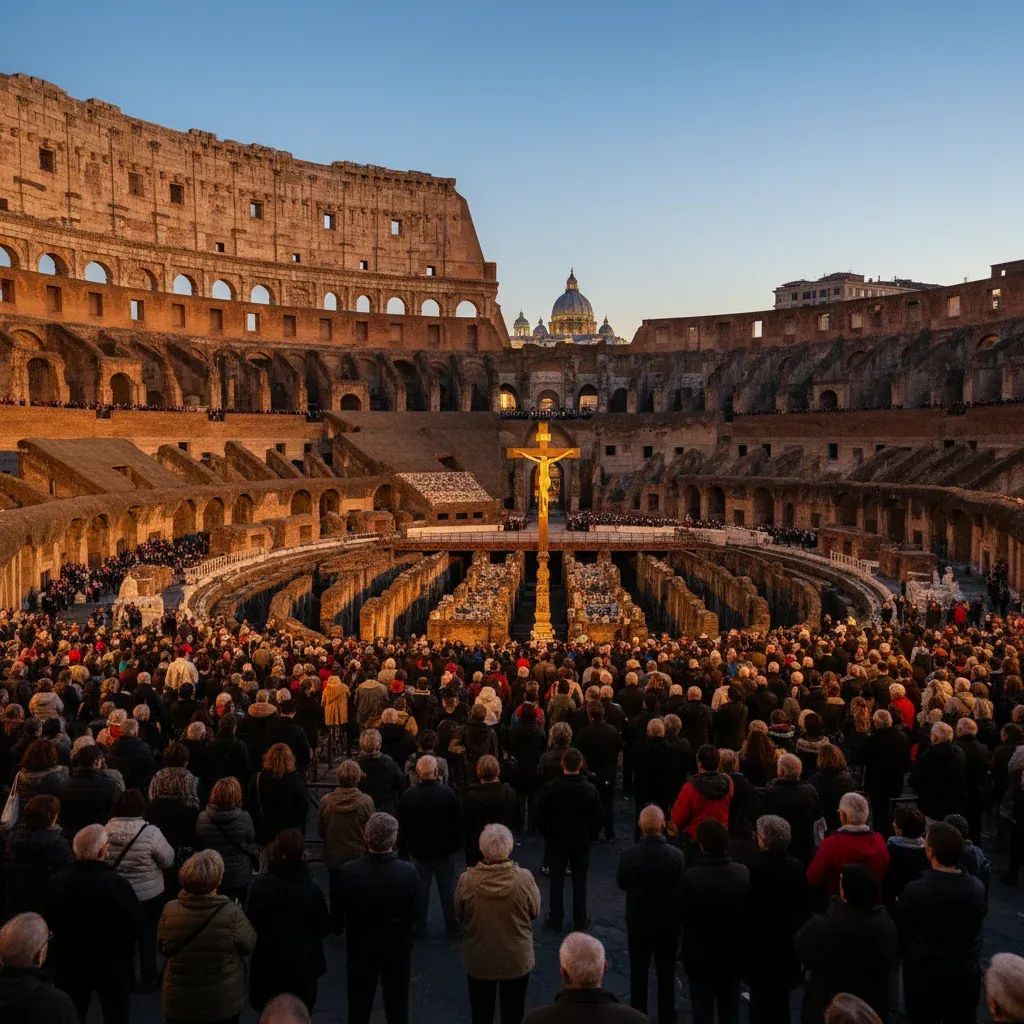
Pope Leone XIV delivered an uncompromising message at the Colosseum on Good Friday evening: those who unleash wars will face divine judgment. In meditations composed by Padre Francesco Patton, former Custodian of the Holy Land, the pontiff's first Via Crucis since ascending to the papacy became a sharp rebuke to global leaders wielding unchecked power—and a warning that their decisions to start or prolong conflicts carry eternal consequences.
Why This Matters
• Unprecedented gesture: Pope Leone XIV personally carried the cross through all 14 stations, the first pontiff to do so since 1964.
• Direct accountability language: The meditations state that every authority—from judges to economic policymakers—will answer to God for choices that fuel war, oppression, or violence.
• Active diplomacy: The Pope held phone calls with Ukrainian President Volodymyr Zelensky and Israeli President Isaac Herzog in late March, urging ceasefires and "just and lasting peace."
• Regional relevance: With Italy hosting Vatican City and serving as a gateway to Mediterranean conflict zones, the Pope's stance directly influences political and humanitarian discourse across the peninsula.
A Ritual Transformed into Rebuke
The Via Crucis—traditionally a meditative reenactment of Christ's final hours—became a pointed political and moral declaration under Leone XIV's stewardship. The first station's text, penned by Patton, opens with a blunt observation: "There are those who believe they have received unlimited authority and think they can use and abuse it at their own pleasure."
This is not the language of abstract theology. It is a direct challenge to heads of state, military commanders, and economic architects who justify bloodshed as strategic necessity. Patton's meditations insist that power is not absolute but borrowed—and that every wielder of authority, from the courtroom to the battlefield, will face divine reckoning for how they exercise it.
The text specifies the stakes: "The power to start or end a war, the power to educate to violence or peace, the power to fuel the desire for revenge or reconciliation, the power to use the economy to oppress peoples or to free them from misery." This catalog reads less like liturgy and more like a prosecutorial list of charges awaiting judgment.
The Colosseum as Courtroom
Leone XIV's decision to carry the cross himself through all 14 stations was not mere symbolism. It was a physical statement. The last pope to do so was Paul VI in 1964, at the height of Cold War nuclear brinksmanship. Now, with wars grinding through Ukraine and escalating in the Middle East—including heightened tensions involving Iran and Lebanon—the gesture carries renewed urgency.
In the week leading up to Good Friday, the pontiff engaged in direct diplomacy. His late-March call with Zelensky discussed humanitarian corridors and prisoner exchanges, with the Ukrainian leader extending an invitation for the Pope to visit Kyiv. A separate call with Herzog addressed the spiraling violence in the Holy Land, where Christian communities have faced displacement and death.
Vatican observers note that Leone XIV's tone toward Kyiv has been markedly more supportive than that of his predecessor, signaling a shift in Holy See strategy as the conflict enters its third year. Italy, which hosts significant Ukrainian refugee populations and serves as a logistics hub for aid shipments, is directly implicated in these diplomatic maneuvers.
What This Means for Residents
For those living in Italy, the Pope's message carries both spiritual weight and practical implications. The Vatican remains a moral authority that shapes public discourse, influences coalition politics in Rome, and sets the tone for humanitarian priorities across the country.
Catholic voters and civil society: The Pope's condemnation of war as "scandal before God" reinforces the position of Italy's peace movements, which have organized vigils and demonstrations in cities like Rome, Milan, and Florence. His words provide moral cover for politicians who advocate restraint in military spending or question arms exports.
Humanitarian sector: The Via Crucis meditations explicitly link Christ's suffering to "victims of modern-day warfare," which includes the tens of thousands of Ukrainian refugees currently residing in Italy. Aid organizations, many Catholic-affiliated, will use the Pope's language to justify funding appeals and policy advocacy.
Interfaith communities: By invoking Saint Francis of Assisi—whose 800th death anniversary falls this year—the meditations draw on Italy's most beloved peacemaker. Francis's call for "disarmed hearts" resonates beyond Catholicism, offering a framework for dialogue with Muslim and Jewish communities concerned about Middle Eastern violence.
Patton's Theology of Power
Padre Francesco Patton, who authored the meditations, is no stranger to conflict zones. As Custos of the Holy Land until recently, he led the Franciscan order responsible for maintaining Christian holy sites in Jerusalem, Bethlehem, and Nazareth—cities routinely caught in crossfire. His theology is not abstract; it is forged in checkpoints, refugee camps, and cemeteries.
His meditations cite the Gospel of John, where Jesus tells Pilate: "You would have no authority over me unless it had been given you from above." Patton interprets this as a universal principle: all human power is contingent, not sovereign. Leaders who treat authority as personal property—whether in declaring war, manipulating economies, or trampling human dignity—are acting outside their mandate.
This theology has immediate relevance. In a Europe where populist leaders increasingly invoke national sovereignty to justify unilateral action, Patton's reminder that power is accountable to a higher authority challenges both secular and religious nationalism. For Italian readers familiar with domestic debates over migration policy, defense budgets, and European Union cohesion, the message is clear: no leader is above moral law.
A Shift in Vatican Strategy
Leone XIV's papacy, though still in its early months, has demonstrated a more confrontational approach to global conflict than his predecessor. The 59th World Day of Peace on January 1, 2026, saw the Pope call for a "disarmed and disarming peace," explicitly criticizing rising military expenditures. In October 2025, at the Community of Sant'Egidio's interfaith gathering in Rome, he declared: "No war is holy; only peace is holy."
These are not diplomatic pleasantries. They are doctrinal statements that bind Catholic teaching to active pacifism. The Pope's meditations at the Via Crucis extend this logic: if no war is holy, then every war-maker is a blasphemer.
This stance places the Vatican in potential tension with NATO allies, including Italy, which contributes troops and infrastructure to collective defense. Yet it also aligns with a broader global Christian movement—spanning Catholic, Protestant, and Orthodox traditions—that has shifted from "just war" theory to radical nonviolence as the default Christian position.
The Silence That Condemns
One of the most striking elements of Patton's meditations is their emphasis on complicity. The text does not merely condemn those who start wars but also those who "remain silent" in the face of suffering. This implicates media, civil society, and ordinary citizens who normalize violence through indifference.
For Italy's information sector, this is a pointed critique. The Pope has previously warned that journalism must show "the true face of war" rather than serve as a "megaphone for power." In an age of curated social media feeds and algorithm-driven news, the call to witness—and to resist the sanitization of violence—is both ethical and professional.
The Burden of the Cross
As Leone XIV walked the Via Crucis route, carrying the wooden cross under floodlights and before thousands of pilgrims, he embodied the meditations' central claim: that authority is servitude, not dominion. The cross is a burden, not a scepter. Those who wield power in the service of death will, according to the Pope's theology, find that burden crushing when they stand before God.
For Italians—whether practicing Catholics, cultural believers, or secular citizens—the spectacle at the Colosseum offered a rare moment of moral clarity in a world saturated with ambiguity. Wars are not tragic necessities. They are choices. And choices, the Pope insists, have authors who will be held to account.
Whether that account is rendered in history books or at the gates of eternity may be a matter of belief. But the Pope's message leaves no room for neutrality: those who choose violence cannot claim ignorance of the cost.


