
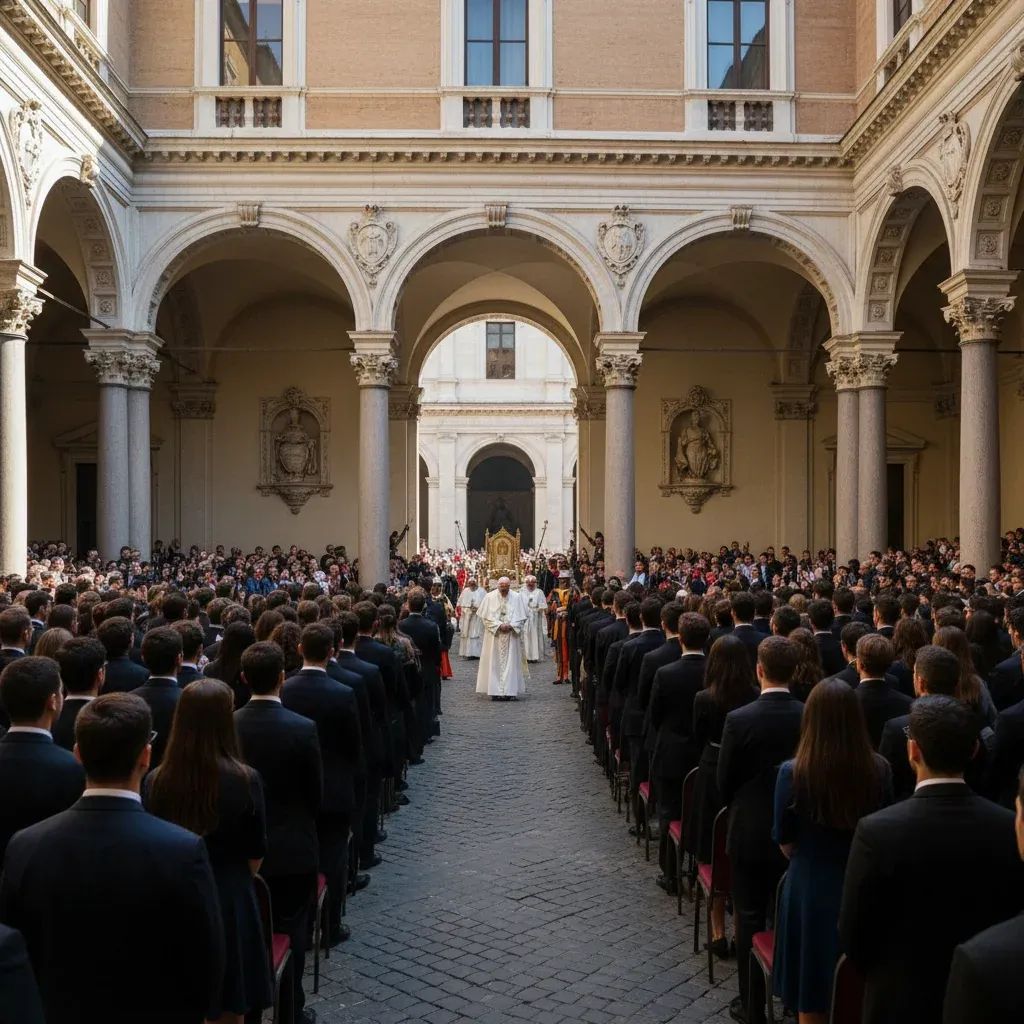
The Vatican has confirmed that Pope Leo XIV will make a pastoral visit to Italy's largest university, La Sapienza in Rome, on May 14, 2026, a move that closes an 18-year rift between the Holy See and the academic institution. The visit comes after Pope Benedict XVI's scheduled appearance in 2008 was canceled following protests by faculty and students who objected on grounds of academic secularism and the separation of Church and state.
Why This Matters
• First papal visit in 35 years: The last Pope to set foot on the Sapienza campus was John Paul II in 1991.
• Symbolic reconciliation: The visit addresses lingering tensions from 2008 when protests forced Benedict XVI to cancel his lecture on the Galileo controversy.
• Youth engagement focus: Pope Leo XIV, the first American-born pontiff, elected May 8, 2025, has made dialogue with students a cornerstone of his papacy.
• Historic ties: La Sapienza was founded by Pope Boniface VIII in 1303 and remained under papal governance for over five centuries until 1870.
A Packed Schedule of Symbolism
The Pontifical Household Prefecture released a detailed itinerary that blends religious ritual with academic protocol. Pope Leo XIV will depart the Vatican at 10:00 and arrive at the university chapel "Divina Sapienza" at 10:20, where Rector Antonella Polimeni and chaplain Don Gabriele Vecchione will receive him. After a silent prayer and brief greeting with a student delegation, the pontiff will move to the central plaza to address the broader student body from the monumental staircase at 10:30.
At 10:45, a private meeting with Rector Polimeni will take place inside the Rectorate Palace, followed by the ceremonial signing of the university's Book of Honor. At 11:00, the Pope will unveil a commemorative plaque marking the visit and greet members of the Academic Senate as well as university staff. A tour of the exhibition "Sapienza and the Papacy" is scheduled for 11:15, offering a historical reflection on the institution's roots.
The centerpiece event—an assembly with faculty and students in the Aula Magna—begins at 11:30. Rector Polimeni will deliver opening remarks before Pope Leo XIV takes the floor. The pontiff's address is expected to focus on themes of peace, hope, and the university's role as a bridge between cultures and generations, according to Vatican sources. The event concludes at 12:15, with the Pope departing at 12:30 and arriving back at the Vatican by 12:50.
What This Means for the Academic Community
For La Sapienza—a sprawling institution with over 110,000 students and a reputation as Europe's largest university—the visit represents both validation and friction. The 2008 debacle remains a raw memory: 67 professors, including future Nobel laureate Giorgio Parisi, signed a letter condemning the invitation to then-Pope Benedict XVI, citing his 1990 remarks about the Galileo trial as incompatible with scientific independence. Student protests escalated into sit-ins and a "week of anti-clericalism," forcing the Vatican to withdraw.
This time, reactions are mixed but more measured. Marco, a philosophy student, told reporters the visit is "an unprecedented honor, not something that happens every day at our university." Others, like Lucia, a fellow student, questioned the relevance of papal authority "for new generations in a constantly evolving world." The 2021 protests against an agreement between Rector Polimeni and the Holy See—where students chanted "Get priests out of the university!"—suggest that concerns over institutional secularism persist among vocal segments of the student body.
Yet the prevailing mood appears cautiously optimistic. Cardinal Vicar of Rome Baldassare Reina emphasized Pope Leo XIV's "great attention to the youth" and the importance of engaging with "those who approach the future through various sciences and research." University officials have framed the visit as a chance to strengthen intergenerational and intercultural dialogue, positioning the institution as a space for pluralism rather than ideological exclusion.
Beyond Rome: A Busy Papal Calendar
The Sapienza visit is part of a packed spring and summer itinerary designed to reinforce Pope Leo XIV's pastoral priorities. On May 23, the pontiff will travel by helicopter to Acerra, in the Campania region, an industrial town near Naples synonymous with Italy's notorious "Land of Fires"—a sprawling area plagued by illegal waste dumping and environmental contamination. The visit will include a 9:15 meeting at the Cathedral with Campania's bishops, clergy, and families who lost loved ones to pollution-related illnesses. At 10:30, in Piazza Calipari, Pope Leo XIV will address mayors and residents from surrounding municipalities, delivering a second speech focused on environmental justice. The Pope will be welcomed by Bishop Antonio Di Donna of Acerra, Roberto Fico, President of the Campania Region, and local civil authorities.
Then, on July 4, the Pope will fly to Lampedusa, the Mediterranean island that has become a symbol of Europe's migration crisis. The schedule includes a cemetery vigil with floral tributes, a stop at the "Gate of Europe" monument, and the blessing of a plaque at Molo Favaloro, which will be dedicated to Pope Francis. A Mass is set for 10:30, with an image of the Madonna of Portosalvo displayed prominently. Before departing, Pope Leo XIV will greet migrants, sick children, and volunteers. Departure from Lampedusa is scheduled for 12:30, with arrival back in Rome by 13:45.
A Political Aside: Populism and Participation
During a recent audience with members of the European People's Party (EPP), Pope Leo XIV delivered remarks that double as a critique of Italy's polarized political climate. "The people are not merely passive subjects, recipients of political proposals and decisions," he said. "They are first and foremost called to be active subjects, co-participants in every political action." He warned that disengagement breeds populism and elitism—two forces he described as "widespread in today's political landscape."
Quoting Alcide De Gasperi, the postwar Italian statesman and EPP founder, the Pope urged lawmakers to "place the human person at the center, with the leaven of evangelical fraternity, the cult of law inherited from the ancients, the cult of beauty refined over centuries, and the will to truth and justice sharpened by a millennial experience." It was a pointed reminder, delivered to a center-right political family, that genuine popular politics requires time, shared projects, and a love of truth—not the shortcuts of digital virality.
The Road Ahead
The May 14 visit to La Sapienza represents a significant moment in the relationship between the Vatican and Italy's most prominent secular university. The visit will test whether institutional memory and maturity allow a secular university to welcome a religious leader without compromising its intellectual independence, and whether the Vatican can engage with one of Italy's most proudly pluralist institutions without triggering the backlash that marred 2008.
The encounter hinges on dialogue—the kind Pope Leo XIV has championed since his election just over a year ago. His visit to La Sapienza, framed as pastoral rather than academic, attempts to sidestep the 2008 debate over whether a Pope has standing to deliver a lectio magistralis on science and faith. Instead, the focus is on presence: prayer, conversation, and a shared reflection on the role of education in an uncertain world. For one morning in mid-May 2026, the largest university in Italy will once again host the Bishop of Rome—an encounter that, regardless of its political or theological implications, will be closely watched across Europe and beyond.


