
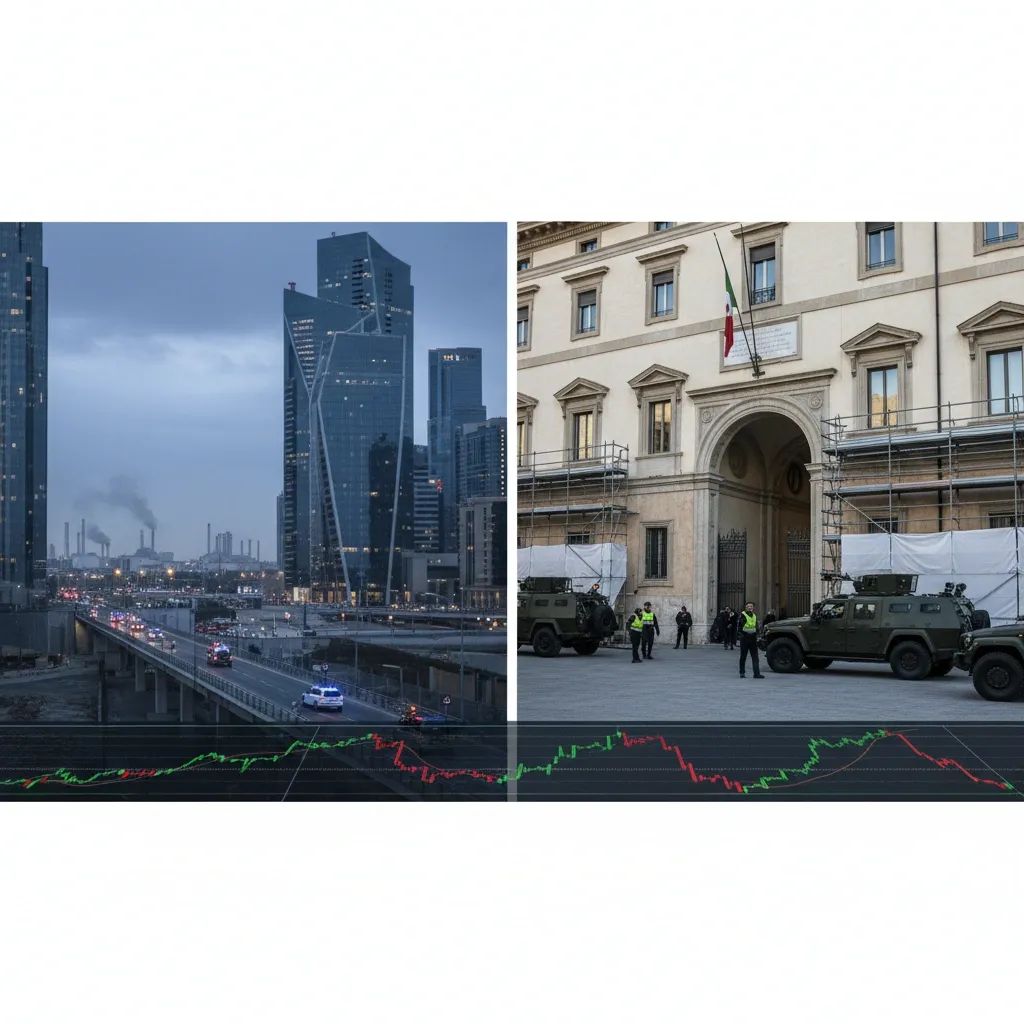
The Italy government has mobilized a full diplomatic and consular response as thousands of Italian citizens remain stranded in the United Arab Emirates following Iran's retaliatory missile strikes against U.S. and Israeli targets across the Gulf. Approximately 300 Italian Air Force personnel sheltered in bunkers in Kuwait after the strikes, while oil prices have surged toward crisis levels, exposing Europe's vulnerability to Middle East instability.
Why This Matters:
• Over 2,000 Italians are stranded in Dubai and Abu Dhabi due to airspace closures and flight suspensions, including approximately 200 students on educational programs.
• 300 Italian Air Force personnel in Kuwait took shelter in bunkers after a missile strike hit their base; all reported safe but the facility sustained significant damage.
• Oil prices are climbing past $100/barrel as Iran threatens closure of the Strait of Hormuz, which handles 20-30% of global petroleum shipments—a move that will translate directly into fuel costs for Italian households and businesses.
• Foreign Minister Antonio Tajani will brief Senate committees on Monday afternoon, while diplomatic coordination continues with the Italian President Sergio Mattarella receiving regular updates from Prime Minister Giorgia Meloni.
What Italian Residents Should Know
For Italian citizens and residents with family or travel connections to the Middle East, the Farnesina's Crisis Unit is the primary contact point. The Foreign Ministry has established a Gulf Task Force with expanded capacity. Citizens in the region are urged to register with the nearest Italian Embassy or Consulate immediately. For urgent assistance, contact the Farnesina Emergency Line: +39 06 3691 or email crisisitaly@esteri.it. Italy imports approximately 90% of its crude oil, making fuel price volatility a direct concern for households and businesses. During the 2008 energy crisis, similar supply disruptions resulted in fuel price increases of 15-25% within weeks.
Italians Caught in the Crossfire
The most acute concern for Rome centers on Dubai and Abu Dhabi, where the Italian Consulate has added five emergency phone lines and deployed consular staff to the airport to assist stranded nationals. Many are tourists caught mid-vacation; others are young Italians enrolled in training programs who now find themselves in hotel lobbies watching air defense systems intercept incoming missiles.
Antonio Tajani, Foreign Minister and Deputy Prime Minister, confirmed that the UAE government is covering accommodation costs while the situation stabilizes. "The consul and vice-consul were at the airport yesterday assisting groups, including minors," Tajani said in a briefing at the Farnesina on Sunday afternoon. "We are in constant contact, and everyone is being looked after."
Italy's Defense Minister Guido Crosetto was in Dubai when the airspace closed on Saturday. The minister had traveled to the Emirates earlier in the week and remained grounded alongside ordinary travelers. A high-rise near the Italian Embassy in Abu Dhabi was hit by debris, forcing diplomatic staff to relocate operations to the ambassador's residence temporarily.
Military Personnel Safe but Base Damaged
In Kuwait, approximately 300 Italian Air Force personnel assigned to a coalition base scrambled into bunkers as Iranian ballistic missiles struck the facility on Saturday morning. The runway sustained heavy damage, but all Italian military members emerged unharmed. Italy's Defense Ministry has confirmed no plans to evacuate the contingent at this time, signaling confidence that the immediate threat has passed—though the broader regional security picture remains volatile.
No Italian civilians or military personnel were involved in the U.S.-Israeli strikes on Iran, according to Tajani, who emphasized that Rome was not consulted prior to the operation. This has fueled a domestic political debate about Italy's place—or lack thereof—in Washington's decision-making process.
Diplomatic Backchannel and Parliamentary Scrutiny
Prime Minister Giorgia Meloni has spent the weekend on the phone with Middle Eastern leaders, EU Commission President Ursula von der Leyen, and Cyprus President Nikos Christodoulides, whose country currently holds the rotating EU Presidency. She subsequently briefed President Sergio Mattarella at the Quirinale Palace on Sunday, ensuring Italy's head of state is kept current on both the diplomatic outreach and consular logistics.
Tajani, who participated overnight in a G7 foreign ministers' videoconference alongside U.S. Secretary of State Marco Rubio, will face lawmakers on Monday at 15:00. He will appear before the joint Senate Foreign Affairs and Defense Committees to outline Italy's position, explain the government's crisis management, and address opposition criticism that Rome was blindsided by its closest allies.
The briefing follows a request from Senate Foreign Affairs Committee Chair Stefania Craxi. Tajani indicated he has already spoken with opposition leaders who sought clarity. "Everything we are doing, we are recounting minute by minute, primarily to reassure Italian families with relatives living or traveling abroad," he said.
Italy's Stance: Diplomacy First, but Sympathy for Preemption
The Meloni government has walked a careful line, publicly advocating for diplomatic de-escalation while expressing understanding for the rationale behind the strikes. Tajani made clear that Italy opposed Iran acquiring nuclear weapons and had long supported diplomatic efforts to contain Tehran's atomic ambitions. "As the Prime Minister has said repeatedly, we favored diplomacy—but Iran could not be allowed to have the bomb," he stated. "Iran's intransigence provoked this reaction, because Israel and the United States perceived a threat to their security."
Regarding Iran's retaliatory barrage, which struck targets in Saudi Arabia, Oman, Kuwait, Bahrain, and the UAE—none of which participated in the original strikes—Tajani stated: "We condemn Iran's reaction, which attacked countries that had nothing to do with it. The Iranian regime has isolated itself by attacking the Gulf states—an act inconsistent with regional stability. We stand in solidarity with the Gulf nations, who are victims of this assault."
Matteo Salvini, Italy's other Deputy Prime Minister and leader of the League party, stated on Sunday: "If a regime is building an atomic bomb and poses a threat to Western countries, those who intervened did so to address a security concern." He added, however, that diplomacy remains preferable.
Opposition Criticizes Government's Marginal Role
The Five Star Movement leader Giuseppe Conte issued a statement accusing the Meloni administration of failing to protect Italian interests. "The Italy led by Meloni didn't receive advance notice of the heavy U.S. and Israeli attacks on Iran," Conte wrote on social media on Sunday.
Conte highlighted the situation of Defense Minister Crosetto, grounded in Dubai, along with the 300 soldiers sheltering in bunkers and the broader economic fallout from potential supply disruptions. He concluded: "Minister Tajani and Minister Crosetto's isolation abroad reflects a loss of political dignity."
Economic Impact for Italian Residents
For Italians, the most immediate concern is economic. The Strait of Hormuz, a 21-mile-wide chokepoint through which roughly 20-30% of the world's oil and gas flows, is now under implicit threat. Italy, which imports approximately 90% of its crude oil and 60% of its natural gas, faces renewed inflationary pressure. The last significant supply disruption—during the 2008 energy crisis—resulted in fuel price increases of 15-25% over several weeks.
Shipping routes through the Red Sea and the Gulf are already being rerouted around the Cape of Good Hope, adding weeks to transit times and driving up costs for goods transported from Asia to Europe—a factor that eventually reaches Italian consumers through higher prices on electronics, groceries, and other products.
Europe's Fractured Response
The European Union has issued statements of concern and called for restraint, but the bloc remains divided on how to confront Tehran. France, Germany, and the United Kingdom released a joint declaration urging a negotiated solution, explicitly noting they did not participate in the strikes. Spain's Prime Minister Pedro Sánchez condemned unilateral military action, while Nordic countries emphasized dialogue and adherence to international law.
Italy has emerged as one of the more assertive voices within the EU, pushing for tougher sanctions and supporting the potential designation of Iran's Islamic Revolutionary Guard Corps as a terrorist organization. Yet the lack of advance consultation with European allies has left frustration. The Meloni government, which campaigned on restoring Italy's stature globally, now faces questions about whether it wields real influence in Washington.
The Road Ahead
Tajani's Senate appearance on Monday will be closely watched for operational details and any indication of how Rome plans to navigate the gap between its transatlantic commitments and its economic exposure to Middle East volatility.
For ordinary Italians, the immediate priorities are clear: ensure loved ones abroad return safely, monitor official guidance, and prepare for potential increases in energy costs. For the government, the test is whether it can translate diplomatic engagement into tangible protection for citizens and effective management of economic consequences at home.


