
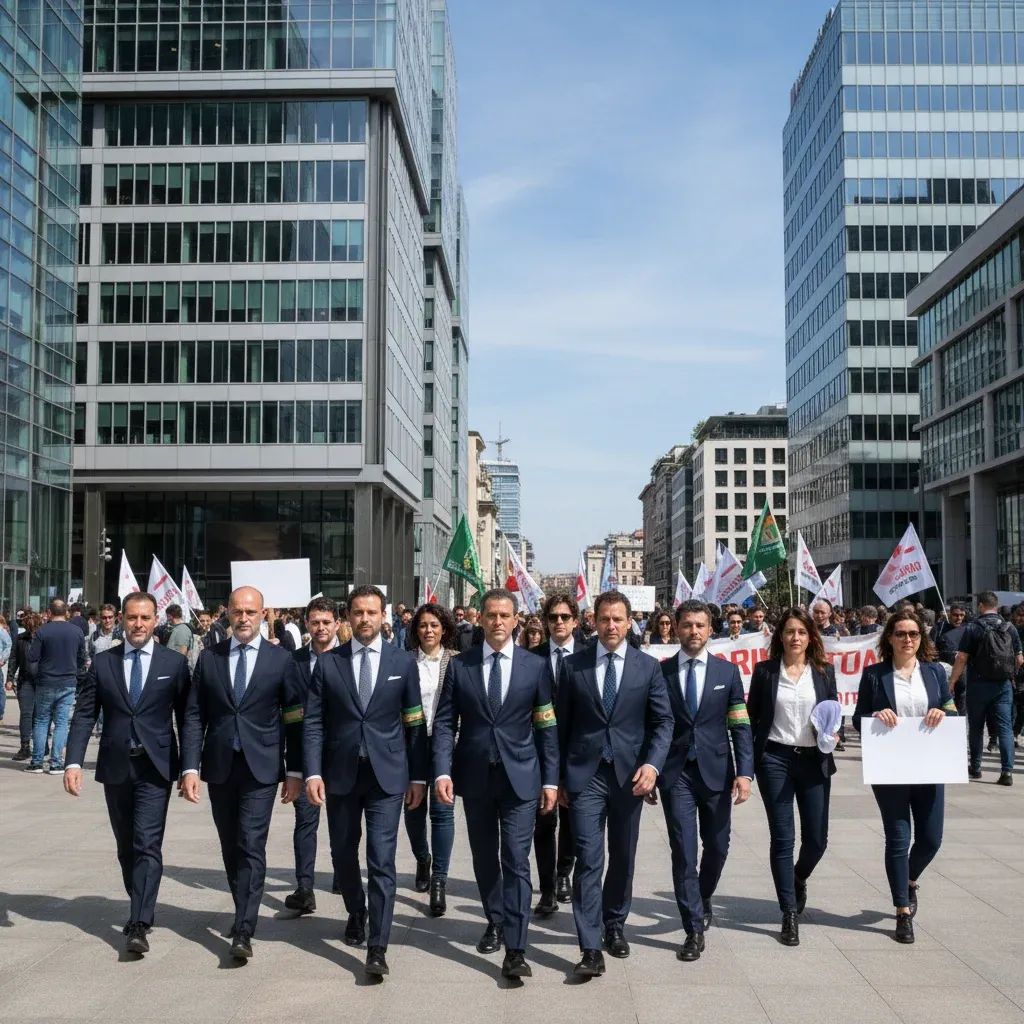
Borsa Italiana employees will walk off the job for half a day tomorrow, April 30, marking the second major strike in less than a year as workers escalate their demands regarding decision-making authority and working conditions at Italy's stock exchange.
Why This Matters
• Market disruption expected: Trading operations at Piazza Affari could face delays or slowdowns between 12:30 PM and 3:00 PM tomorrow.
• Centralization concerns: Unions warn that decision-making power is being concentrated outside Italy, with strategic choices increasingly made from Paris rather than Milan.
• Labor tensions: A failed conciliation attempt signals ongoing disagreements between management and workers over organizational structure and workplace conditions.
The Strike and Its Background
Workers represented by unions including FISAC-CGIL will stage a protest outside Palazzo Mezzanotte in Milan tomorrow afternoon, their second collective action since June 2024. That initial strike—the first in Piazza Affari's history—prompted Euronext leadership to engage in emergency discussions with Italian workers and management.
The current dispute reflects a fundamental disagreement over the governance structure at Italy's financial hub following Euronext's acquisition of Borsa Italiana in April 2021, when the exchange transitioned from London Stock Exchange Group ownership after Brexit.
Centralization vs. Local Autonomy: The Core Issue
At the heart of the dispute lies how Euronext operates Piazza Affari. When the pan-European exchange network—headquartered in Paris and operating bourses across multiple European cities—took control of Borsa Italiana, unions argue they were promised a structure respecting local decision-making authority. Workers now contend that operational control and strategic planning have become increasingly centralized outside Italy.
According to union statements, budget decisions and business strategy are being determined from Paris rather than through local management structures. This centralization, workers argue, diminishes Italy's role within the Euronext network and reduces the strategic autonomy of Piazza Affari.
Workplace Conditions and Labor Relations
Beyond governance questions, rank-and-file employees report concerns about working conditions and overtime demands. Negotiations over flexible work arrangements and compensation have stalled between management and unions representing Borsa Italiana's workforce.
Unions cite mounting workloads and increasing stress, with workers expressing frustration that despite engagement in dialogue, management has not adequately addressed their concerns. An April conciliation session ended without progress, prompting unions to authorize tomorrow's strike.
What This Means for the Market and Italy
For investors and market participants, tomorrow's strike creates operational uncertainty during a critical trading window. The earlier June 2024 walkout demonstrated workers' willingness to take action when disputes remain unresolved.
Beyond immediate market mechanics, the dispute reflects broader questions about Italy's role within Euronext. Financial market infrastructure represents a strategically important asset, and the location of key decision-making authority carries implications for how Italy's capital markets operate within the broader European system.
Historical Context: From London to Paris
To understand today's tensions, it helps to recall Piazza Affari's recent trajectory. Before 2021, Borsa Italiana was part of the London Stock Exchange Group. Brexit prompted regulatory complications, leading LSEG to divest its Italian holdings. Euronext, seeking to expand its southern European presence, acquired Piazza Affari with a €4.3 billion transaction.
The deal was framed as positioning Italy within a continent-spanning exchange network with enhanced opportunities. Yet the integration has exposed questions about how a centralized European exchange operator can maintain meaningful local participation and decision-making authority at national level.
The Path Forward: Union Demands and Management Response
Union demands center on transparent organizational planning and respectful labor relations. Workers seek clarity on how Euronext intends to manage Italian operations and want meaningful participation in decisions affecting their workplace.
Management has yet to issue a detailed public response to tomorrow's strike. Whether the two sides can resolve these disputes remains uncertain, but the strike signals that earlier discussions have not yielded sufficient resolution on workers' core concerns.
For now, investors and policymakers will watch tomorrow's action as an indicator of labor-management relations at Piazza Affari—and as a test of whether the exchange can operate effectively within the broader Euronext structure while addressing Italian workers' expectations for meaningful participation in strategic decisions.


