
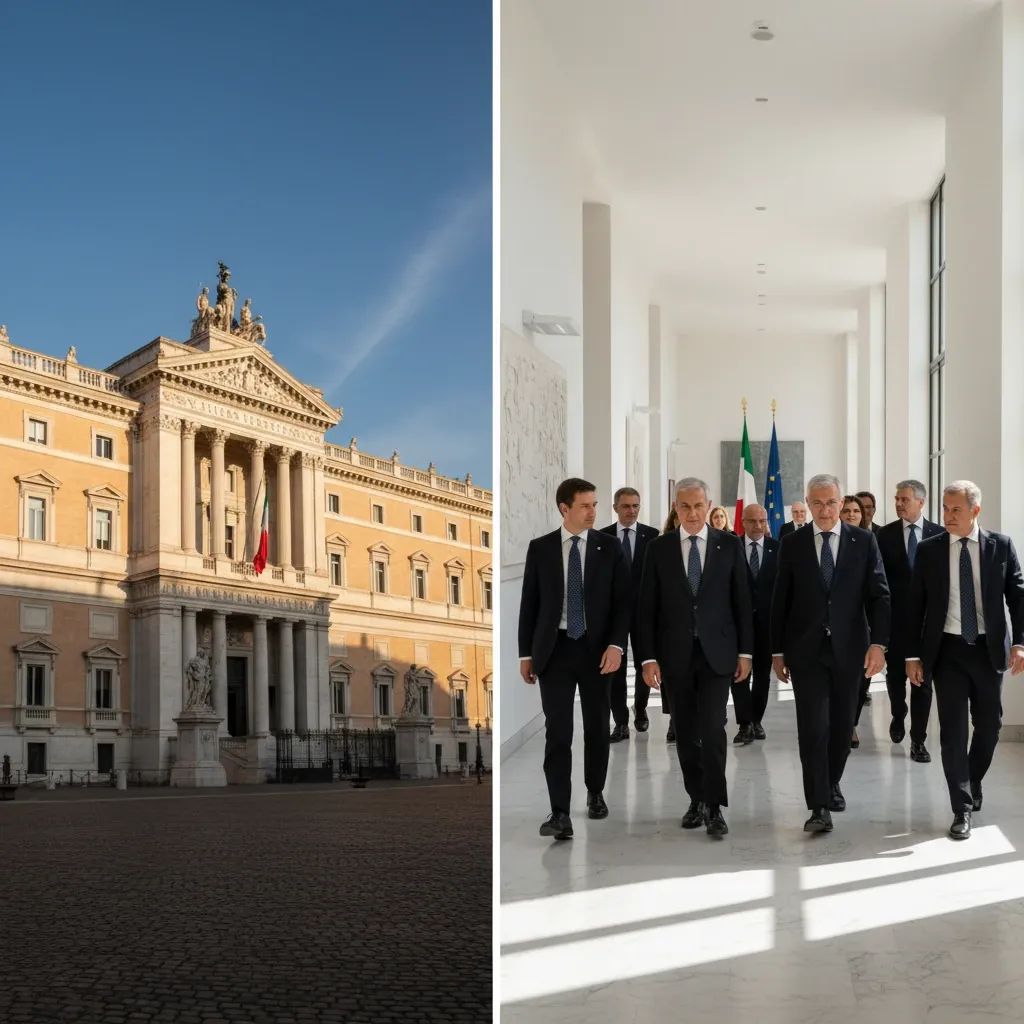
The Italy Ministry of Justice finds itself at the center of a constitutional crisis after the Quirinal Palace requested urgent clarifications on a controversial presidential pardon granted to Nicole Minetti, a former Lombardy regional councilor convicted of facilitating prostitution and embezzlement. The case has ignited fierce political backlash, with opposition lawmakers demanding Justice Minister Carlo Nordio step down and questioning Prime Minister Giorgia Meloni's silence on what they characterize as institutional negligence.
Why This Matters
• Institutional trust at stake: The Quirinal's demand for supplementary analysis suggests possible inaccuracies in the clemency dossier—a development unprecedented in Italy's modern republican history.
• Political accountability test: Opposition parties view this as a litmus test for Meloni's government, framing Nordio's position as untenable if procedural flaws are confirmed.
• Precedent for clemency oversight: The case may reshape how presidential pardons are vetted, particularly when based on humanitarian grounds involving family medical emergencies.
• What it means for Italian governance: In Italy's system, the Justice Minister bears political responsibility for ensuring accurate documentation reaches the President, who relies entirely on Ministry-provided information. This case tests whether ministerial accountability extends to investigative rigor, not just formal procedure.
The Pardon and Its Unraveling
Minetti received a presidential pardon on humanitarian grounds, citing the severe health condition of a minor family member requiring specialized medical care abroad. The decision followed standard constitutional procedure: a formal petition reviewed by the Milan Court of Appeals Prosecutor General (who issued a non-binding favorable opinion), followed by Justice Ministry evaluation and transmission to President Sergio Mattarella, who holds exclusive authority to grant clemency under Article 87 of the Constitution.
When investigative reporting by Il Fatto Quotidiano emerged, it raised alarming questions about the factual basis of the mercy request. The newspaper's inquiry suggested the minor at the center of the humanitarian claim had a biological mother residing in Uruguay, and that the reconstruction presented to secure the pardon might diverge substantially from reality. Additional scrutiny focused on Giuseppe Cipriani, Minetti's partner, and possible irregularities in his documented connections to the case.
These revelations prompted the Quirinal to take the rare step of requesting the Justice Ministry immediately acquire information to verify the accuracy of press reports—a move signaling serious institutional concern about the quality of information that reached the President's desk.
What This Means for Italy's Institutional Balance
The controversy exposes a critical vulnerability in Italy's clemency system: the President relies entirely on documentation provided by judicial authorities and the Justice Ministry, possessing no independent investigative apparatus to verify facts. When that documentation proves flawed or incomplete, the constitutional relationship between the Quirinal and the executive branch comes under strain.
Debora Serracchiani, a deputy and justice policy chief for the Democratic Party (PD), characterized the situation as "unprecedented gravity" in a statement demanding Nordio's resignation. "The pardon is an instrument of maximum constitutional delicacy that cannot be managed with improper or superficial investigations," Serracchiani argued. "The supplementary analysis requested by the Quirinal signals a level of approximation and sloppiness at via Arenula [the Justice Ministry's Rome address] never seen before."
Serracchiani's critique hinges on the concept of institutional fiduciary trust: "If false elements were submitted to the Quirinal, we would face clear evidence of superficiality in managing a proceeding of maximum constitutional sensitivity—an attitude that would amount to betrayal of the institutional trust relationship with the Quirinal, which represents the summit of our Republic and the guardian of the Constitution."
The opposition lawmaker directed her challenge squarely at Meloni: "What is Giorgia Meloni waiting for to make Minister Carlo Nordio step aside? There is no more time to lose. His permanence at the Justice Ministry is proving extremely damaging, and the department appears without guidance or control."
Political Calculus and Constitutional Precedent
The case carries echoes of past clemency controversies that have tested Italy's republican institutions. Most directly relevant is the 2006 pardon of Ovidio Bompressi, convicted in the murder of Police Commissioner Luigi Calabresi, which created constitutional friction when then-Justice Minister Roberto Castelli initially refused to countersign the decree. The Constitutional Court's Ruling 200/2006 clarified that ministerial countersignature is a mandatory act, though the minister may record dissenting views. This precedent establishes that while the President holds final authority on clemency, the Justice Minister bears political accountability for the quality of the investigative process that informs presidential decisions.
Angelo Bonelli of the Italian Left-Green Alliance (AVS) announced a parliamentary question to Nordio, emphasizing "too many shadows" and the necessity of clarifying what verification checks were actually performed. Nordio responded to Serracchiani's criticism by suggesting she "reread the article of the criminal procedure code on provisions relating to pardons"—a retort that opponents interpreted as evasive rather than substantive.
The Justice Ministry's Defense
The Italy Ministry of Justice has launched immediate verification procedures with the Milan Appeals Court Prosecutor General's Office, which originally provided the favorable (though non-binding) opinion supporting the pardon. Ministry officials maintain that standard protocols were observed throughout the clemency evaluation: a formal petition was submitted, judicial opinions were solicited, information from law enforcement and penitentiary institutions was gathered, and the minister transmitted the case to the Quirinal with appropriate observations.
Yet the Quirinal's decision to request supplementary information—an unusual step that signals dissatisfaction with the initial dossier—suggests the presidential office harbors concerns about either the completeness or the accuracy of what was presented. This creates a political problem for Nordio even if no formal procedural violations are ultimately discovered: the appearance of institutional carelessness may prove as damaging as actual malfeasance.
What Happens Next
The Justice Ministry must now complete its verification process and report findings to the Quirinal. Concrete next steps include: the ministry's response to the Quirinal's supplementary information request, ongoing parliamentary questions from opposition deputies, and potential calls for a government reshuffle if findings confirm significant inaccuracies in the original clemency dossier.
The timeline and content of the Justice Ministry's report to the presidential office will likely determine the political trajectory. For residents following Italian politics, this represents a test of whether ministerial accountability extends beyond formal procedural compliance to encompass genuine investigative rigor—a principle that could reshape how future executive decisions are vetted.


