
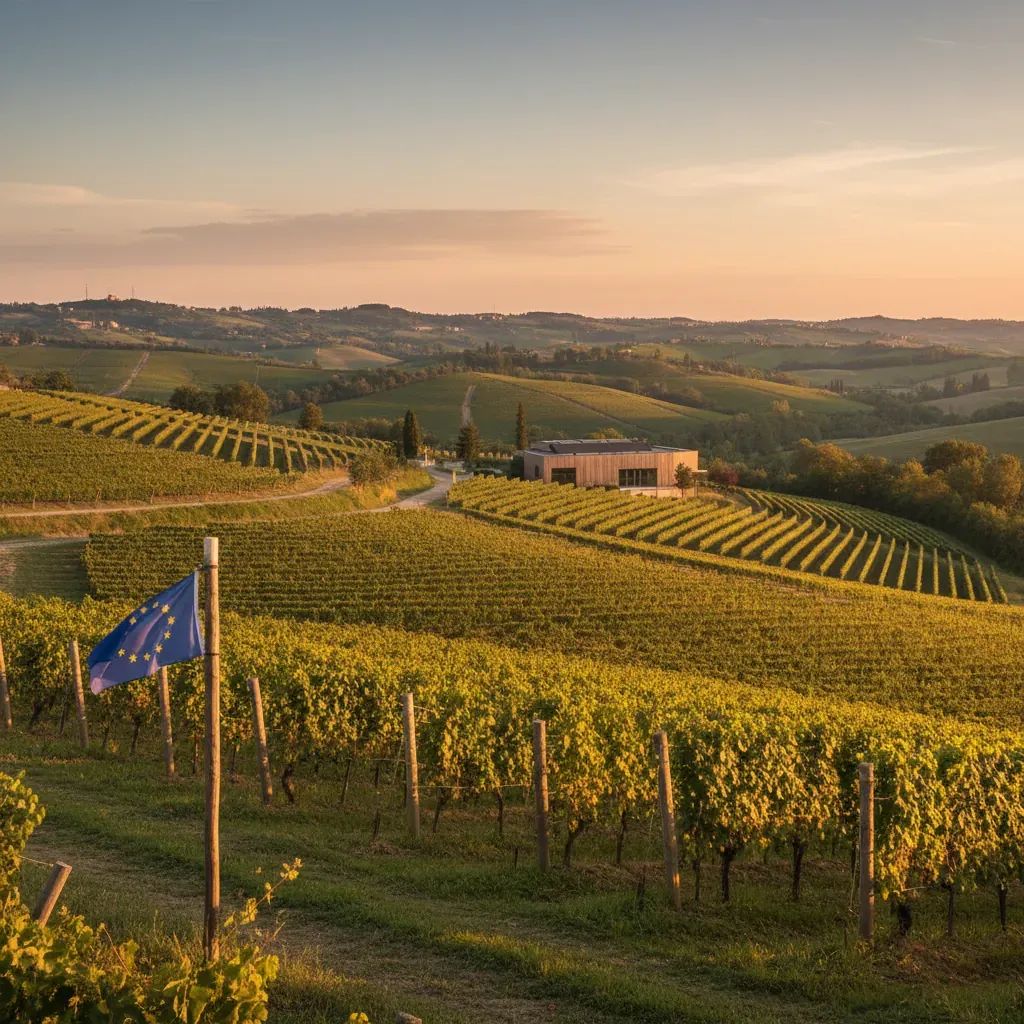
The Council of the European Union has cleared a sweeping support package for the wine industry, a decision that will unlock larger subsidies, looser planting rules and new “alcohol-free” labels—changes poised to reshuffle how vineyards, bottlers and even tourists experience wine in Italy.
Why This Matters
• €323.9 M already earmarked for Italy under the new rules—funds that regions will start allocating this spring.
• EU aid share rises to 60 % (80 % for climate projects), reducing the cash wineries must put up themselves.
• “Alcohol-free” (≤0.05 % vol) and “reduced-alcohol” wines get a legal framework; DOP/IGP bottles remain excluded.
• Enotourism finally qualifies for Brussels money, opening a nine-year funding window for tasting rooms, digital tours and events.
From Brussels to the Vineyard: The Core Reforms
At the heart of the so-called Pacchetto Vino is more than just cash. Brussels has stretched planting authorisations from 3 to 8 years, granted consortia wider powers to manage supply, and formally codified two new market segments: “alcohol-free” (up to 0.05 % vol, labelled “0.0 %”) and “reduced-alcohol” (minimum 0.5 % vol and 30 % lower than the original strength). Belgium lobbied hard to block the term low alcohol; lawmakers opted for the more sober reduced alcohol to avoid misleading health claims.
Money on the Table: Funding Streams & How to Tap Them
Italy’s Ministry of Agriculture, Food Sovereignty and Forests has divided €323.883 M in national OCM-Wine funds for 2025-26 as follows:
• €144.2 M for vineyard conversion & climate adaptation.
• €98.0 M for promotion in non-EU markets—now reimbursable at 60 % EU + 30 % national for SMEs.
• €57.7 M earmarked for cellar upgrades and efficiency projects.
Add to that the new 80 % EU ceiling for anti-climate-risk investments, and many estates will see their private outlay fall below the level of a single vintage’s marketing budget.
New Labels, New Consumers
Producers eyeing the booming “mindful drinking” niche can finally export dealcoholised bottles without legal fog. Italy, however, has confirmed that DOP and IGP wines may not be de-alcoholised—Chianti 0 % will not exist. Trade bodies such as Unione Italiana Vini worry the word reduced sounds like a fault, yet consumer studies in Germany and the US forecast double-digit growth for these styles through 2028.
Climate Insurance & Crisis Tools
Heat waves, late frosts and peronospora outbreaks cost Italian growers roughly €1 B in 2025. The new scheme lets regions cover up to 100 % of disease-prevention costs and, for the first time, finance permanent vine grubbing to stabilise oversupply. Distillation and green-harvest support is capped at 25 % of each state’s wine budget, providing a safety valve if prices collapse.
Enotourism Gets a Budget Boost
Tasting rooms, vineyard guesthouses and even augmented-reality tour apps now count as eligible expenditure. Brussels will pay 60 % for up to 3 years, renewable twice for a maximum 9-year runway—long enough to amortise a new visitor centre or multilingual booking platform. With France still number one in global wine tourism, Italy’s 400+ protected denominations see this as a strategic chance to close the gap.
What This Means for Residents
• Small wineries: Prepare grant applications before regional calls open in May; pairing climate adaptation with promotion raises the subsidy rate.• Job seekers: Expect seasonal demand for tour guides, marketing experts and precision-ag tech roles in wine districts.• Consumers: Supermarket shelves will soon feature “0.0 %” bottles; remember these cannot carry prestigious DOP/IGP seals.• Local councils: Vineyard expansion can now be phased over 8 years, easing pressure on land registries and planners.
The Road Ahead
The legislative text still awaits final legal-linguistic checks, but ministries are already aligning national decrees. First calls for projects should hit the Gazzetta Ufficiale by early summer, giving producers a narrow window to pivot strategies before the 2026 harvest. For Italy—Europe’s largest wine exporter by volume—the package is less a lifeline than a leverage tool: use it well, and the peninsula could turn climate anxiety into competitive advantage.


