
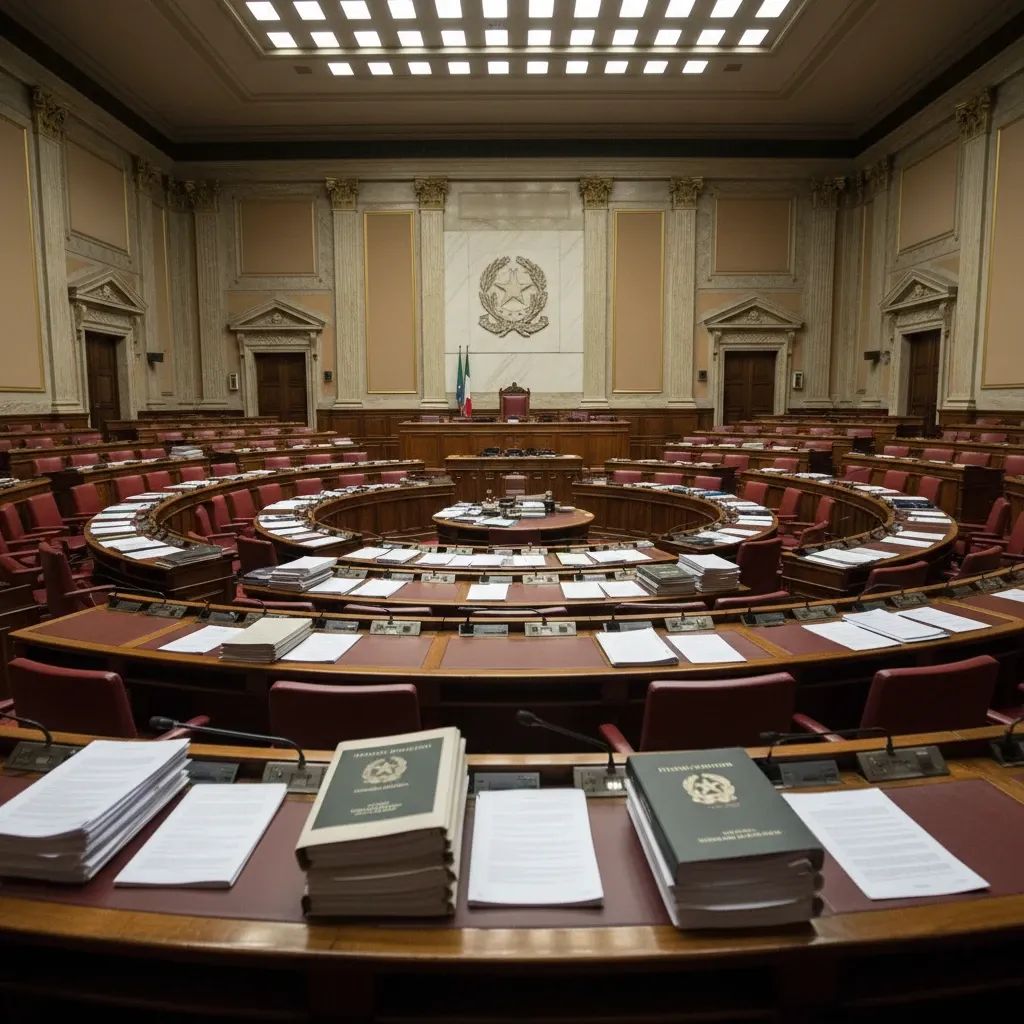
The Constitutional Standoff: What Happened
The Italian Cabinet faces a constitutional standoff with the Presidential Palace over a contested provision in its security decree. The President has raised objections to the legislation—a power granted under Article 74 of Italy's Constitution, which allows the head of state to send bills back to Parliament with reasoned concerns, though lawmakers can ultimately proceed with a confidence vote.
To understand why this matters: Italy's President serves as a constitutional guardian independent of political parties. When the President raises objections, it signals deep concerns about whether a law respects constitutional principles. The government can override these objections and continue forward, but doing so creates institutional tension and public scrutiny.
Here's the critical timeline issue: Italian decree-laws must be converted to permanent legislation within 60 days or they expire automatically—becoming null. This decree's deadline falls on April 25, Liberation Day, when Parliament is typically closed. That time pressure is driving the government's unusual two-step strategy: approve the bill through a confidence vote now, then immediately draft a corrective decree to address the President's concerns.
Why This Matters:
• The government is asking Parliament to vote on legislation the President considers constitutionally problematic, then fix it afterward via a separate decree—an unusual process that raises questions about parliamentary oversight.
• A €615 incentive scheme for attorneys assisting voluntary migrant returns remains legally uncertain while the constitutional dispute continues.
• The entire Security Decree contains measures affecting daily life, including harsher penalties for carrying blades and expanded police authority, which will become law once the Chamber completes the confidence vote.
The Controversial Provision: The €615 Lawyer Incentive
At the heart of the institutional clash sits Article 30-bis of Security Decree No. 23/2026, introduced during Senate review. The provision assigns the National Council of Lawyers (CNF) a role in voluntary assisted repatriation programs and offers attorneys approximately €615 per case—comparable to court-appointed legal aid rates but controversial because payment depends on the client actually leaving Italy.
Legal experts and magistrates warn this creates a conflict of interest that undermines the attorney-client relationship. The lawyer's fundamental duty is to represent the client's interests, but a financial incentive tied to the client leaving Italy creates competing loyalties. As one constitutional scholar summarized it: the state is asking lawyers to simultaneously defend clients' rights while being financially rewarded for those clients accepting state-desired outcomes.
President Sergio Mattarella summoned undersecretary Alfredo Mantovano to express serious reservations about the scheme. The National Council of Lawyers (CNF) immediately disavowed the provision, stating it was never consulted about its statutory role in the program and does not consider repatriation assistance within its institutional mandate. The National Association of Magistrates (ANM) echoed those concerns, describing the measure as an "attack on the right to defense."
Constitutional scholars argue the provision potentially violates principles of judicial protection and professional independence enshrined in Italy's Constitution.
The Government's Response and Two-Decree Strategy
Prime Minister Giorgia Meloni has defended the policy's underlying logic—encouraging voluntary returns—as "common sense," though acknowledging the legal mechanism requires technical adjustment.
Facing the April 25 deadline, the government opted for an unusual maneuver: push the bill through the Chamber of Deputies with a confidence vote, then immediately draft a corrective decree. Parliamentary Affairs Undersecretary Matilde Siracusano explained the government rejected amending the bill directly because that would trigger a mandatory third reading in the Senate—scheduled for April 25 itself—with no guarantee opposition parties would cooperate. Allowing the decree to expire would sink the entire security package.
The corrective decree, expected for Cabinet approval by Friday, will reportedly expand the pool of eligible recipients beyond lawyers to include mediators and civil society organizations. Critically, it will also remove the condition that payment depends on successful repatriation, addressing the President's key constitutional objection.
However, that change significantly increases budgetary requirements. The original funding allocation—€246,000 for 2026, €492,000 annually for 2027 and 2028—assumed payments only for completed departures. The Chamber Budget Committee has already raised concerns about financial coverage.
What This Means for Foreign Residents Living in Italy RIGHT NOW
If you're a foreign national considering voluntary assisted repatriation, here's what you need to know:
Current situation: Voluntary assisted repatriation programs remain operational under existing law. These programs have been part of Italian immigration policy for over a decade, typically funded through European Union instruments like the Asylum, Migration and Integration Fund (AMIF) and managed through international organizations like the International Organization for Migration (IOM).
The uncertainty: The specific provision in this decree—allowing private attorneys to receive per-case payments—is currently in legal limbo. Until the corrective decree passes and receives final approval, the rules governing attorney compensation remain unclear.
Should you wait? If you're considering voluntary return through established programs (IOM, other organizations), you can proceed. Those programs operate under existing EU-funded frameworks regardless of this decree. If you're seeking legal assistance from a private attorney regarding voluntary return, you may want to wait until the corrective decree clarifies the legal situation and removes the appearance of improper financial incentives.
When the corrective decree passes: The revised system will likely expand who can provide repatriation assistance (not just lawyers, but mediators and civil society groups) and will decouple payments from successful departures, making the relationship more straightforward and less ethically complicated.
The broader security measures: The Senate approved April 17 harsher penalties for carrying blades, treating spring-loaded knives as unlicensed weapons, and expanded police authority to issue warnings to minors. These provisions will become law once the Chamber completes the confidence vote and the decree converts to permanent legislation.
Parliamentary Chaos and Institutional Friction
Monday night's parliamentary session descended into procedural complexity when a long-anticipated corrective amendment failed to materialize by the 22:30 deadline. Opposition deputies spent Tuesday morning requesting clarification, and when none came, center-left lawmakers occupied the government benches in the chamber, forcing a suspension and emergency meeting of party group leaders.
Democratic Party Secretary Elly Schlein called it a "paradox" that Parliament was being asked to vote on an allegedly unconstitutional provision, then fix it afterward with a separate decree. Five Star Movement leader Giuseppe Conte accused the majority of creating an "institutional short circuit."
Deputy Prime Minister and Transport Minister Matteo Salvini, when asked about the Presidential Palace raising objections, responded: "Nothing surprises me anymore." Green-Left Alliance leader Angelo Bonelli criticized this as "very serious words" demonstrating the government's resistance to constitutional constraints.
The disagreement highlights a deeper tension: the government prioritizes rapid implementation of security measures, while the President and opposition emphasize proper constitutional procedure.
Constitutional Guardrails and Precedent
Italy's post-war Constitution assigns the President a non-partisan role as guarantor of constitutional order. Article 74 grants the head of state power to send legislation back to Parliament with reasoned objection; lawmakers can override by re-approving. More commonly, Presidential concerns are resolved through negotiation before formal promulgation.
In 2018, Mattarella refused to appoint economist Paolo Savona as Finance Minister, citing Eurosceptic views as incompatible with Italy's treaty obligations—underscoring the President's genuine constitutional authority.
Conflicts between branches can escalate to the Constitutional Court. While the Presidency carries political immunity, ministers who countersign acts bear legal responsibility—an accountability mechanism embedded in Italy's parliamentary system.
What Happens Next
The government's two-decree strategy avoids direct constitutional litigation but has already drawn criticism for circumventing standard parliamentary deliberation. Whether the corrective decree satisfies the President remains unclear. Quirinale sources indicate the President will "evaluate by reading the documents," and some observers suggest Mattarella may request to review the corrective text before formal approval—an unusual step signaling the gravity of his concerns.
Interior Minister Matteo Piantedosi emphasized that voluntary assisted repatriation "is certainly not an invention of this government" but has operated under EU law for over a decade. He confirmed the administration is "preparing a correction" to address constitutional sensitivities.
The episode has entered Italy's periodic institutional tensions, a reminder that even with a solid parliamentary majority, the Constitution's guardrails retain real power to shape policy outcomes.


