
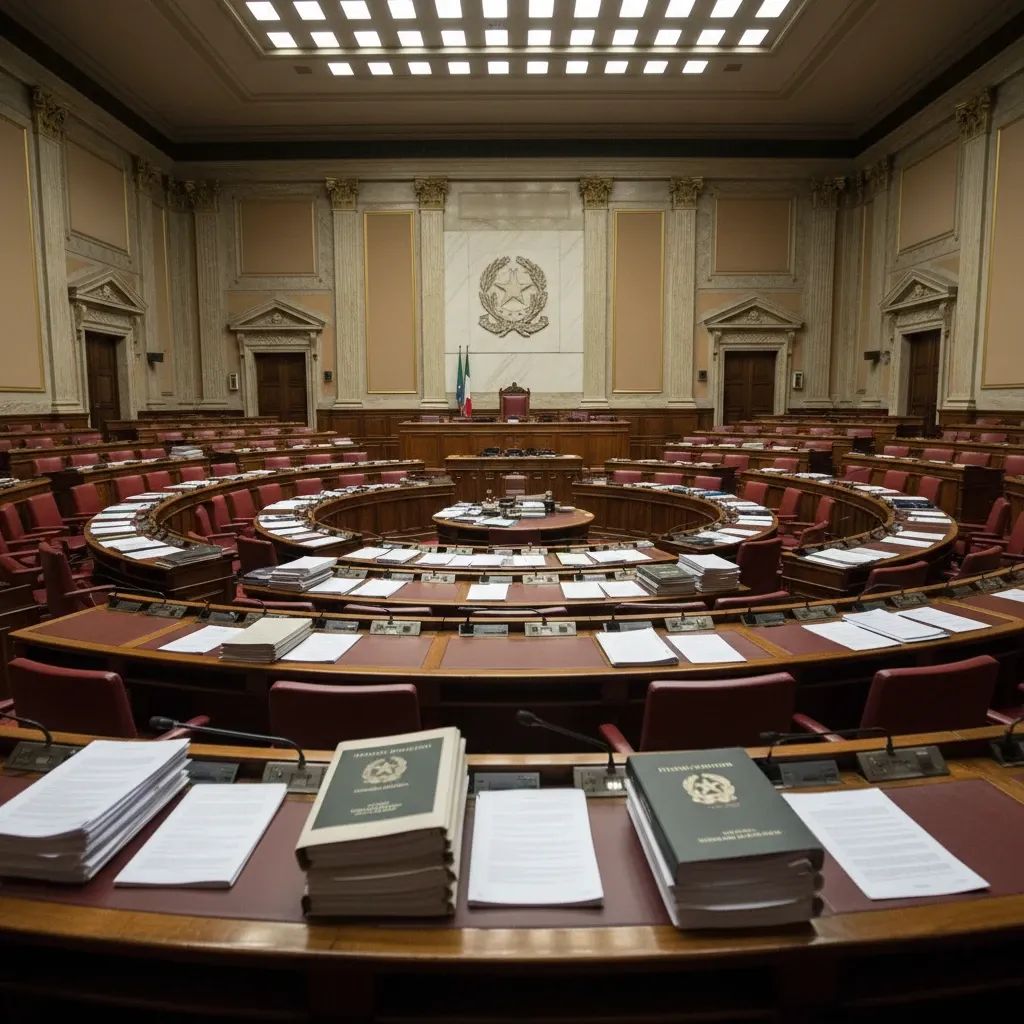
Italy's Security Decree is trapped in a constitutional quicksand. Parliament must finalize the legislation by April 25—just four days from now—but the Italian Presidency refuses to sign it unless the government removes (or fundamentally reshapes) a controversial provision that would pay lawyers €615 each time they successfully shepherd a migrant toward voluntary deportation. What began as a security measure has become a clash between executive momentum and constitutional principle, with implications that extend far beyond legal technicality into how Italian society treats vulnerable populations and safeguards the independence of its courts.
Why This Matters
• Constitutional standoff: The Quirinale (presidential office) has flagged the lawyer-payment scheme as potentially unconstitutional, threatening to block an entire 33-article decree over one disputed provision.
• Judicial independence at stake: The incentive structure creates a financial motive for legal professionals to favor deportations over defending clients' rights—a fundamental conflict of interest.
• Four-day deadline: If parliament cannot convert the decree by April 25 (Liberation Day), the entire package expires, forcing the government to start from scratch or accept partial defeat.
The Core Problem: Misaligned Incentives
At the heart of the standoff lies a deceptively simple idea with troubling implications. The contested Article 30-bis offers €615 to any lawyer who provides consultation to a migrant choosing voluntary repatriation—but only if the migrant actually departs. On paper, it seems symmetrical: Italy already funds free legal counsel (gratuito patrocinio) for migrants contesting expulsion orders, so compensating lawyers who facilitate willing exits appears logically sound. Prime Minister Giorgia Meloni made this exact argument while touring the Salone del Mobile design fair in Milan, speaking with evident frustration about opposition objections.
But the legal profession and constitutional guardians see a different picture. The Consiglio Nazionale Forense (CNF), Italy's bar association, has declared it was never consulted about the arrangement and does not consider administering such payments part of its institutional role. More fundamentally, Confprofessioni, the Organismo Congressuale Forense, and the Unione Camere Penali (criminal law chambers) have all flagged the same concern: tying a lawyer's fee to the outcome of a case—in this case, whether a client departs—creates a structural conflict between the attorney's financial interest and the client's interests.
This is not abstract theory. A lawyer paid €615 upon successful deportation faces an inherent pressure to encourage departure, even when that client might have legitimate grounds to challenge an expulsion order or seek alternative legal status. The independent counsel—historically considered essential to the rule of law—becomes a quasi-agent of state migration policy.
Interior Minister Matteo Piantedosi pushed back against this framing during remarks to the Chamber of Deputies, noting that assisted voluntary repatriation programs have existed in Italy for over a decade under European law. "These are not an invention of this government," he said, promising that technical corrections would address concerns while the core policy remained intact. Yet Piantedosi did not address the specific constitutional worry: that compensating lawyers based on deportation outcomes differs fundamentally from supporting neutral legal counsel or funding voluntary-return logistical support.
Presidential Objections and the Constitutional Squeeze
On Monday, Cabinet Secretary Alfredo Mantovano carried the decree to the Quirinale for presidential signature. President Sergio Mattarella refused, citing what sources describe as "irragionevolezza" (unreasonableness) in subordinating lawyer compensation to a specific result rather than the provision of professional services. The objection echoes concerns previously raised by the Ministry of Justice and Ministry of Economy, both of which issued negative opinions before the decree reached Mattarella's desk.
The presidential stance rests on Article 24 of Italy's Constitution, which guarantees the right to legal defense in proceedings. That right—a bedrock principle of democratic governance—is hollow if the defender's financial incentive pulls in the opposite direction of the client's interests. Mattarella has consistently framed migration policy within the context of Italy's constitutional and international legal obligations, warning in past public statements that the state cannot sacrifice fundamental protections in pursuit of administrative goals.
This creates an acute dilemma. The decree, approved by the government on February 5 and signed by Mattarella 19 days later, must become law by April 25 or it lapses entirely. Parliament cannot amend the text in time because the legislative window is too narrow. Yet the president will not sign a decree that retains the lawyer-payment provision in its current form. The only escape hatch: a separate legislative measure introduced after the April 25 conversion that would modify the problematic rule while allowing the main decree to pass untouched.
Meloni signaled acceptance of this workaround. "We're collecting technical considerations from the Quirinale and from the legal profession, and we'll transform those into an ad hoc measure," she told reporters, her tone suggesting this was a reasonable bureaucratic adjustment, not a constitutional retreat. Yet her insistence that "the measure remains" also revealed her determination to preserve the core policy, suggesting whatever "corrections" emerge may amount to cosmetic refinement rather than substantive change.
Parallel Systems and the Erosion of Legal Aid
The lawyer-payment dispute is not isolated. Buried deeper in the decree is another provision that strips free legal aid from migrants whose asylum claims have been rejected if they wish to appeal expulsion orders. This creates a two-tier system: those fighting expulsion go undefended because the state no longer funds their counsel; those accepting departure find themselves assigned lawyers financially incentivized to see them go.
Together, these provisions reshape the legal landscape for some of Italy's most vulnerable residents. A migrant denied asylum protection faces a choice: appeal the decision without financial means to hire a lawyer, or accept deportation and provide a pathway for state-compensated counsel to facilitate the exit. Either way, the deck is stacked.
The decree also hardens criminal penalties. Building occupations now carry sentences of up to seven years imprisonment; blocking roads or railways draws sentences of up to six years. For police officers accused of crimes, a new provision creates a separate investigative registry for cases invoking "justifiable cause" (causa di giustificazione), shielding officers from standard criminal procedures. Protesters face up to 12 hours of preventive detention if authorities deem them a threat at demonstrations, regardless of whether any crime has occurred.
How Europe Handles Voluntary Returns
Italy is not inventing assisted voluntary repatriation. The European Union has embedded such programs in its migration framework for nearly two decades. The Returns Directive (2008/115/CE) mandates that once removal orders are issued, member states grant migrants up to 30 days to leave voluntarily. The EU Asylum, Migration and Integration Fund (FAMI) finances related programs. The European Commission adopted a formal Strategy on Voluntary Return and Reintegration in 2021, reinforced by the New Pact on Migration and Asylum (2024) and a proposed common return system framework from March 2025.
However, no other EU member state known to operate assisted voluntary repatriation programs has introduced a payment structure directly linking lawyer compensation to deportation outcomes. Most programs provide travel vouchers, reintegration grants in countries of origin, and logistical support—but they do not financially incentivize legal professionals based on whether clients actually depart. The distinction matters because it speaks to how different democracies weigh administrative efficiency against professional independence.
Parliamentary Breakdown and Political Deadlock
The dispute boiled over into chaos on the chamber floor. Opposition deputies physically surrounded and occupied the government benches during a procedural vote on Tuesday, prompting the Chamber president Fabio Rampelli to expel Democratic Party deputy Arturo Scotto and suspend proceedings. The occupation was symbolic but revealing: opposition lawmakers wanted to make a physical statement that the government's procedural acceleration was suffocating scrutiny.
Democratic Party Group Leader Chiara Braga demanded a full leadership conference before work resumed. "We cannot proceed without clarity," she said. Did the government intend to strip the provision from the decree, or push it through anyway? The Five Star Movement (M5S), Green and Left Alliance (AVS), and Più Europa all echoed her demand. AVS deputy Marco Grimaldi asked bluntly: "Will this amendment exist or not? We're asking you to pause."
The breakdown reflects broader frustration with how the decree was fast-tracked. Time constraints meant the government bypassed normal amendment procedures, forcing through a package riddled with last-minute provisions and technical problems. When the presidential office objected, there was no procedural valve to release pressure—only the option of passing the decree whole or letting it collapse.
The Government's Calculus Moving Forward
Meloni has made her position unmistakable: the lawyer-payment mechanism will survive in some altered form. "It's a common-sense measure, and frankly, I'm surprised by the opposition's reaction," she said. The government's strategy appears to be securing presidential sign-off on the main decree by April 25, then pursuing a separate corrective instrument that technically satisfies the Quirinale's constitutional concerns while preserving the underlying policy objective.
Whether that maneuver will work depends on how the presidential office responds. If the government introduces minor tweaks—say, eliminating the CNF's formal role or adding language about "professional discretion"—Mattarella may accept the compromise. But if the revised provision still ties lawyer compensation to deportation outcomes, the core constitutional problem remains unresolved.
Interior Minister Piantedosi confirmed the government was "preparing a correction," language suggesting a fix was in motion. Yet he provided no detail about what that correction would entail, leaving all parties guessing whether meaningful change was coming or merely rhetorical window-dressing.
What Happens Next
The next 96 hours will test whether Italy's constitutional guardrails can withstand political pressure from an executive determined to pass security legislation. If the decree lapses, the government loses a package it has invested political capital defending. If the government and Quirinale reach a compromise, that compromise becomes a precedent for how future disputes over migration and judicial independence are resolved. If the government pushes through anyway and the presidential office yields, constitutional objections are effectively overruled by executive determination.
For residents of Italy—whether Italian citizens, migrants, or foreign workers—the outcome will shape how aggressively state policy can reshape legal counsel's role in migration proceedings, how long demonstrators can be detained without charge, and whether occupants of abandoned buildings face felony charges or administrative removal.
The decree is nominally about security. But its real subject is the boundary between administrative efficiency and constitutional constraint—and whether that boundary still holds when the pressure is on.


