
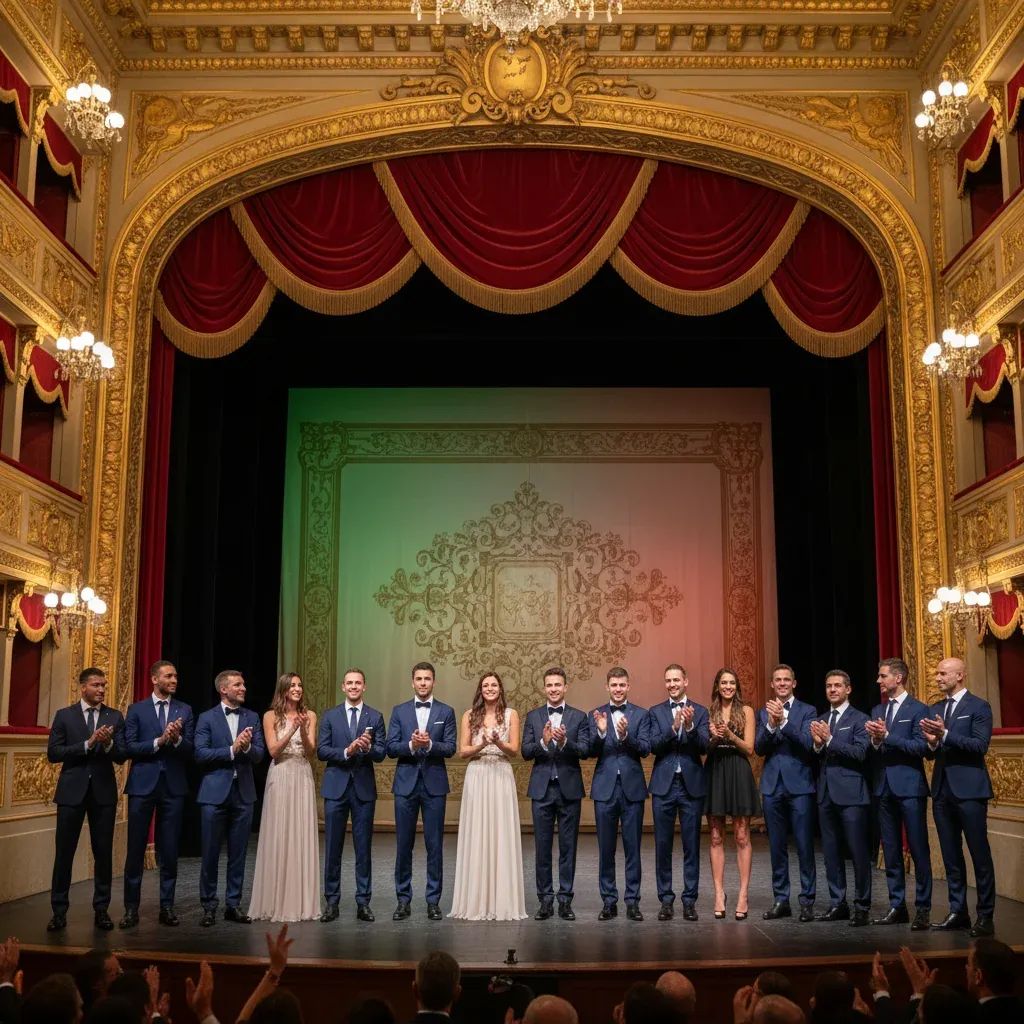
Italy's winter sports elite will converge on the Ariston stage on Wednesday, February 25, just as the nation enters the final countdown to its Paralympic Games. The Italy state broadcaster Rai has confirmed that three Olympic gold medallists—short-track speed skater Arianna Fontana, speed skater Francesca Lollobrigida, and biathlete Lisa Vittozzi—will appear alongside four Paralympic athletes during the Sanremo Festival's evening broadcast (the appearance is scheduled for the evening slot on Rai 1), marking a rare collision of athletic achievement and entertainment television.
The Sanremo Festival runs through Saturday, February 28, 2026, and the Wednesday evening slot typically attracts millions of viewers across Italy.
Why This Matters
• Italy's most-decorated Olympic athlete takes the Sanremo stage: Fontana now holds 14 Olympic medals, surpassing every other Italian athlete in Olympic history across all sports and eras.
• A deliberate media strategy to amplify Paralympic visibility: By positioning Paralympic athletes alongside freshly crowned Olympic champions on Italy's most-watched television event, Rai is working to channel Olympic momentum into support for the Games starting March 6.
• The appearance happens just 11 days before the Paralympics open: This timing is no accident—it creates a bridge between the Olympic closing energy and the adaptive sports competition ahead.
The Record-Breaker and Her Teammates
Fontana's presence carries particular weight. The 35-year-old Lombard overcame an injury suffered last autumn to return to competition this winter with striking results. At the European Championships in Tilburg this past January, she claimed gold in the 1500m short-track event—her first continental title in that distance since 2017. Then at Milano Cortina itself, she added three more medals to her already formidable tally: two silvers in the 500m and the women's 3000m relay, plus gold in the mixed-team relay. That final gold in the relay pushed her career total to 14, an achievement that fundamentally reshapes Italian Olympic history. For context, the previous record holder had 10 medals. Her selection as Italy's opening ceremony flag-bearer underscored her status as the country's defining Winter Olympian.
Lollobrigida, equally 35, captured gold in both the 5,000m and 3,000m speed skating events. Her trajectory itself tells a story worth examining: she transitioned from inline skating into long-track speed skating relatively late in her athletic life, yet achieved Olympic gold. Vittozzi, at 31, delivered a breakthrough for Italian women's biathlon by winning the nation's first individual Olympic gold medal in the 10km pursuit—a victory that punctured the Nordic and German dominance that has historically defined the sport.
The Paralympic Contingent Takes Shape
Wednesday's stage will also host Paralympic athletes whose achievements deserve equal prominence. Giacomo Bertagnolli, competing with severe visual impairment, brings four Paralympic gold medals from previous Games. At Beijing 2022, paired with sighted guide Andrea Ravelli, the duo captured two golds and two silvers—evidence of the technical precision required in adaptive Alpine skiing. Wheelchair curler Giuliana Turra completes the group invited to the Ariston.
These athletes represent the starting line for Italy's Paralympic delegation. The Federazione Italiana Sport Invernali Paralimpici formally presented the squad on February 20 in Milan, where the 40 athletes plus three additional guides were introduced to media and selected public representatives. They will compete across six disciplines in the upcoming Games. Among them, Giuseppe Romele stands out. The cross-country skier took bronze at Beijing 2022 and recently won the World Cup 10km Mass Start Classic—a victory that demonstrates Italy possesses genuine medal contenders in adaptive skiing. Para ice hockey has already scheduled preparation matches against Canada on February 25 and 27, with the team entering the Olympic Village on March 1 and facing the United States in their inaugural Paralympic contest on March 7.
Understanding Sanremo's Reach and Cultural Function
The Ariston Theatre commands an audience that few other broadcasts in Italy—or Europe—consistently achieve. Wednesday's evening broadcast typically attracts over 10 million viewers across Rai 1, making Sanremo the kind of cultural phenomenon that transcends entertainment. The festival has run annually since 1951 and serves as a collective experience in an era where media consumption has otherwise fragmented across countless platforms.
Historically, Sanremo accommodates multiple types of achievement within a single evening: musical competition, political appearances, celebrity moments, and cultural landmarks. This Wednesday marks the continuation of that tradition. The athlete appearances integrate naturally into a format designed to reflect what Italy considers worthy of national attention and celebration. The musical acts will perform alongside the athletic narratives, creating an unusual but deliberate juxtaposition that has defined Sanremo's identity for decades.
The Strategic Timing for Paralympic Promotion
Paralympic Games consistently underperform Olympic events in television viewership across most countries—a pattern Italy mirrors. By placing Paralympic athletes on Sanremo's stage alongside Olympic champions who are still riding waves of national acclaim, Rai is attempting to compress the typical attention gap that favors Olympic Games. The athletes themselves function as advocates carrying forward the narrative momentum that Milano Cortina generated.
For residents of Liguria, particularly those in Sanremo itself, the festival generates measurable economic impact through hotel occupancy, restaurant traffic, and intensified security operations throughout the coastal city through Saturday's finale. For the broader Italian audience, Wednesday offers an intimate encounter with athletes who ordinarily appear only in competitive settings—a chance to witness their personalities in a non-sport context, to hear them speak about their achievements in their own words.
Why This Appearance Matters Beyond Entertainment
The convergence of Olympic champions with Paralympic athletes on Sanremo's stage functions as a statement about Italian sporting identity. It acknowledges that elite competition encompasses both Olympic and Paralympic disciplines—a principle that funding agencies, broadcasters, and governing bodies increasingly emphasize but that the general public has been slower to internalize.
Fontana's Olympic medal record establishes her as one of Italy's most accomplished athletes across any discipline. Yet her appearance at Sanremo serves another purpose: it humanizes elite achievement. The athlete who wins medals in competitive venues becomes, for an evening, part of popular culture. That transformation matters for how Italy understands excellence and dedication.
The Paralympic athletes' presence carries equal significance. Bertagnolli's partnership with guide Ravelli demonstrates the technical sophistication of adaptive sports—the precision, the coordination, the training required. For viewers watching on Wednesday evening, that message may register more powerfully than any written explanation could achieve.
The Broader Context of Winter Sport in Italy
Milano Cortina marks the third time Italy has hosted the Winter Olympics—Cortina d'Ampezzo in 1956, Turin in 2006, and now the current Games. Each hosting has accelerated infrastructure development across the regions involved. This time, improvements span Lombardy and Veneto, including renovated Alpine facilities, enhanced rail connectivity between Milan and mountain venues, and expanded accessibility features mandated by the International Paralympic Committee. These investments position Italy's winter sports ecosystem for sustained competitive advantage in future Olympic cycles.
The Paralympic Games (March 6-15, 2026) will generate significant economic activity across the Lombardy and Veneto regions, with visitor influx estimated at comparable levels to the Olympic period, driven by domestic and international accessibility tourism and local engagement. Many Italian residents can attend events directly—tickets for Paralympic competitions remain available through the official Milano Cortina ticketing platform, with pricing tiers designed to encourage local participation, particularly for residents of northern Italian regions.
Fontana's career spanning from Vancouver 2010 through Milano Cortina 2026—five Olympic cycles—reflects the institutional commitment required to develop elite short-track speed skaters. Year-round facility access, specialized coaching, structured development pipelines: these investments compound across decades. Her journey from youthful prodigy to record-setting veteran illustrates how sustained support creates sustained excellence.
What Happens Next
The Sanremo Festival runs through Saturday night, February 28, with the final evening traditionally capturing the week's largest audience. The musical competition winner will represent Italy at the Eurovision Song Contest, maintaining Sanremo's established role as a launching pad for international cultural visibility. For the athletes, Wednesday's appearance represents the final major media moment before Olympic attention fully transitions to Paralympic competition.
The Paralympic torch relay runs February 24 through March 6 (opening day), with the relay route passing through major Italian cities including Rome, Florence, and Milan, before concluding at the Arena di Verona. Residents in these urban centers can view the torch relay in their cities—check official Milano Cortina channels for exact dates and times for your location. The Opening Ceremony takes place at the Arena di Verona on March 6 at 7 PM. Tickets for the Opening and Closing Ceremonies are available through the official ticketing platform and remain the primary in-person viewing option for residents unable to attend competition events.
Within two weeks of appearing at Sanremo, Fontana, Lollobrigida, Vittozzi, Bertagnolli, Ravelli, and Turra will transition from entertainment television to their supporting roles within Italy's Paralympic campaign. Whether their Wednesday evening appearance genuinely shifts public attention toward adaptive sports will become clear in the weeks ahead. For residents interested in following the entire Paralympic journey, coverage will be broadcast on Rai 2 and Rai Sport, with live streaming available through RaiPlay.


