
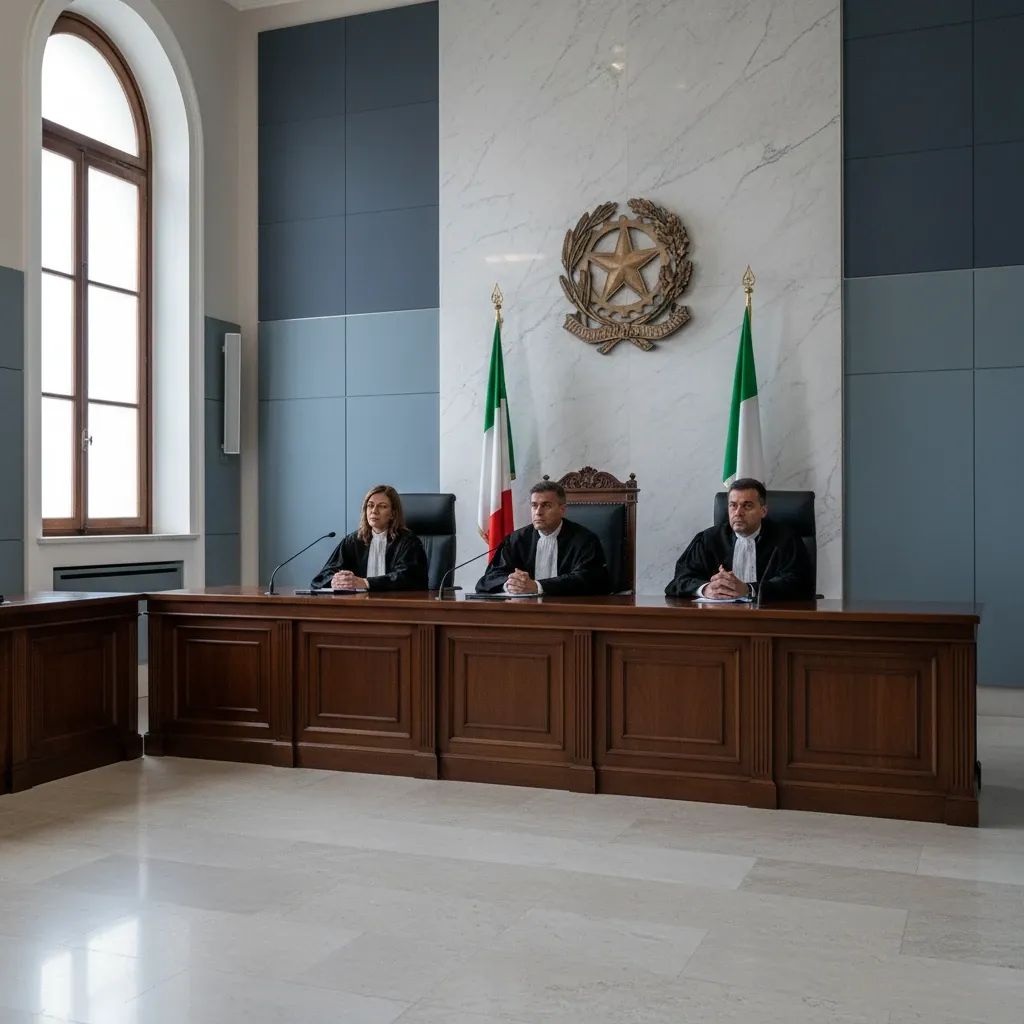
The Italian Parliament's lower chamber has passed a confidence vote on the government's controversial security decree with 203 votes in favor, 117 against, and 3 abstentions, setting the stage for final approval while simultaneously triggering an extraordinary legal maneuver to address constitutional concerns raised by President Sergio Mattarella.
The decree, formally designated as Decree-Law 23/2026 and published in the Gazzetta Ufficiale on February 24, 2026, represents one of the most comprehensive public security overhauls in recent years, with provisions spanning urban crime prevention, police powers, and immigration enforcement. Yet its passage has been overshadowed by an unprecedented parliamentary dance: on Friday, April 25, 2026, as deputies cast their final votes, the Council of Ministers will convene in a government room inside Montecitorio itself to approve a corrective decree modifying the law's most contentious provision before the ink is even dry.
Why This Matters
• Legal limbo for lawyers: A €615-per-case incentive for legal professionals assisting voluntary migrant returns has triggered warnings of professional ethics violations and potential unconstitutionality.
• Presidential intervention: The Quirinale's objections have forced the government into an unusual two-decree choreography to avoid formal rejection.
• Immediate enforcement: New rules on knife possession, youth violence prevention, and "differentiated arrest" for protest-related crimes took effect in late February and directly affect daily life across Italy.
• Budget uncertainty: Expanding the incentive program to mediators and NGOs—and paying out regardless of outcome—has left the Economy Ministry scrambling to find coverage as costs balloon.
The Flash Point: Paying Lawyers to Facilitate Deportations
At the heart of the political firestorm is Article 8-bis, which originally earmarked €615 per successful procedure for attorneys who assist irregular migrants in applying for assisted voluntary return (AVR). The government framed this as a pragmatic measure to accelerate the repatriation process, pointing to only 2,500 successful AVR cases between 2023 and 2025.
Legal and judicial bodies reacted with alarm. The National Forensic Council (CNF) publicly declared it had never been consulted and demanded removal of any reference to its involvement, arguing the scheme falls outside its institutional mandate. The Union of Italian Criminal Chambers (UCPI) went further, labeling the provision an "apology for unfaithful representation"—a potential breach of the ethical duty to act solely in a client's interest, not the state's policy goals.
The National Association of Magistrates (ANM) echoed this "bewilderment," warning that tying lawyer compensation to deportation outcomes creates a textbook conflict of interest and undermines the Article 24 constitutional guarantee of effective legal defense. Opposition lawmakers pointed to two criminal statutes potentially triggered by the arrangement: unfaithful legal representation and corruption.
Economy Minister Giancarlo Giorgetti acknowledged the problem obliquely when questioned about budget allocations for the expanded program. "We are working on it," he told reporters. "I cannot predict the outcome of the State Accounting Office's review, which will be rigorous and serious as always."
What This Means for Residents
For anyone living in Italy—whether citizen, resident, or migrant—the security decree introduces tangible shifts in law enforcement and daily regulation:
Urban Security & Possession OffensesCarrying knives or pointed instruments now triggers mandatory confiscation and harsher penalties. Online sellers must implement electronic traceability for blade sales, and selling such items to minors is prohibited. Pickpocketing of specific items—payment cards, identity documents, smartphones, and computers—is now prosecutable ex officio (meaning police can act without a formal complaint from the victim).
Youth Violence & Parental LiabilityPolice prefects can issue formal warnings (ammonimento—official cautions) to minors involved in assault, brawling, threats, or intimidation when weapons are present. Parents face administrative sanctions if minors repeat violent or stalking behavior, embedding accountability into family law.
Protest & Public OrderAuthorities gained powers to impose Daspo urbano (urban access bans that restrict individuals from specific neighborhoods hit by serious crime). Officers may detain individuals deemed a threat to peaceful demonstrations for up to 12 hours without charge. Penalties for failure to notify authorities of planned protests have increased sharply, and police can execute "delayed flagrante delicto" arrests for property damage during rallies and dangerous fleeing.
Immigration EnforcementBeyond the lawyer incentive controversy, the decree facilitates ship detentions for NGO rescue vessels and streamlines deportation procedures. It also abolishes automatic legal aid for expulsion proceedings, regardless of income, effectively pricing many migrants out of legal representation.
The Quirinale Objection and the Two-Decree Solution
President Mattarella's reservations were never formalized as a veto but were communicated through back-channels as "manifest distortions" in the attorney compensation scheme. The presidency's institutional role—Mattarella "speaks through acts"—leaves final judgment for the moment of promulgation, when he must sign, return, or append observations.
Interior Minister Matteo Piantedosi confirmed the government's strategy: "We have always held Quirinale observations in the highest regard. The provision retains utility and dignity—relaunching assisted voluntary return programs already conducted with humanitarian organizations—and we will proceed according to the observations received."
The corrective decree will broaden eligibility beyond lawyers to include mediators and humanitarian associations, and crucially, will award the €615 fee regardless of whether the migrant ultimately departs. This expansion substantially inflates projected costs, complicating the budget arithmetic that the Ragioneria Generale dello Stato must certify before the decree can advance.
Parliamentary insiders expect Mattarella to evaluate both texts—original and corrective—by Saturday, April 26, 2026, the constitutional deadline before the decree would lapse.
Political Battle Lines
Opposition parties have attacked the package as "propaganda legislation" marred by "institutional clumsiness."
Democratic Party leader Elly Schlein accused the government of "racing to approve a norm they'll have to correct one minute later, and only thanks to the Quirinale's intervention—otherwise they would have barreled ahead."
Five Star Movement leader Giuseppe Conte took the floor in the Chamber for a frontal assault on Prime Minister Giorgia Meloni: "You called this 'common sense,' yet it configures two crimes: unfaithful representation and corruption. You are compelling lawyers to commit two offenses! This is a desperate attempt to patch over your failures on flow management—320,000 landings, rescues, deportations, and the Albania centers debacle."
Debora Serracchiani, the PD's justice spokesperson, termed the rule "manifestly unconstitutional," while Riccardo Magi of Più Europa called it "yet another affront to the Constitution."
The center-right coalition held firm. League deputy Gianangelo Bof dismissed claims of scandal: "This isn't a crime—it's parity. We provide free legal aid for those who appeal to stay even without the right, yet we balk at a contribution for those who freely choose to return home."
Forza Italia struck a more cautious tone. Spokesman Raffaele Nevi said, "We believe it was right to hear the lawyers, who raised valid points. Now we will evaluate the new proposal on its merits."
European Context and the Voluntary Return Debate
Italy's controversial incentive arrives amid broader European momentum toward tougher return policies. On March 26, the European Parliament adopted a new EU Returns Regulation by 389 votes to 206, streamlining expulsion procedures and explicitly supporting "return hubs in third countries." Detention periods can now extend to 24 months in certain cases, and left and center parties voted against while right-wing blocs allied with far-right groups to push the measure through.
Caritas and Amnesty International have condemned this European-wide shift, with Caritas warning the regulation "stigmatizes and criminalizes migrants further," while Amnesty called it a "new low" for migrant treatment in Europe.
Assisted voluntary return programs have become increasingly common across the continent—expanding from five schemes in 1995 to 35 by 2011, largely coordinated by the International Organization for Migration (IOM). Yet scholars and NGOs challenge whether these programs are truly "voluntary," noting that for many migrants, the only alternative to assisted return is forced deportation, making consent effectively coercive.
The Road Ahead
After left-center deputies staged a symbolic occupation of the hemicycle, the Chamber faces two more days of heated debate before the April 25, 2026 deadline. Final passage will convert the decree into law—but only if the corrective decree clears the Council of Ministers in time and survives Mattarella's scrutiny.
The dual-decree tactic is without recent precedent in Italian legislative practice, underscoring both the political urgency the government attaches to the package and the institutional friction generated by the attorney provision. Legal scholars note that if Mattarella declines to sign either text, the entire edifice could collapse, forcing a restart that would allow the original February decree to lapse.
For Italy's legal community, the episode has crystallized long-standing concerns about erosion of professional independence in the face of executive policy objectives. For migrants and advocacy groups, it signals a hardening enforcement posture that pairs new penalties with reduced access to representation. And for residents navigating daily life in Italian cities, the decree's knife bans, youth sanctions, and protest restrictions represent the most tangible shifts—rules already in force as the political drama plays out behind closed doors at Montecitorio.


