
April 25 Exposes Italy's Unfinished Reckoning With Its Past
As Italians prepare to mark the 81st anniversary of Liberation Day on Saturday, the nation's political establishment is fracturing over a fundamental question: what does it actually mean to celebrate freedom from fascism? The answer coming from Rome's parliament and streets suggests the country remains deeply divided, with some openly rejecting the antifascist consensus that has underpinned Italian democracy since 1945. For residents living in Italy, April 25 is far more than historical commemoration—it is a national holiday deeply embedded in civic life and political identity, shaping contemporary political discourse and institutional practice.
Why This Matters
• Constitutional stakes: The ability to commemorate the Resistance without controversy has become a metric for how—or whether—Italy's political leadership accepts the democratic order itself.
• Public safety concern: Neofascist graffiti campaigns targeting Resistance memory in Rome and elsewhere suggest organized efforts to delegitimize the founding values of the republic.
• Educational spillover: How politicians frame April 25 directly influences school curricula, regional funding priorities, and the framing of fascism in Italian civic life.
When Parliament Became a Battlefield
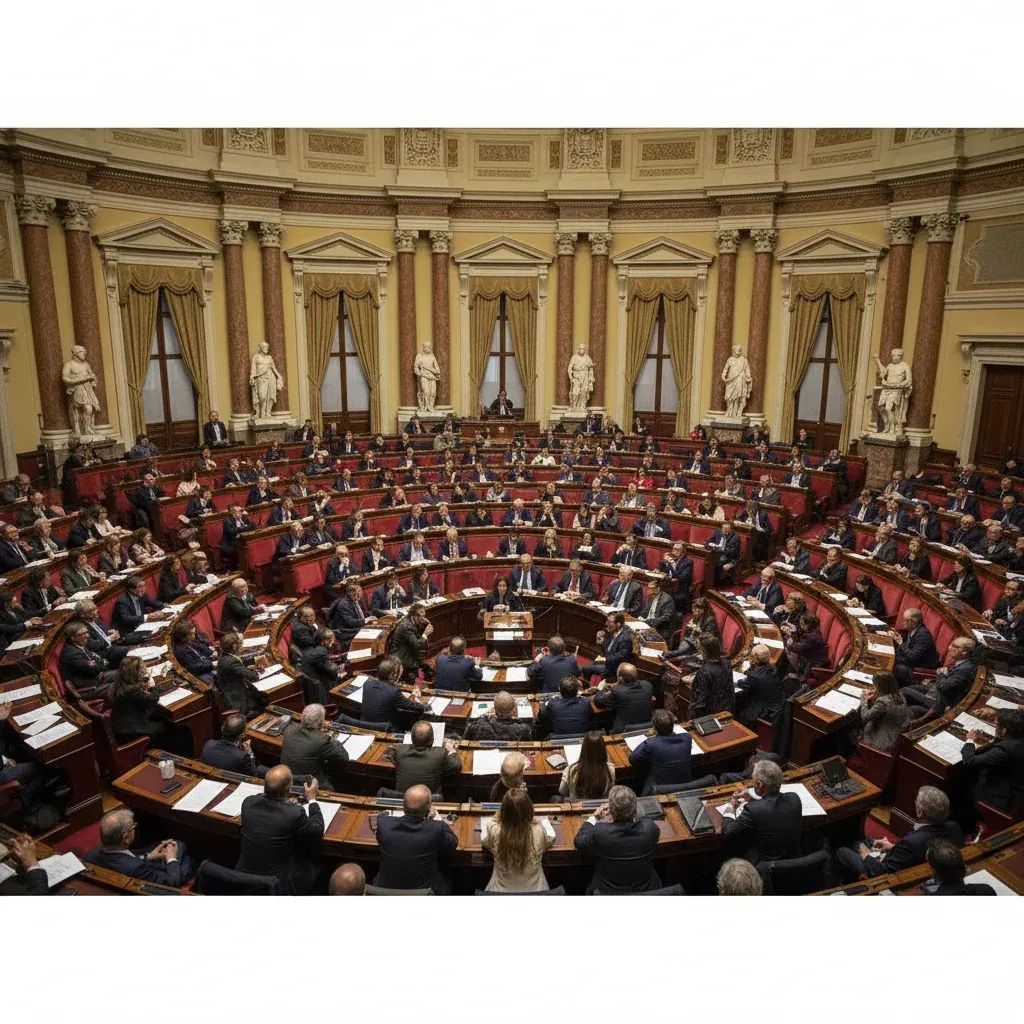
The chaos began where it rarely does: in the Chamber of Deputies on Thursday morning, during what should have been routine legislative work. Three opposition lawmakers—Marco Grimaldi (Avs), Chiara Gribaudo (PD), and Bruno Tabacci—started singing Bella Ciao, the revolutionary anthem of the Italian Resistance. The melody spread like flame across the left-wing benches, swelling into a full chorus. For those in the chamber, the moment carried emotional weight; for observers elsewhere, it signaled something more troubling: that ordinary legislative business could barely contain the pressure of competing historical narratives.
The governing coalition's response was immediate and defiant. Lawmakers broke into Il Canto degli Italiani—the national anthem—and rose to their feet. The chamber became a choral stage, with most of the Brothers of Italy (FdI) and Forza Italia members standing. But not everyone. League party deputies remained seated. So did Deputy Prime Minister Matteo Salvini, Interior Minister Matteo Piantedosi, and Undersecretary Nicola Molteni. The symbolism was unmistakable: a point-blank refusal to participate in a ritual meant to bind the nation together.
Salvini later characterized the opposition's singing as a breach of decorum. "We came here for the security decree, not a concert," he said. "I respect the national anthem, but singing Bella Ciao looks like disrespect." The statement reveals the fault line: for the left, Bella Ciao channels the Resistance's universal aspiration—freedom from tyranny. For Salvini's League and sympathetic circles, the song carries partisan baggage, a coded assertion of communist or socialist dominance over how Italy's founding story is told.
The ANPI Scarf as Political Statement
Chiara Braga, the PD's parliamentary group leader, appeared on the chamber floor wearing an ANPI (National Association of Italian Partisans) scarf—a deliberate choice that no lawmaker makes by accident. "April 25 divides only those harboring nostalgia we will never accept," she declared. The language was pointed. By "nostalgia," she meant those who, in some form, regret fascism's defeat. By saying "we will never accept" it, she was drawing a line: either you are antifascist or you are outside the legitimate political consensus.
Gianfranco Rotondi (FdI) countered: "This center-right government needs no exam on April 25. You sing to divide." Nicola Fratoianni (Avs) responded: "Calling Bella Ciao divisive reveals the hypocrisy of your appeals to unity." What unfolded was not debate but competing claims to national legitimacy—a struggle over whether the Resistance belongs to all Italians or chiefly to those who fought fascism.
This matters in concrete ways. Brothers of Italy traces its organizational lineage through the post-fascist Italian Social Movement (MSI), founded by former officials of Mussolini's puppet Italian Social Republic (1943-1945). While Meloni has worked to distance her party from those origins, the historical association remains a political scar. When ANPI leaders or center-left politicians invoke the Resistance, they are implicitly saying: your government's ancestors sided with Nazism until the very end. The response—claims of "divisiveness"—amounts to a request to stop making that historical connection.
Graffiti as Organized Political Theater
The parliamentary clash was merely the opening act. On Thursday night and Friday morning, neofascist vandals struck Rome's streets with a coordinated campaign. Large black posters bearing white lettering appeared in multiple neighborhoods: "25 aprile, infami partigiani" (April 25, infamous partisans). Sites included Piazza Epiro in the working-class Appio Latino district and other locations still being catalogued by municipal authorities.
The timing was no accident. Senator Ilaria Cucchi (Green and Left Alliance) correctly identified it as "not random vandalism but a specific political gesture." The graffiti represented an organized effort to delegitimize the Resistance on the eve of its most sacred commemoration. Such incidents have grown more visible. In January 2024, hundreds gathered in Rome to commemorate three far-right militants killed in 1980, many openly performing the banned fascist salute. That event generated political controversy but minimal legal consequences—authorities struggled to apply the law consistently.
Italy's legal framework on fascist symbols and gestures remains ambiguous. A Supreme Court ruling in January 2024 specified that the fascist salute becomes criminal only if it creates public disorder or risks reviving a fascist party—conditions so vaguely defined that prosecution becomes nearly impossible. This legal grey zone allows such displays to proliferate, particularly in working-class Rome neighborhoods historically associated with communist organizing, where Fascio Littorio symbols, Celtic Cross markings, and references to Mussolini remain visible on walls.
The Rome chapter of the Democratic Party urged law enforcement to remove the graffiti immediately and identify perpetrators. Yet everyone involved understood the deeper problem: enforcement mechanisms are weak, and the political will to prosecute may be wavering in a government that includes parties still ambivalent about antifascism.
How the Political Classes Will Mark Saturday
The Italian government has committed to institutional observances that attempt to present a united front while actually revealing deep fissures:
Prime Minister Giorgia Meloni will stand beside President Sergio Mattarella at the Altare della Patria (Altar of the Fatherland) in Rome, joined by Chamber President Lorenzo Fontana and Senate President Ignazio La Russa. This ceremonial alignment serves a purpose: it suggests that FdI—despite its ideological pedigree—has been fully absorbed into the republican consensus. Whether that consensus is genuine or merely theatrical remains contested.
Foreign Minister Antonio Tajani (Forza Italia) will attend the Fosse Ardeatine ceremony, where 335 Italians were killed by Nazi forces in 1944. Salvini, ever the tactician, chose the American Cemetery in Tavarnuzze near Florence, where US soldiers who died liberating Italy rest. The choice sidesteps partisan Resistance framing entirely, anchoring Liberation instead to Allied military power.
The center-left opposition will scatter across Italy's symbolic geography:
• Angelo Bonelli and Nicola Fratoianni (Avs) will march in Milan, site of the national demonstration that draws tens of thousands annually.
• PD leader Elly Schlein will visit Sant'Anna di Stazzema in Tuscany, where Nazi forces massacred 560 civilians in 1944—a location that centers civilian suffering rather than partisan heroism.
• Five Star Movement president Giuseppe Conte will commemorate at the Salvo D'Acquisto monument in Naples.
• Matteo Renzi (Italia Viva) will attend Florentine ceremonies.
The fragmentation of the political calendar mirrors the fragmentation of national consensus. No single event unites the leadership; instead, each faction performs its own version of patriotism, hoping voters accept their particular framing as authentic.
Youth Challenge the Party Line
A crack has opened within the governing coalition itself. Forza Italia's youth wing announced participation in the Milan march, effectively defying the party's institutional strategy. Luca Toccalini, head of the League's youth department, criticized the move sharply: "Politicizing April 25 by marching with political parties is wrong—Liberation Day belongs to everyone."
The complaint rings hollow given historical precedent. In 1994, Umberto Bossi, founder of the League, unexpectedly appeared at the Milan march—a move coded as resistance against Silvio Berlusconi's first government, which allied with the post-fascist MSI. Bossi's appearance then demonstrated that even right-wing figures occasionally find strategic value in claiming Resistance legitimacy. The 2025 youth rebellion suggests younger Forza Italia members may feel no such ideological constraint.
The Contest Over Song
The ceremonial choice between Bella Ciao and Il Canto degli Italiani encodes fundamentally different versions of Italian history. Contrary to popular belief, Bella Ciao was likely not widely sung among partisans during WWII itself. Songs like Fischia il vento dominated among combatants, particularly in communist brigades. Bella Ciao acquired its iconic status in the postwar period, especially after its performance at the Festival dei Due Mondi in Spoleto in 1964. Its adoption reflected deliberate calculation: lyrics celebrating universal freedom and opposition to dictatorship, stripped of specific communist or Catholic references, could unify the ideologically diverse antifascist coalition.
The song's melodic origins remain debated—theories connect it to work songs of mondine (rice field workers) in northern Italy, or to older Piedmontese folk traditions. Regardless, its contemporary reach is global. Bella Ciao has been sung by Hong Kong democracy protesters, Kurdish fighters in Syria, Iranian demonstrators, and French marchers after Charlie Hebdo. Netflix's "La Casa de Papel" introduced it to millions worldwide.
Il Canto degli Italiani, by contrast, dates to 1847 and celebrates Italy's unification struggle. Adopted as the national anthem in 1946 alongside the republican constitution, it represents state legitimacy rather than revolutionary aspiration. The right's preference for this anthem frames April 25 as generic "liberation" achieved by Allied forces, not as an Italian civil conflict in which citizens fought one another over what postwar democracy would become.
1945 to 2025: The Unresolved Question
April 25, 1945 marked the call for general insurrection issued by the National Liberation Committee as Allied forces advanced into northern Italy. Partisan formations—communists, socialists, Catholics, liberals, monarchists—fought alongside one another, liberated cities independently, established provisional governments, and captured fascist officials.
This history creates lasting discomfort for the political right. The Italian Social Republic, Mussolini's Nazi-aligned puppet state controlling northern Italy from 1943-1945, represented the alternative. Former RSI officials founded the MSI after the war, maintaining that the Resistance lacked legitimacy. The MSI did not fully disavow fascism until its 1995 transformation into the National Alliance. Brothers of Italy, co-founded by Meloni in 2012, carries the genealogy forward—not identical, but traceable.
For most Italians, April 25 offers reassurance that democratic institutions remain robust enough to commemorate the forces that built them. For others, the day represents an opportunity to contest what they see as leftist monopolization of patriotism. The parliamentary song battle, the neofascist graffiti campaigns, and the dispersed governmental ceremonies all trace the same underlying reality: the Resistance remains contested political terrain in 2025, and its meaning will not be settled by laws, symbols, or ceremonies alone. Until the political right achieves full, unambiguous antifascist commitment—not merely in rhetoric but in institutional practice and party genealogy—April 25 will remain a day of profound division masquerading as national unity.


