
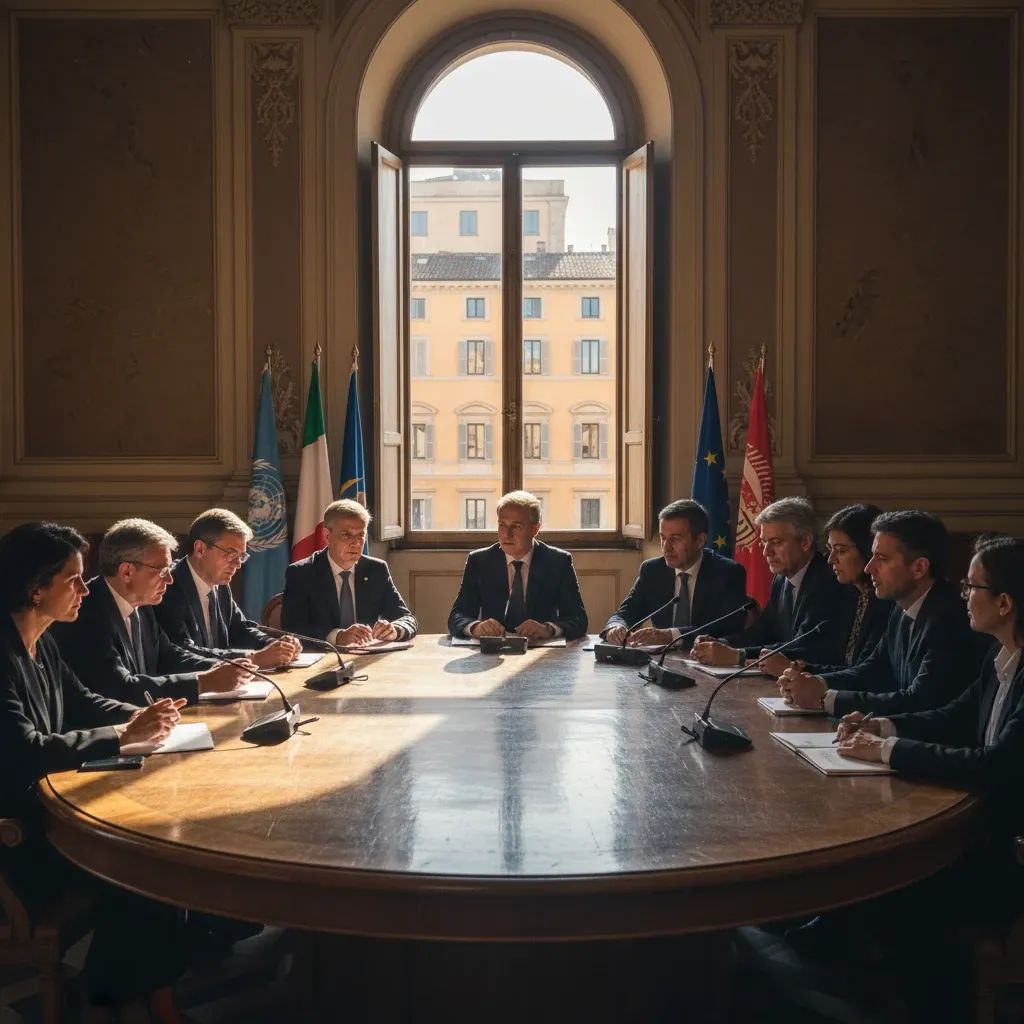
The Italy-based trade union Uil has used its 76th founding anniversary to double down on solidarity with union activists facing persecution, imprisonment, and exile across authoritarian regimes, signaling a strategic shift from domestic labor battles to global human rights advocacy in an increasingly fractured geopolitical landscape.
At a March 5 ceremony in Rome, Uil Secretary General Pierpaolo Bombardieri framed the anniversary not as a celebration of institutional longevity, but as a platform to amplify voices silenced by violence, detention, and forced displacement. The event featured testimonies from Shiva Boroumand, an Iranian activist; Nataliya Levytska, vice president of Ukraine's independent KVPU union; Maksim Pazniakou, exiled acting president of Belarus's BKDP trade union confederation; and Andrea Avveduto from Pro Terra Sancta, alongside Giorgio Marrapodi, Italy's Permanent Representative to the United Nations.
Why This Matters
• Italian unions are pivoting their mission: Uil's engagement goes beyond collective bargaining, anchoring itself in international human rights law and multilateral diplomacy.
• Direct support for at-risk unionists: Includes financial aid, asylum assistance, and advocacy before the UN and the International Labour Organization (ILO).
• Signal to Rome: Bombardieri's emphasis on international law and multilateralism contrasts sharply with rising nationalist rhetoric across Europe, positioning Uil as a counter-narrative force within Italy's civil society.
From Postwar Roots to Global Advocacy
Founded on March 5, 1950, Uil emerged during Italy's postwar reconstruction as one of the nation's three major labor confederations, alongside CGIL and CISL. While historically focused on wage negotiations and workplace conditions, the union has increasingly positioned itself as a defender of freedom of association and trade union rights in countries where those protections have collapsed.
Bombardieri made clear the union's strategic intent: "We have chosen on this day to remember the commitment of this organization for 76 years in its relationships with trade unions and trade unionists who suffer." He singled out Iran, Ukraine, Belarus, and Palestine as priority theatres where Uil maintains active partnerships, often with unions operating underground or from exile.
The message is unambiguous: peace and international law are non-negotiable, even as wars reshape development trajectories and erode multilateral norms. "The moment is dramatic," Bombardieri stated. "War is dictating the lines of development. We reaffirm that peace is the primary good and that international law cannot be violated."
The Human Cost: Iran, Belarus, Ukraine
Iran: Boroumand's testimony underscored the lethal risks faced by those challenging the regime. "In many of these countries, there is no respect for life," Bombardieri said. "You lose your life because you protest. You lose your life because you disagree. You are imprisoned because you oppose labor interventions." Uil has maintained links with Iranian labor activists despite systematic repression by Tehran.
Belarus: Uil has supported the Congress of Democratic Trade Unions of Belarus (BKDP) since President Alexander Lukashenko dissolved independent unions and imprisoned their leaders. Pazniakou's presence in Rome as exiled acting president symbolized the continuity of that partnership and Uil's commitment to backing the union's work from exile.
Ukraine: Since the February 2022 Russian invasion, Uil has delivered humanitarian aid and bolstered operational ties with the KVPU, one of Ukraine's largest independent trade union confederations. Levytska's participation highlighted how labor organizing persists under siege conditions, with union halls converted to distribution centers and collective bargaining replaced by emergency coordination. Bombardieri described KVPU as a "primary partner" and pledged ongoing support.
What This Means for Italy's Civil Society
Uil's anniversary strategy reveals a calculated repositioning within Italy's increasingly polarized political environment. By centering its narrative on international law, UN institutions, and the ILO, the union is staking out ideological ground distinct from both the nationalist right and the populist left.
This approach has practical implications:
• Leverage within European forums: Uil's partnerships with exiled unions strengthen its voice in European Trade Union Confederation (ETUC) discussions on sanctions, asylum policy, and defense spending.
• Domestic credibility: Demonstrating solidarity with persecuted activists abroad reinforces Uil's positioning as a principled actor at home, especially amid debates over Italy's own labor laws and protest rights.
• Recruitment and identity: For younger members and potential recruits, the union's global posture offers a values-driven narrative beyond wage negotiations—an appeal to solidarity as a moral framework.
Bombardieri pointedly invoked the postwar international order, suggesting that while UN mechanisms "perhaps need to be revisited," abandoning them would be catastrophic. "International law has regulated peace since World War II," he argued. "We think it is necessary to return there, especially in such a delicate moment."
Palestine as a Priority Concern
Bombardieri identified Palestine as one of Uil's priority areas of concern, alongside Iran, Ukraine, and Belarus, signaling the union's commitment to advocating for worker rights and international law across multiple geopolitical hotspots. The presence of Andrea Avveduto from Pro Terra Sancta underscored this focus.
A Movement Under Pressure Everywhere
Bombardieri's closing remarks framed the event as a message to Uil's own membership: "We think it is necessary to make their voices heard more than ours, to tell our delegates, our leaders, that there is a world drifting toward wars that break out continuously—but also that there is a solidarity among peoples, among workers, that still prevails."
That optimism is tested daily, as trade unionists face detention, torture, and suppression for organizing and advocating for worker rights across multiple regions. Uil's partnerships are not symbolic. The union channels financial support, coordinates asylum requests through Italy's Ministry of Interior, and advocates before the ILO Committee on Freedom of Association when member states violate Convention 87, which guarantees the right to organize.
Looking Ahead: Peace as a Labor Issue
As geopolitical fractures deepen and authoritarian governance spreads, Uil's 76th anniversary marks a pivot point. The union is arguing that peace, international law, and worker rights are inseparable—that a world of unchecked aggression and collapsed norms is fundamentally hostile to labor organizing.
Whether that vision resonates beyond the Rome conference hall will depend on Uil's ability to translate solidarity into tangible outcomes: securing asylum for threatened activists, maintaining funding pipelines to exiled unions, and keeping international law at the center of Italy's domestic debate.
For now, Bombardieri's message is clear: in a world where dissent can mean serious consequences, solidarity is not optional—it is survival.


