
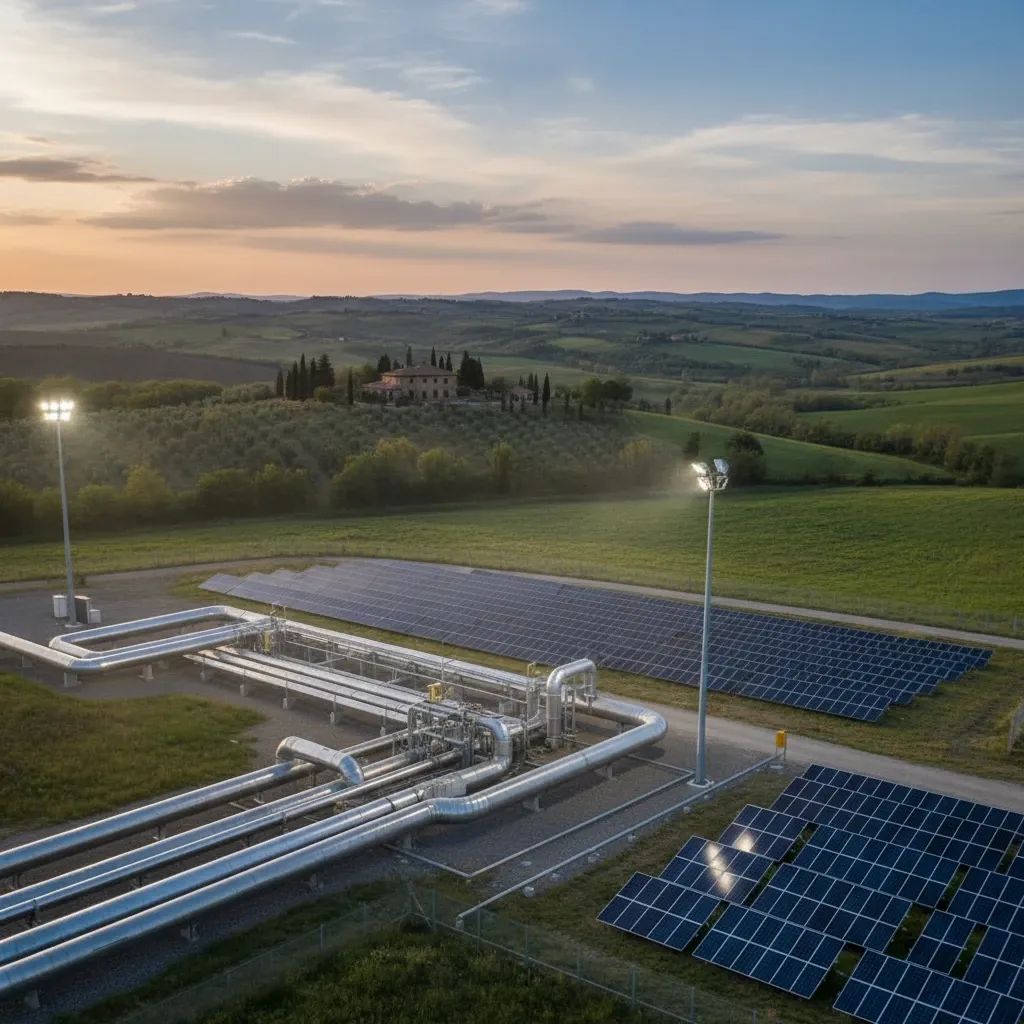
Italy's strategic gas reserves have reached 45%, placing the country at nearly double Germany's storage capacity as Europe confronts its most challenging refill season in three years. While the European Union collectively sits at just 29.55% of total storage capacity—equivalent to 334.35 TWh—Italy's proactive stockpiling strategy signals a crucial divergence in how member states are preparing for the upcoming winter's energy demand.
Why This Matters
• Italy is refilling at 0.16% daily while Germany continues to draw down reserves at -0.19%, highlighting divergent national strategies.
• Gas prices spiked to €53.24 per MWh in early April amid Middle East conflict, complicating EU-wide refill efforts.
• The EU target of 90% by November 1 appears increasingly unrealistic, with Brussels quietly revising expectations to 80%.
Italy Leads Europe in Storage Resilience
As of mid-April, Italy's national gas storage system holds approximately 91.23 TWh at 44.76% capacity—a position that stands in stark contrast to most European neighbors. The country began the injection season from a base of 43.4%, significantly above the continental average of 28%, and has maintained consistent daily additions throughout the past two weeks.
The Italian Ministry of Environment and Energy Security attributes this performance to diversified supply routes and strategic infrastructure investments. Italy now sources 34% of its gas via liquefied natural gas (LNG) terminals, leveraging its Mediterranean position to secure cargoes from North Africa, the United States, and Qatar. This geographic advantage allows Italy to function as an emerging transit hub, recently enabling deliveries of Azerbaijani gas through the Trans-Adriatic Pipeline (TAP) to reach Germany and Austria.
Germany, by contrast, holds just 57.49 TWh at 23.22%—a reflection of its different strategic position following the loss of Russian supplies. With roughly 40 underground storage facilities and a structural capacity near 240 TWh, Germany possesses Europe's largest storage infrastructure. However, the severing of Russian pipeline imports in 2022 has required Berlin to replace reliable volumes with more expensive LNG and Norwegian gas. The country's heavy manufacturing base and weather-dependent demand patterns further complicate refill dynamics.
Geopolitical Shocks Reshape European Gas Markets
The injection season, formally launched on April 1, has been hampered by volatile pricing driven by escalating tensions in the Middle East. Conflict involving the United States, Israel, and Iran triggered temporary closures affecting maritime energy transit routes. Industry sources estimate such disruptions can amplify competition between European and Asian buyers, driving the Dutch TTF benchmark to €53.24 per MWh by mid-April—the highest level since February.
Additional supply constraints have emerged from infrastructure challenges in major LNG-producing regions. Industry analysts note that unexpected maintenance or damage to liquefaction facilities can temporarily reduce export capacity, representing near-term limitations on available LNG volumes.
By April 16, prices had retreated to €42.70 per MWh following signals of renewed diplomatic engagement. Reports indicate ongoing negotiations between major regional players, which could potentially ease supply concerns and support more aggressive European storage injections if resolved.
What This Means for Residents and Businesses
For households and companies across Italy, current storage levels translate into greater supply security and reduced rationing risk heading into the 2026-2027 heating season. The country's robust reserves provide a buffer against geopolitical shocks and reduce exposure to emergency measures seen in other member states during previous crises.
Energy-intensive industries—particularly in manufacturing hubs like Lombardy, which houses half of Italy's underground storage facilities in depleted gas fields, ensuring supply reaches major population and industrial centers—benefit from reliable access and reduced disruption risk. This stability provides planning advantages compared to regions with lower reserves.
However, consumers should note that wholesale gas prices remain elevated compared to pre-crisis norms. The current TTF level of €42.70 per MWh is still substantially above the €20-30 range typical before 2022. While Italy's strong storage position ensures supply security, it does not eliminate the price premium currently reflected in retail bills. Storage provides protection against supply shortages, but market prices remain influenced by global demand and geopolitical factors.
Regulatory Framework and EU-Wide Coordination
The European Commission extended its gas storage regulation through the end of 2027, maintaining the 90% refill mandate but introducing new flexibility. Member states now have a two-month window—from October 1 to December 1—to hit the target, rather than a hard November 1 deadline. Countries facing adverse market conditions or technical constraints may deviate by up to 10%, with the Commission authorized to grant an additional 5% reduction if circumstances warrant.
Intermediate benchmarks for February, May, July, and September have been downgraded to indicative targets, allowing governments to prioritize cost management over rigid timelines. Italy's Stogit, the primary storage operator, has already signaled confidence in meeting the November threshold, citing strong LNG inflows and adequate pipeline capacity from North Africa.
Brussels is also coordinating a phased elimination of Russian gas imports. A total ban on Russian LNG takes effect by the end of 2026, with pipeline deliveries prohibited by autumn 2027. Member states were required to submit national diversification plans by March 1, outlining alternative supply strategies. Italy's early pivot to LNG and TAP volumes positions it well ahead of this transition.
The Storage Gap Across Europe
The disparity between national storage performances underscores fragmented energy strategies. While Italy approaches 45% and Portugal sits at an impressive 91.6% (on smaller absolute capacity), the Netherlands languishes at 6.84%, and several Central European states remain below 20%. This variance reflects differences in infrastructure, policy priorities, and access to import terminals.
The European Network of Transmission System Operators for Gas (ENTSOG) reported EU-wide storage at approximately 28% on April 1—the lowest level in three years and a return to pre-crisis norms. To reach even the revised 80% target by year-end, the bloc must inject an average of 1.5 TWh daily over the next six months, a pace contingent on favorable prices and LNG availability.
Looking Ahead: Risks and Opportunities
Several variables will determine whether Italy maintains its lead and whether Europe collectively secures adequate reserves. LNG import capacity is expanding, with new regasification terminals coming online in Germany and other northern states, but construction delays and permitting bottlenecks have slowed deployment.
Price volatility remains the principal wildcard. Any resumption of regional hostilities, unexpected supply outages, or surge in Asian demand could re-ignite competition for cargoes and push TTF prices back above €50 per MWh. Conversely, a durable diplomatic resolution and mild summer weather would ease injection economics and accelerate refill rates.
Italy's investment in storage infrastructure and supply diversification has created advantages that will play a critical role in absorbing injections through the storage season. The technical capacity exists to accommodate volumes, though market conditions will influence commercial decisions about timing and volumes.
Strategic Implications for Energy Security
Italy's storage leadership reflects a strategic repositioning based on diversified supply sources, LNG infrastructure investment, and geographic advantages. By leveraging its Mediterranean position, the country has established more resilient supply access compared to landlocked or northern European neighbors. This resilience translates into economic competitiveness for Italian industry and energy sovereignty for policymakers.
Different member states have pursued varying strategies in response to the loss of Russian supplies. Some have prioritized rapid LNG terminal construction, while others have focused on pipeline alternatives and storage expansion. These different approaches reflect distinct geographic, industrial, and policy considerations facing each country.
As negotiations continue on regional energy security and European storage operators race to fill underground caverns before winter 2026-2027, Italy's storage position provides advantages. Whether that edge endures will depend on sustained international cooperation, continued EU coordination, and the capacity of markets to absorb steady demand without triggering price escalations.


