
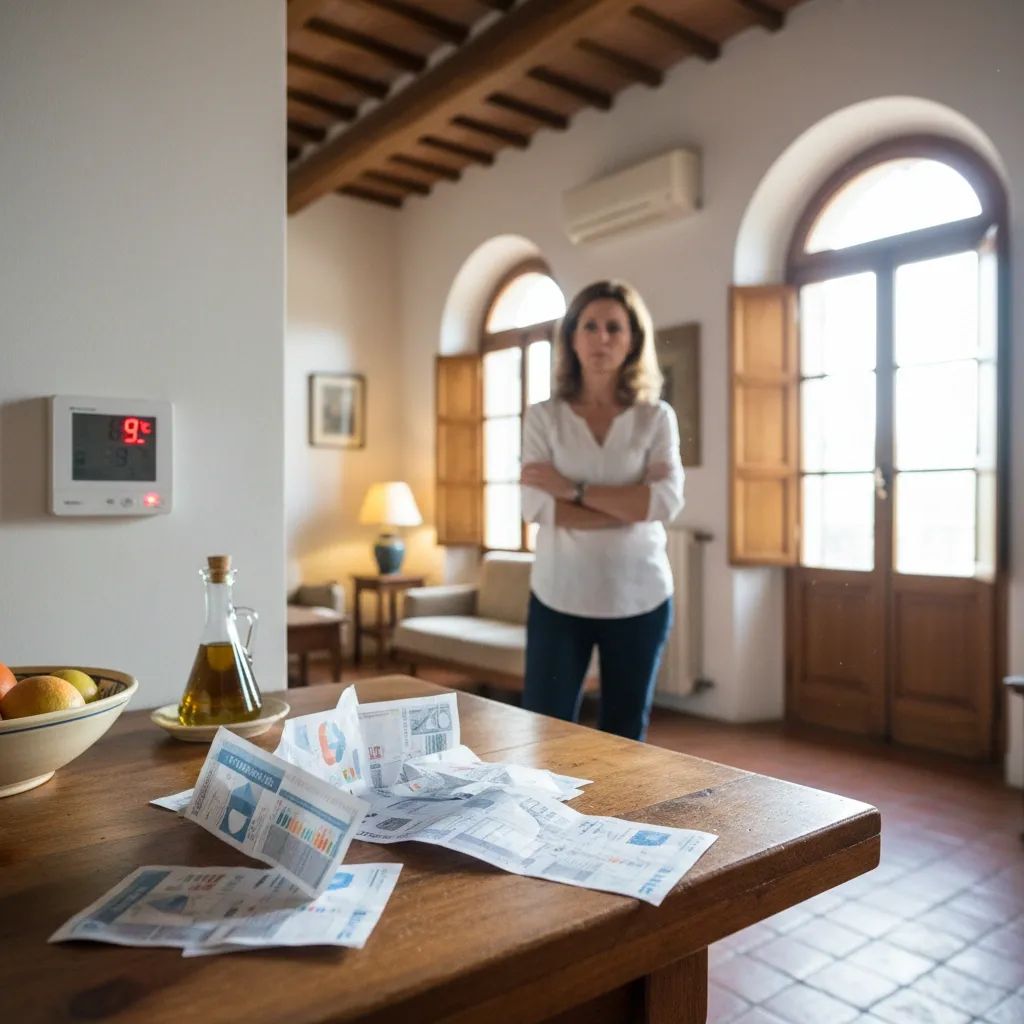
A Middle East conflict that erupted in late February 2026 has exposed Italy's dangerous dependence on gas-fired power, with electricity generation costs surging over 50% in just 10 days and consumers now facing one of Europe's highest energy price burdens. The crisis has already cost the European Union an extra €2.5 billion in fossil fuel imports, but the pain is far from evenly distributed.
Why This Matters:
• Italy's electricity prices are nearly double Spain's: Gas sets wholesale power prices 89% of the time in Italy versus just 15% in Spain
• Your bills are climbing: Italian households face substantial increases as wholesale electricity prices have jumped significantly, pushing total annual energy costs higher
• The structural gap is widening: While Spain added 40 GW of renewable capacity since 2019, Italy's slower rollout leaves consumers vulnerable to every geopolitical shock
The Arithmetic of Dependence
The Italy electricity market operates under a brutal mathematical reality: when gas determines wholesale power prices 89% of the hours—as it has throughout early 2026—every spike in global fuel markets flows directly into consumer bills. Through 2025, wholesale electricity in Italy averaged €116 per megawatt-hour, compared to €87 in Germany, €65 in Spain, and €61 in France. All three of those countries crossed a critical threshold Italy has not: renewable generation surpassing fossil fuel output in 2025.
The current conflict affecting the Strait of Hormuz and energy infrastructure in Qatar has pushed European gas benchmark prices from roughly €31/MWh before the crisis to a peak of €61/MWh in early March—a 93% surge in weeks and the highest level in three years. The Dutch TTF index, Europe's reference price, has settled above €50/MWh, with forecasts projecting further increases in coming months.
For context, Italy's PSV gas index has moved with market volatility since late February, but forward-looking prices tell a different story. Italian power generators still burned gas for the majority of production hours through early 2026, making the country a price-taker in a seller's market.
Spain's Structural Shield
Spain offers a working model of decoupling. The country installed 40 GW of renewable capacity between 2019 and early 2026, pushing its renewable share to 56.8% of the electricity mix in 2024—the highest on record—and maintaining that trajectory into 2026 with solar covering a significant portion of generation. The result: gas influences Spanish wholesale prices only 15% of the time from the beginning of 2026 onward, and average electricity costs run roughly one-third below the European average.
When gas prices exploded in the first days of March 2026, Spanish consumers largely avoided the shock. The country's electricity infrastructure now operates with what energy analysts call "structural decoupling"—a system where abundant wind and solar set the marginal price most hours, relegating gas plants to backup status. Spain also benefits from robust LNG import infrastructure and a legacy nuclear base, providing flexible capacity to manage demand peaks without defaulting to gas.
Italy, by contrast, remains tethered to a centralized gas-fired generation model that made economic sense when fuel was cheap and geopolitics stable. That era is over. The country added 15 GW of renewable capacity between 2021 and 2024—falling short of the 9 GW annual target set in the National Integrated Energy and Climate Plan (PNIEC)—with potential to displace 3.8 billion cubic meters of gas annually and save an estimated €1.4 billion. But potential and reality diverge sharply when regulatory delays, regional permitting battles, and policy uncertainty slow project deployment.
Who Profits, Who Pays
The conflict has reshuffled global energy economics. U.S. liquefied natural gas exporters stand to gain substantially in additional revenues, according to Italian climate think tank Ecco, as Qatar's LNG exports face disruption and American suppliers capture market share. Italy imports about 24% of its LNG from Gulf states like Qatar, equivalent to 6.4 billion cubic meters annually—roughly 8% of total gas consumption. While that exposure is manageable in volume terms, the price contagion affects all molecules equally in a globally traded commodity market.
European leaders have scrambled to respond. Italian Prime Minister Giorgia Meloni has proposed policy measures to reduce short-term costs, but response from other EU member states reflects divided priorities on how to balance immediate relief with long-term energy independence. Instead, the European Commission is promoting dynamic electricity contracts and smart metering to help consumers optimize usage around price fluctuations—a tactical fix for a strategic problem.
The International Energy Agency has coordinated strategic petroleum reserve releases to cushion the oil shock, which has pushed Brent crude above $100 per barrel. These measures buy time but do not solve the underlying vulnerability.
What This Means for Residents
If you live in Italy, the immediate outlook is higher bills and continued price volatility. Natural gas consumption has fallen in recent years, providing modest efficiency gains, but that cannot offset the current price shock. The European gas market remains structurally tight, with storage levels monitored closely and any extended disruption in Gulf supplies likely to trigger further price spikes.
The medium-term question is whether Italy will accelerate renewable deployment fast enough to escape the gas trap. Beatrice Petrovich, Senior Energy Analyst at Ember, framed the choice starkly: "The difference between Spain and Italy is not geographic, it's political. It's the result of investment choices made in recent years. The single most urgent and effective thing the Italian government could do to lower bills is to launch new renewable energy auctions and provide regulatory certainty."
Regional resistance to wind and solar projects, complex permitting procedures, and inconsistent policy signals have slowed Italy's energy transition relative to peers. Meanwhile, the country's elevated wholesale electricity prices reflect a structural premium paid for gas dependence—a premium that grows with every geopolitical tremor.
Europe's Uneven Armor
Across the EU, the crisis has exposed divergent levels of resilience. Countries that pursued aggressive renewable deployment, energy efficiency retrofits, and demand-side management—Germany, Spain, France, Denmark—now enjoy lower exposure to fossil fuel price swings. Italy, Poland, and several Eastern European states remain more vulnerable, despite progress in diversifying gas suppliers and building LNG import terminals.
The EU as a whole has reduced Russian gas imports substantially in recent years, replacing volumes with LNG from the U.S., Qatar, Egypt, and Azerbaijan. Renewables supplied 48% of internal EU energy production in 2024, with solar becoming an increasingly significant contributor. Yet fossil fuels still dominate the gross available energy mix, and a substantial share of total energy comes from imports.
The current shock has cost the EU €2.5 billion in extra fossil fuel imports in the first 10 days alone. Extrapolated over months, that burden becomes economically and politically unsustainable, particularly for countries like Italy where energy-intensive industries face competitiveness pressures and household budgets are already stretched.
The Policy Pivot
Energy analysts and climate groups now argue that the crisis makes the case for faster, not slower, decarbonization. Ecco's analysis emphasizes that countries betting on renewables, efficiency, and electrification are better insulated from price volatility, because the fuel—sun and wind—costs nothing and geopolitics cannot embargo it. Italy's challenge is translating that logic into action: launching large-scale renewable auctions, streamlining grid connection rules, and providing long-term revenue certainty to attract private capital.
The government's National Recovery and Resilience Plan allocates funding for clean energy projects, but execution has lagged ambition. Regional governments hold significant permitting authority, and local opposition—rooted in landscape concerns, misinformation, or economic interests tied to fossil infrastructure—has bottlenecked projects. Without a coordinated push to overcome these barriers, Italy risks remaining a high-cost energy island in an increasingly decarbonized European grid.
In the near term, consumers have limited options: optimize consumption during off-peak hours if on a dynamic tariff, improve home insulation to reduce heating and cooling loads, and monitor contract renewals carefully as fixed-rate deals reset to current market prices. The structural fix, however, lies beyond individual action. It requires a political commitment to build out renewable generation at the pace Spain demonstrated—and that Italy's own climate targets demand.


