
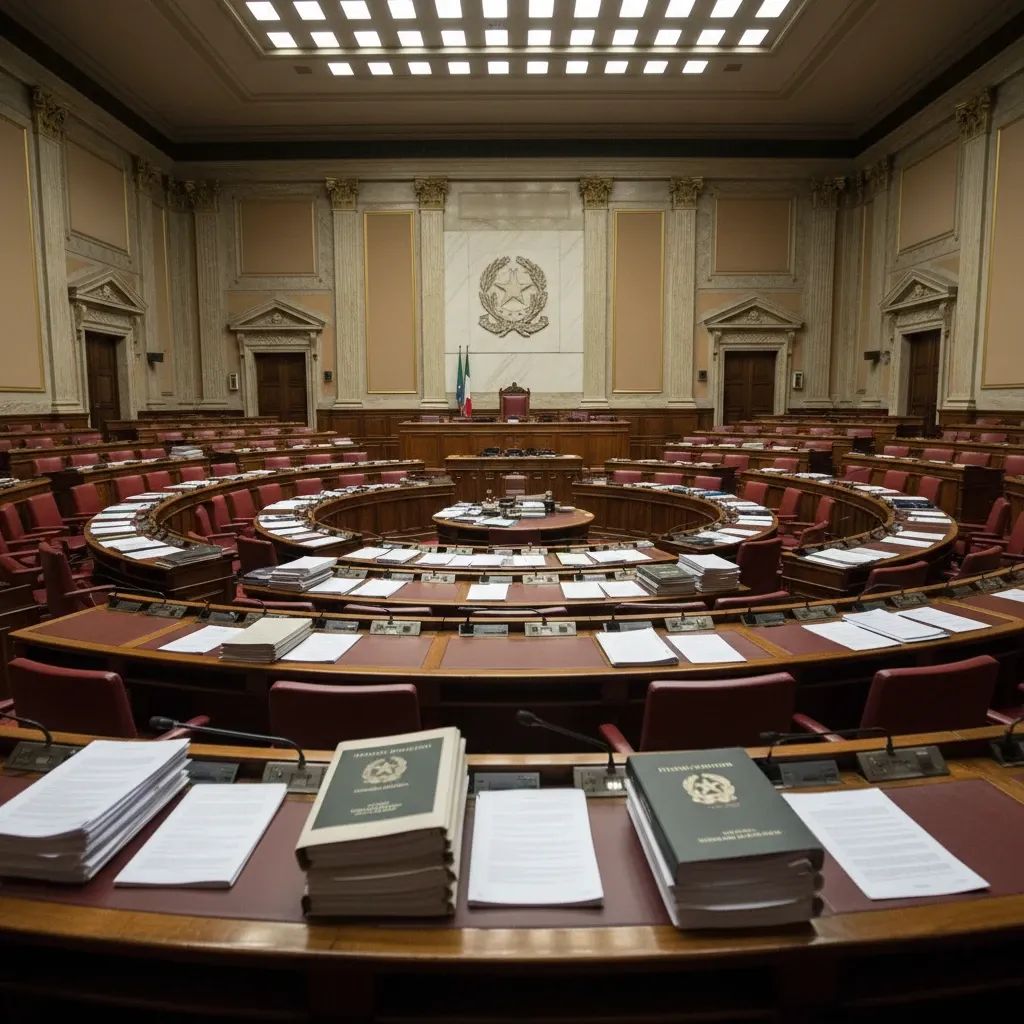
The Italy Parliament is racing against a 25 April 2026 deadline to convert a controversial security decree into law, a package that now includes a €615 payment scheme for lawyers who facilitate migrant departures—a provision that has triggered constitutional alarm bells and professional uproar among the nation's legal establishment.
Why This Matters
• Legal ethics at stake: Attorneys would receive payment only after a migrant physically leaves Italy, raising conflict-of-interest concerns
• Budget allocation: €246,000 set aside for 2026, rising to €492,000 annually in 2027–2028
• Constitutional scrutiny: President Sergio Mattarella is monitoring the issue with "maximum attention" and may refuse to sign if concerns remain unaddressed
• Conversion deadline: The decree expires this Saturday, leaving virtually no parliamentary time for amendments
A Lawyer Payment Scheme No One Requested
At the heart of the dispute sits Article 30-bis, an amendment introduced by Senator Marco Lisei of Fratelli d'Italia in March. The provision authorizes a €615 fee—equal to the first-settlement allowance in the IOM's RI.VOL.A.RE. voluntary return program—paid to any attorney who shepherds a migrant through the voluntary repatriation process and ensures the individual boards a flight home.
The amendment explicitly assigns the Italy National Bar Council (Consiglio Nazionale Forense) a role in administering these payments and collaborating with the Interior Ministry on assisted return programs. There is one problem: the Council insists it was never consulted and learned of its purported involvement only after the Senate approved the text on 17 April.
Francesco Greco, president of the Bar Council, told Il Manifesto that the institution has no authority to pay individual practitioners for case outcomes. "We can pay Council staff, but not attorneys," he emphasized, adding that the scheme falls outside the Council's constitutional remit. The body has formally requested Parliament strike the provision entirely.
Why Constitutional Scholars Are Alarmed
Legal scholars and professional associations argue the measure distorts the foundational principle that lawyers owe undivided loyalty to their clients, not to policy objectives. The Union of Italy Criminal Chambers declared the amendment incompatible with the Constitution, warning it transforms advocates from rights defenders into "mere executors of government policy."
Because compensation is conditional on departure, critics contend the arrangement creates a direct financial incentive for attorneys to prioritize repatriation over exploring legitimate asylum claims or appeals. This violates the ethical tenet that legal work is an obligation of means, not results—a distinction central to Italian jurisprudence.
President Mattarella's office has signaled that the decree could face a veto unless the clause is "sterilized" or rewritten. Constitutional advisers at the Quirinale reportedly believe the provision erects an economic barrier to justice and undermines the principle that legal defense must be "full, free, and concretely accessible," particularly for asylum seekers who lose access to state-funded representation if they appeal after an initial rejection.
The Political Calculus: No Time, No Changes
Despite mounting pressure, the governing coalition has made clear it will not amend the text. Any modification in the Italy Chamber of Deputies would trigger a third reading in the Senate, a procedural loop the government cannot afford with a Saturday expiration looming.
"There is nothing to correct," Senator Lisei said bluntly, defending his amendment. Lucio Malan, leader of Fratelli d'Italia's Senate caucus, framed the measure as evening the playing field: "Today the state pays lawyers only when they appeal an expulsion order. With this rule, attorneys are compensated for work they currently do for free."
Only Noi Moderati, the centrist party led by Maurizio Lupi, has hinted at a future fix. Justice spokesperson Gaetano Scalise called the provision "a normative overreach" against the constitutional function of legal defense and pledged a "subsequent intervention" to revisit or eliminate it, contingent on dialogue with the Bar Council.
Yet government sources, speaking on condition of anonymity, were unequivocal: the parliamentary timetable has closed. On Tuesday, the joint Constitutional Affairs and Justice committees will vote on 1,231 opposition amendments—all but 8 filed by non-opposition lawmakers aligned with MEP-turned-deputy Alessandro Vannacci—in a session scheduled to run until midnight. The plenary vote, requiring two days under confidence-vote procedures, follows immediately.
Opposition parties have announced they will flood the floor with motions and procedural interventions to slow passage. Francesco Boccia of the Democratic Party labeled the entire decree "authoritarian and culturally fascist," while Italia Viva's Davide Faraone called it proof of "a government more confused than convinced." Michela Di Biase, also of the PD, termed the lawyer incentive a "remigration bonus" that commodifies human rights practice.
What This Means for Residents
For anyone living in Italy—whether citizen, resident, or asylum seeker—the decree represents a significant shift in how the state approaches both security and migration.
The security package introduces a 12-hour preventive detention power for individuals deemed a public-order risk before demonstrations, a tool civil-liberties advocates warn could chill lawful protest. It also extends criminal immunity to law enforcement and others who commit offenses under legally recognized justifications, a shield critics say is unnecessarily broad.
On migration, the voluntary-return incentive is part of a broader push to accelerate departures. Yet by conditioning lawyer fees on actual departure rather than quality of counsel, the measure risks distorting the legal market. Attorneys who depend on state compensation may face pressure—implicit or explicit—to discourage meritorious appeals, particularly in borderline asylum cases where outcomes hinge on nuanced factual presentation.
For foreign residents navigating Italy's immigration system—whether renewing permits, sponsoring family members, or advising friends—understanding this shift in how legal counsel operates in migration matters provides insight into broader government priorities on immigration enforcement. For migrants, the practical effect could be chilling: reduced access to zealous representation at a moment when legal complexity is rising. Italy's asylum-recognition rate hovers around 30%, meaning the majority of first-instance denials are administratively correct—but meaningful review depends on counsel willing to challenge weak evidence or procedural errors.
How Europe Handles Legal Aid and Return Incentives
Italy's approach stands apart from most European models. While the European Union Return and Reintegration Programme, managed by Frontex, offers post-arrival support—housing, vocational training, medical care for up to 12 months—it does not compensate lawyers based on departure outcomes.
Poland, the Czech Republic, and Norway fund voluntary-return schemes but route payments through international organizations like the IOM, keeping legal counsel insulated from performance metrics. Sweden piloted a sustainable-reintegration project for Afghan returnees that included entrepreneurship grants, but again without tying lawyer fees to client departures.
Belgium, Bulgaria, the Netherlands, and Sweden provide legal aid to migrants without income thresholds, ensuring representation regardless of means. By contrast, Austria, Hungary, Lithuania, Romania, and Slovenia offer little or no publicly funded immigration counsel, relying instead on NGOs and Red Cross societies.
Italy's proposed model—direct payment to private attorneys contingent on a policy outcome—has no clear analogue in the EU-27. This uniqueness has amplified concerns that the provision was drafted without comparative legal research or consultation with the Bar Council, whose institutional memory spans decades of professional-ethics jurisprudence.
Lingering Questions and Next Steps
If the decree passes unamended, two exit strategies remain on the table. The Cabinet could issue a separate decree abrogating Article 30-bis in a future session, though this would require fresh parliamentary approval within 60 days. Alternatively, implementing regulations could be written in a way that renders the provision inoperative without formal repeal—a bureaucratic sleight of hand that would satisfy neither the Bar Council nor constitutional purists.
Meanwhile, legal associations have warned of escalating professional action. The Organismo Congressuale Forense, a cross-association body, has declared the bar in a state of agitation, and further strikes or work stoppages are under discussion.
For now, the spotlight turns to the Chamber floor and, ultimately, to the Quirinale. If Mattarella withholds his signature, the decree dies and the government must start over—a humiliating setback for a coalition that has staked credibility on rapid security reforms. If he signs despite reservations, expect swift constitutional challenges that could freeze implementation for months or years.
Either way, the €615 question has exposed a deeper tension: how far a government can reshape professional ethics in pursuit of migration policy, and whether Parliament will permit institutional safeguards—like an independent bar—to be conscripted into enforcement without consent.


