
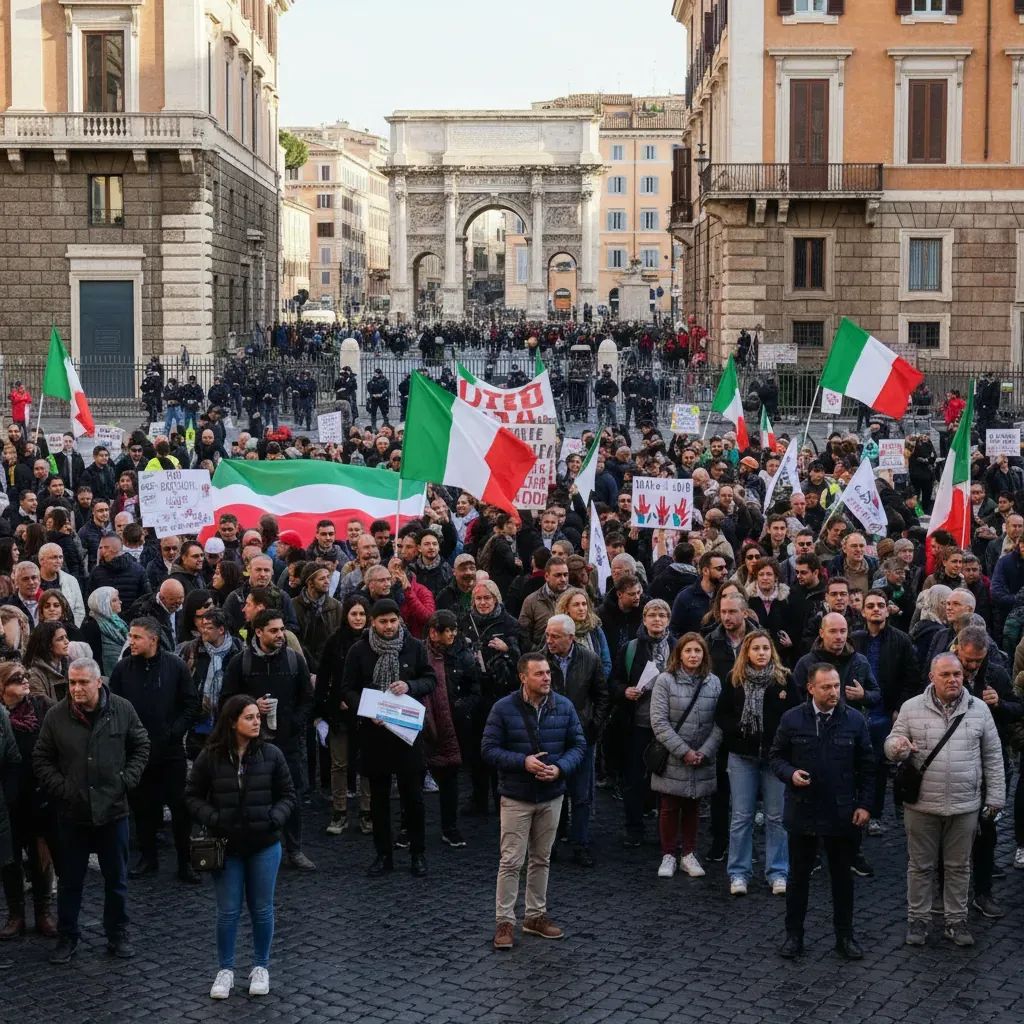
ROME/MILAN, April 25, 2025 — Italy's Liberation Day celebrations descended into chaos this year, with violent clashes erupting at processions in Rome and Milan, underscoring deep fractures within the country's left-wing coalition over geopolitical allegiances. The annual April 25 commemoration — traditionally a day of unity against fascism — instead exposed bitter divisions over Israel, Palestine, and Ukraine.
Why This Matters
• Physical assaults at Italy's largest Liberation Day marches signal a breakdown in coalition discipline among anti-fascist groups.
• The Radicali Italiani party is demanding accountability from Italy's National Association of Italian Partisans (ANPI) — the influential World War II veterans' organization that has moral authority over Liberation Day commemorations nationwide — after its president was hospitalized.
• Holocaust survivors' relatives required heavy police protection after receiving death threats referencing Nazi atrocities.
Rome: Pepper Spray and Ambulances
The most violent confrontation occurred in the Italian capital, where Matteo Hallissey, president of Radicali Italiani, was rushed to hospital after being assaulted by demonstrators who objected to his group's display of Ukrainian flags. According to party secretary Filippo Blengino and treasurer Patrizia De Grazia, the attack happened near the Piramide Cestia monument when militants "with red flags" surrounded their delegation, deploying pepper spray and physically beating members.
"We were attacked by fascists carrying red flags — they beat us and sprayed us with capsicum," the pair stated in a formal complaint. Blengino and fellow activist Ivan Grieco were subsequently ejected from the procession despite their long history of anti-fascist activism, solely because they carried banners supporting Ukraine and other oppressed peoples.
The Radicali contingent has now issued an ultimatum to ANPI. They demand a clear denunciation of what they term "squadrist methods" — a loaded term in Italian politics referencing Mussolini-era paramilitary violence. The Radicali used the term "fascists" ironically to describe far-left militants, arguing that their violent tactics mirror those of the fascist squads the day is meant to commemorate defeating. The party argues that the right to march on Liberation Day belongs to all anti-fascists, regardless of their stance on current conflicts.
Police and emergency services intervened to separate the factions, but the incident has triggered accusations that ANPI's silence amounts to complicity. As of this writing, the association has not issued a comprehensive statement addressing the Rome violence.
Milan: Holocaust References and Blocked Streets
At the national procession in Milan — typically the largest Liberation Day gathering in Italy — a different but equally troubling scene unfolded. Hundreds of pro-Palestine activists physically blocked the Jewish Brigade contingent from advancing, chanting "assassins," "get out," and "Free Palestine" while surrounding the marchers. The Jewish Brigade — a World War II unit of Jewish Palestinian volunteers who fought with the British Army and helped liberate parts of Italy — traditionally participates to honor Jewish partisan fighters who resisted Nazi occupation during World War II.
Emanuele Fiano, a Democratic Party parliamentarian and son of Holocaust survivors, reported that protesters shouted "you're just soap we missed" — a reference to Nazi death camps, where victims' bodies were allegedly rendered for industrial use. "One of them told us, 'you're only missing soap,'" Fiano stated, visibly shaken.
Also present in the Jewish section was Luciano Belli Paci, son of Holocaust survivor Liliana Segre, who required a substantial cordon of riot police to proceed. Segre herself, now 95 and a senator-for-life, has faced years of antisemitic threats requiring permanent security detail. The blockade delayed the entire procession, with chants of "shame, shame" echoing through the streets as the standoff continued.
Milan Mayor Giuseppe Sala had warned in advance that this year's commemoration would be "delicate," but the scale of the confrontation exceeded expectations. The Coordinamento per la Pace (Coordination for Peace), an umbrella group of left-wing organizations, had publicly announced plans to create a separate march segment and hold an alternative rally in Piazza San Fedele to protest the Jewish Brigade's participation.
Notably, this year's Milan procession also included members of Italy's Iranian diaspora community, who marched alongside the Jewish Brigade to draw attention to executions under the Tehran regime — a symbolic alliance that further inflamed tensions with pro-Palestine factions.
What This Means for Residents
For Italians accustomed to Liberation Day as a unifying civic ritual, this year's violence represents a troubling shift. The fractures on display transcend typical political theater — they involve physical assaults, hospitalization, and the invocation of Holocaust imagery against descendants of genocide survivors.
The practical implications extend beyond symbolism. ANPI's organizational authority over Liberation Day events is now under scrutiny, with critics arguing that the association has allowed ideological litmus tests to override the broad anti-fascist coalition its founders envisioned. If the organization cannot guarantee participant safety or condemn violence unequivocally, cities may need to impose stricter security protocols or rethink how these processions are structured.
For Jewish Italians, the situation has become untenable. The Milan Jewish Community declined to participate with its official banner this year, citing an atmosphere incompatible with respectful commemoration. The fact that police protection is now mandatory for Holocaust survivors' families at an anti-fascist march highlights the depth of the crisis.
Meanwhile, pro-Ukraine activists face a parallel dilemma: their solidarity with Kyiv's resistance to Russian invasion — a cause many see as directly analogous to Italy's own partisan struggle — is now grounds for expulsion from Liberation Day events. This dynamic has created strange-bedfellow alliances, with some right-wing politicians seizing on the chaos to criticize what they call the left's hypocrisy on totalitarianism.
Contrasts Across the Country
Not all Italian cities experienced violence. In Cagliari, approximately 5,000 demonstrators marched peacefully, carrying rainbow flags and banners calling for peace in Iran, Palestine, and Ukraine. The procession, organized by ANPI and the CGIL trade union, concluded with speeches and renditions of "Bella Ciao" in Piazza del Carmine. Young members of the Memoratu social association set up public boards where participants could write their definitions of resistance today.
Sardinian regional council president Piero Comandini and transport minister Barbara Manca laid wreaths at war memorials, representing Governor Alessandra Todde, who attended commemorations in her hometown of Nuoro.
Yet even peaceful gatherings betrayed underlying tensions. Cuban flags appeared alongside Italian tricolors in Cagliari, while slogans referenced recent constitutional referendums — subtle indicators that participants interpret "resistance" through vastly different ideological lenses.
The Broader Context
The violence fits within a pattern observed across Italy in recent months. In Turin, the April 24 torchlight vigil saw activists burn NATO and European Union symbols in Piazza Castello after the official ceremony concluded. Radicali Italiani had already announced they would skip Turin's events entirely due to what they described as years of harassment.
Minor clashes were also reported in Lodi (a brawl involving roughly 20 people) and Pavia (assaults in Piazza della Vittoria), though it remains unclear whether these incidents were directly tied to Liberation Day tensions or unrelated street violence.
The common thread is an increasing willingness among Italy's activist left to enforce ideological conformity through physical intimidation. What began as vocal protests against the Jewish Brigade in 2024 has escalated into systematic exclusion of groups deemed insufficiently aligned with anti-Israel or anti-NATO positions.
Unanswered Questions
The most pressing question facing Italian civil society is whether ANPI will address the Rome assault with the clarity demanded by Radicali Italiani. The association's credibility as custodian of partisan memory hinges on its response. If it tolerates violence against dissenters, it risks fracturing the anti-fascist coalition beyond repair.
Equally urgent is the question of law enforcement. Despite advance warnings, police were unable to prevent blockades in Milan or assaults in Rome. With Liberation Day an annual fixture, authorities will need revised crowd-control strategies if these patterns continue.
For now, Italy's Liberation Day has become a mirror reflecting the country's geopolitical divisions — a day when historical memory collides with present-day conflicts, and the language of resistance is wielded by all sides.


