
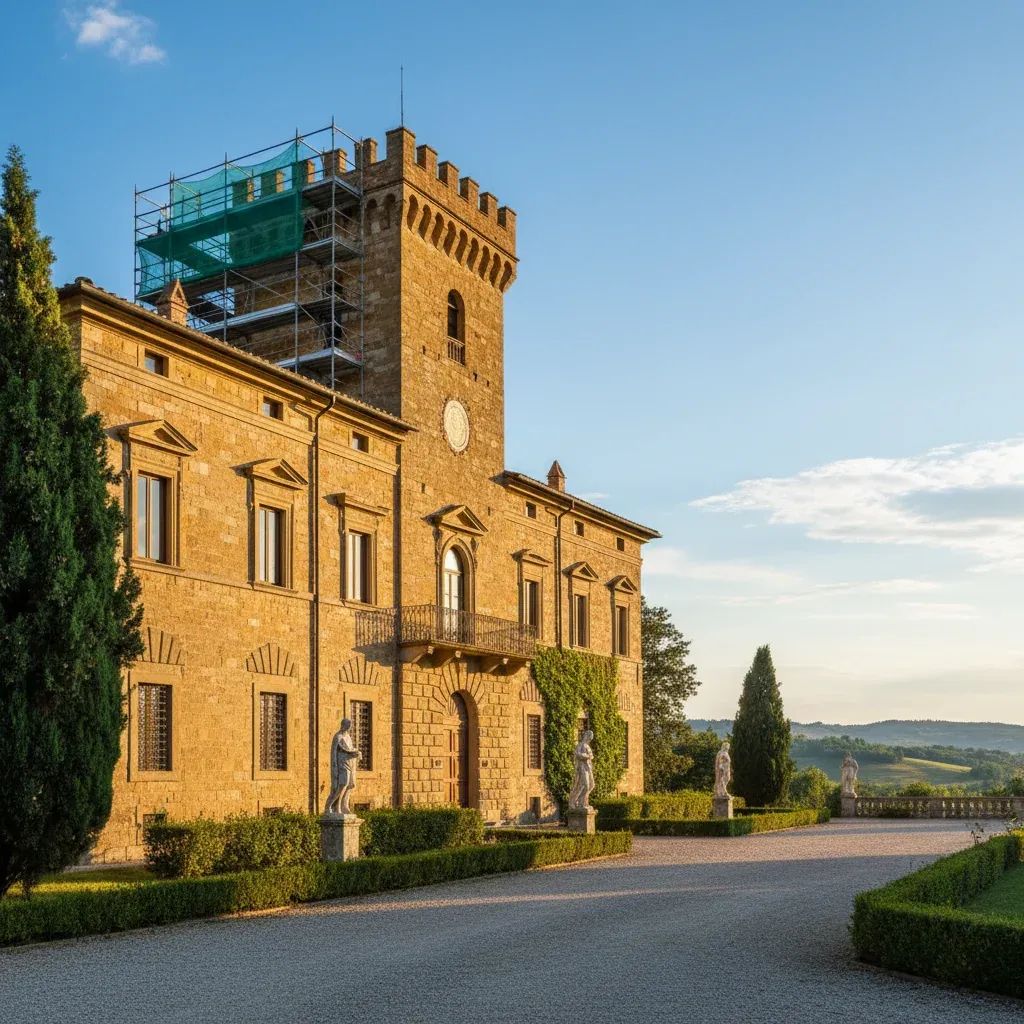
The Italian Association of Historic Houses (ADSI) has pushed the national conversation forward on private cultural property, revealing that over 46,000 privately owned historic buildings spread across Italy contribute more than €1.9 billion to the national economy—yet their survival depends on regulatory reforms that remain stalled in ministerial offices. During its 49th annual assembly in Rome in March 2026, the association laid out a stark reality: thousands of castles, villas, and palaces are prepared to expand cultural and tourism activities, but outdated laws and a lack of fiscal incentives are blocking their potential.
Why This Matters
• Over 10,000 historic homes are ready to increase public access and commercial activity if regulations shift in their favor.
• Private owners self-finance 85% of ordinary maintenance, averaging over €50,000 annually per property, with no state support.
• New legislation enacted in March 2026 (Law 40/2026) introduces digital registries and national valorization strategies, but fails to extend the Art Bonus tax credit to privately held heritage.
• Proposals now circulating in parliament would grant a 65% tax credit for restoration work on private cultural assets, potentially unlocking hundreds of millions in private investment.
A Hidden Economic Engine Running on Fumes
Italy's privately owned historic residences form an invisible infrastructure that supports local economies far beyond their ornamental value. According to the 6th Report of the Observatory on Private Cultural Heritage, released in conjunction with the assembly, roughly 27,000 of these properties actively generate income through hospitality, event hosting, agriculture, and experiential tourism. In 2024 alone, these sites recorded 35 million visitors—a figure that rivals attendance at many state-run museums.
Yet the financial burden falls almost entirely on owners. ADSI data shows that ordinary maintenance is 85% self-funded, with individual properties spending upward of €50,000 per year on upkeep. Extraordinary interventions—structural restorations, façade work, heritage conservation—reached €1.2 billion in 2024, part of a three-year investment cycle totaling €1.9 billion. That figure represents more than 10% of Italy's GDP growth recorded in 2023, a contribution rarely acknowledged in public discourse.
Maria Pace Odescalchi, president of ADSI, framed the issue bluntly: "Historic homes are integral to our national system, not only for their cultural value but for the concrete contribution they make daily to local economies. They create jobs, sustain entire production chains." Her remarks underscored the paradox: properties that function as public goods receive almost none of the fiscal support extended to state-owned heritage.
What the New Law Does—and Doesn't Do
Law 40 of March 17, 2026, amending the Code of Cultural Heritage and Landscape (D.Lgs. 42/2004), introduces several mechanisms designed to modernize heritage management. The most significant addition is a digital registry (Anagrafe digitale), housed within the Ministry of Culture, which systematically collects data on cultural institutions, sites, and public assets. A companion Digital Register of Horizontal Subsidiarity (Albo digitale della sussidiarietà orizzontale) allows private entities to register for indirect management of public cultural properties, increasing transparency in concession procedures.
The law also mandates the creation of guidelines for promoting privately owned cultural assets, explicitly stating these should impose "no burden on owners." Within 24 months—by March 2028—the ministry must define a national valorization strategy titled "Italia in scena," aimed at improving access to heritage, with special attention to inland areas, mountain municipalities, and small villages.
But conspicuously absent from the reform is any expansion of the Art Bonus—a 65% tax credit currently available only for donations supporting public heritage. Private owners, even those who open their properties to the public and shoulder conservation costs, remain ineligible. ADSI and Federculture have called for immediate legislative action to extend the Art Bonus to private cultural assets managed by foundations or third-sector entities, arguing that such a move would make long-term restoration sustainable.
What This Means for Residents and Investors
For anyone living in Italy, the implications are practical. Historic homes anchor rural tourism, support artisan trades, and provide event venues that draw international visitors. But if regulatory barriers persist, many of these properties will close to the public or deteriorate beyond repair. ADSI estimates that over 10,000 owners are willing to expand activities—opening more rooms, hosting more events, creating more jobs—if the legal framework shifts.
The current tax structure also penalizes heritage operators. Restoration work on private historic buildings is taxed at 22% VAT, while comparable work in countries like France or Spain enjoys rates as low as 5%. Proposals to harmonize Italy's VAT regime with European standards have gained traction among cultural federations, but legislative action has been slow.
For investors, the sector presents a paradox: high cultural prestige, strong visitor demand, but limited fiscal incentives. The Bonus Restauro Edifici Storici, a 50% tax credit for restoration of protected buildings, was renewed for 2025-2027 but applies only to private individuals who do not use the property for business purposes. The credit is capped at €200,000 per year, and it cannot be transferred or sold—only used in direct compensation. This limits its utility for large-scale restoration projects typical of historic estates.
Regional Support and National Gaps
Some regional governments have moved faster than Rome. The Lazio Region launched a public call in 2025 offering up to €50,000 for valorization projects at historic villas, parks, and gardens, covering 50% of eligible costs for private entities and up to 100% for small municipalities. Projects funded under this scheme will run through the 2026-2027 period, focusing on public access, digital cataloging, and heritage education.
But regional initiatives are patchwork solutions. Without a unified national policy, owners in regions without dedicated funds are left to fend for themselves. The Fondo per il restauro, a national restoration fund, was allocated just €1 million per year for 2025-2027—a sum that barely covers administrative costs, let alone meaningful conservation work across 46,000 properties.
Political Momentum and Legislative Proposals
The assembly featured support from key political figures. Maurizio Lupi, a member of the Italian Chamber of Deputies, announced that a bill extending the Art Bonus to museums, historic business archives, and private historic homes has been submitted to the Culture Committee. If approved, it would allow private owners to receive a 65% tax credit over three years for restoration and public access investments—mirroring the incentive structure already available to donors supporting public heritage.
Federculture has also proposed rationalizing VAT rates across cultural restoration work, aiming to reduce the burden from 22% to 5%. Such a reform would align Italy with EU norms and could unlock significant private capital currently sidelined by high upfront costs.
The Case for Horizontal Subsidiarity
Underlying these debates is a broader principle: horizontal subsidiarity, the idea that private actors can deliver public goods when equipped with the right tools. The new digital register created under Law 40/2026 is a step in this direction, offering private managers a clearer path to involvement in public heritage projects. But without fiscal parity—without tax credits, reduced VAT, or direct subsidies—private owners remain disadvantaged compared to state-run institutions.
ADSI's assembly made clear that the sector is prepared to invest. Owners are willing to digitize collections, train guides, improve accessibility, and market their properties internationally. What they need is policy coherence: a recognition that private heritage serves a public function and deserves equivalent support.
Where the Money Flows
The €1.9 billion invested by private owners between 2021 and 2023 dwarfs public spending on heritage conservation during the same period. ADSI warns that this investment is fragile. Many owners are elderly, and succession planning is complicated by tax structures that treat historic homes as luxury assets rather than cultural infrastructure. Without reform, properties may pass to heirs who lack the resources or interest to maintain them, or be sold to developers who prioritize commercial use over conservation.
The Observatory's data also highlights regional imbalances. Properties in Tuscany, Lazio, and Lombardy benefit from robust tourism markets and regional support programs. In contrast, historic homes in Calabria, Molise, and inland Abruzzo struggle with lower visitor numbers and minimal public funding, despite being central to local identity and economic resilience.
The Road Ahead
The Italia in scena strategy, due within 24 months by March 2028, could provide a roadmap for coordinated public-private action. But its success hinges on political will. If the strategy simply documents existing assets without creating fiscal incentives, it will join a long list of well-intentioned but ineffective heritage policies.
ADSI and allied organizations have made their case: Italy's privately owned historic buildings are not passive relics but active contributors to culture, employment, and regional development. The question is whether lawmakers will respond with meaningful reform or continue to rely on private owners to shoulder costs that yield public benefits—a model that is visibly unsustainable as restoration backlogs grow and younger generations abandon the sector.
For now, the assembly's message echoes across ministry corridors: effective instruments are needed, and needed soon.


