
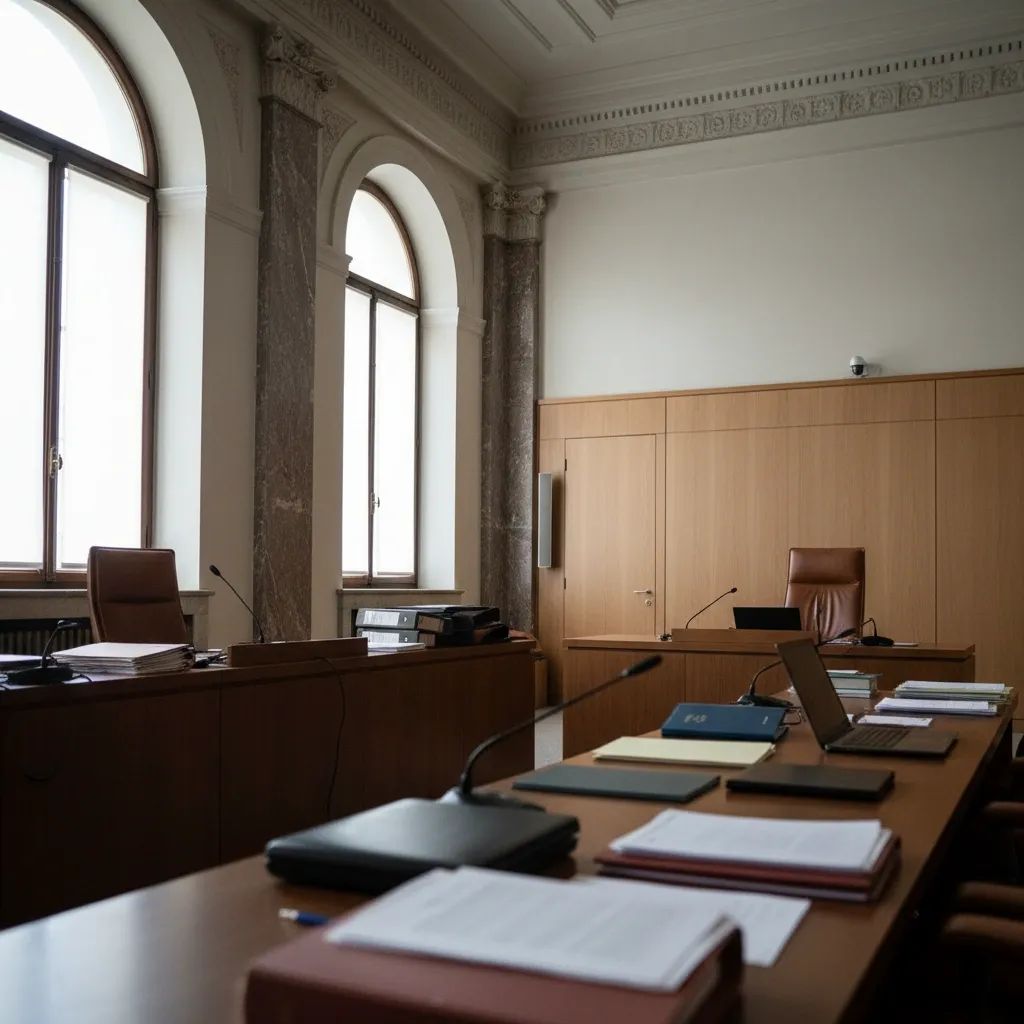
Italy is at the center of an international legal crisis after the International Criminal Court formally referred the country to its governing body for releasing a war crimes suspect, exposing deep tensions between domestic politics and international legal obligations. The referral means Italy could face diplomatic consequences and questions about its commitment to international law, though the Assembly of States Parties has limited enforcement mechanisms beyond public censure.
Why This Matters
• Italy's compliance crisis: The ICC has officially referred Italy to the Assembly of States Parties for failing to cooperate in the January 2025 Almasri case, where Rome released a war crimes suspect and flew him to Tripoli instead of handing him to The Hague.
• Global precedent at stake: If ICC enforcement collapses, the international legal architecture created after World War II to prosecute atrocities faces extinction.
• Judicial staff under attack: Russian courts have sentenced ICC judges—including an Italian national—to 15 years in absentia, while U.S. sanctions have cut off cloud services and email access for prosecutors.
Italian Judge Condemned by Moscow Speaks Out
Judge Rosario Salvatore Aitala, First Vice-President of the ICC and the only Italian national on its bench, delivered a keynote address at the University of Perugia marking the inauguration of the 2025-2026 academic year. His remarks came barely two months after a Moscow tribunal sentenced him to 15 years imprisonment in retaliation for his role in issuing an arrest warrant against Russian President Vladimir Putin.
Aitala warned that the International Criminal Court is under unprecedented pressure. "If the ICC collapses under pressure, what will remain of the post-WWII international justice architecture?" he stated bluntly during his speech titled "Force and Reason: Toward a Politics of Peace."
His address framed the current moment as a civilizational crossroads, contrasting the logic of law—dialogue, restraint, negotiation—with the resurgence of violence as both a domestic political tool and the organizing principle of state relations.
"When historians write about these days, they will point to a return to the culture of violence," he said, "the same culture that marked the decades between the Great War and the Second World War. We are witnessing violence return as the measure of interpersonal relations and as a primitive law in international affairs. This marks a step backward of a century."
The Almasri Case: Italy in the Dock
The ICC's referral of Italy to its governing body represents one of the most serious breakdowns in cooperation since the Court's founding. In January 2025, Italian authorities arrested Osama Almasri Njeem, a Libyan national accused of war crimes and crimes against humanity, pursuant to an ICC warrant. Days later, Italy released Almasri and transported him back to Tripoli aboard an Italian state aircraft—without notifying the Court.
On January 26, 2026, Preliminary Chamber I formally referred the matter to the Assembly of States Parties, citing Italy's failure to fulfill its treaty obligations under the Rome Statute. The decision described the incident as emblematic of the "enormous pressures" facing the institution and stressed that full cooperation from member states is essential for the Court's mandate to function.
The legal fallout in Italy continues. On October 30, 2025, the Court of Appeal of Rome referred a constitutional question to Italy's highest court, acknowledging a conflict between domestic law and international obligations. The Italian Parliament's Chamber of Deputies had refused authorization to prosecute the Minister of Justice for alleged dereliction of duty, effectively shielding executive decisions from judicial review and preventing Italian courts from enforcing Rome Statute commitments.
This constitutional referral is critical for Italy's future approach to international law. If the Constitutional Court sides with Parliament's decision to shield the Justice Minister, it could fundamentally change how Italy implements international arrest warrants, potentially affecting future cases involving foreign nationals on Italian soil. The constitutional review spotlights a deeper structural issue: political discretion potentially overriding judicial independence in matters of international criminal law—a precedent with lasting consequences for Italy's international legal obligations.
Superpowers Target Prosecutors and Judges
The ICC is enduring unprecedented institutional assault from two directions. The United States has imposed multiple rounds of sanctions on Court personnel since June 2025, including travel bans and asset freezes targeting judges and Chief Prosecutor Karim Khan. The sanctions—linked to investigations into both American military conduct in Afghanistan and Israeli officials—have disrupted access to basic digital infrastructure. Personnel sanctioned by Washington have been locked out of Microsoft and Google services, crippling email and cloud document systems critical to case management.
In February 2026, United Nations experts condemned Moscow's sentencing of ICC Prosecutor Karim Khan and eight judges, including Aitala, describing the verdicts as a "flagrant violation of international law" and an "unprecedented attempt to criminalize the exercise of judicial functions." The Russian convictions stem from the Court's March 2023 arrest warrant for Putin, issued for the unlawful deportation of Ukrainian children.
Both Washington and Moscow reject ICC jurisdiction, yet neither is directly subject to the Rome Statute. The United States never ratified the treaty, while Russia withdrew its signature in 2016. The sanctions and criminal convictions represent external efforts to cripple the Court's operations without formal legal standing.
Academic Solidarity and the Peace Initiative
Aitala's Perugia speech doubled as an endorsement of the "Universities, Bridges of Peace" initiative championed by University Rector Massimiliano Marianelli. The project brought together 22 Italian universities to sign the "Charter of Assisi," a document committing academic institutions to promoting dialogue, conflict resolution education, and the primacy of international law.
"We must continue to breathe reason," Aitala said, praising the initiative as "significant, intelligent, and not merely ceremonial—because it opposes reason to force."
The remark reflects a broader trend: as national governments retreat from multilateral justice mechanisms, universities across Europe are stepping into the vacuum. In December 2025, faculty from institutions including the Università Cattolica del Sacro Cuore in Milan, the University of Palermo, the University of Pisa, and the University of Turin signed an open letter condemning sanctions against ICC staff and warning that European inaction erodes both international justice and the continent's credibility as a defender of the rule of law.
The University of Galway's Irish Centre for Human Rights continues to host an annual ICC Summer School, recognized as a flagship training program. Meanwhile, U.S.-based institutions like the Whitney R. Harris World Law Institute at Washington University and the War Crimes Research Office at American University have published extensive legal analyses urging renewed American support for the Court.
What This Means for Residents and Italy's International Standing
For Italy, the ICC referral raises uncomfortable questions about sovereignty, executive authority, and treaty compliance. The constitutional review now underway could force Parliament to choose between affirming judicial independence in international obligations or codifying executive discretion to override them.
If the Italian Constitutional Court rules that domestic political processes can block enforcement of ICC warrants, it would signal a departure from the Rome Statute's binding framework—a move that could embolden other signatories to defy Court orders and fundamentally weaken international justice mechanisms that Italy has long championed.
More broadly, the attacks on the ICC illustrate the fragility of international legal institutions when confronted by determined state actors. The Assembly of States Parties held its first-ever plenary session on non-cooperation in December 2025, acknowledging the systemic nature of the problem. Mongolia was declared non-compliant for failing to arrest Putin during a state visit; Hungary initiated withdrawal procedures in April 2025, effective June 2026; and Burkina Faso, Mali, and Niger announced a joint exit in September 2025, calling the Court a "neoimperialist project."
For professionals, academics, and residents in Italy, the Almasri affair is a reminder that international law enforcement depends on voluntary state cooperation—and that cooperation is increasingly conditional on political expedience. The outcome of Italy's constitutional review will set a precedent for how European democracies navigate conflicting domestic and international legal demands in an era of resurgent nationalism and great-power competition, directly affecting Italy's standing among Western allies and its role as a defender of international law.


