
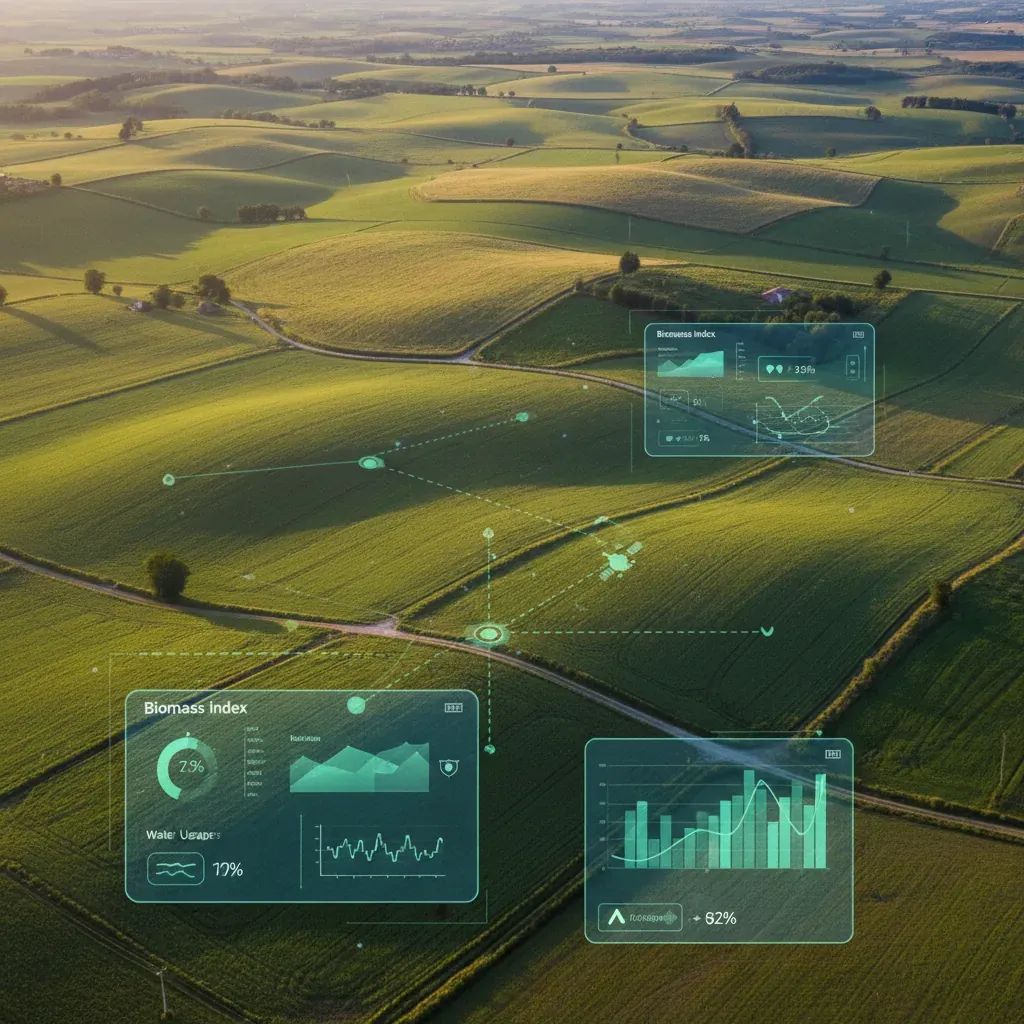
Italy's national insurance association and its agricultural disbursement agency have launched a joint anti-fraud system that combines satellite surveillance with AI-powered risk detection, a move that could save hundreds of millions of euros in public funds while tightening oversight on subsidized farm insurance claims.
Why This Matters:
• Satellite monitoring and artificial intelligence will cross-check farmers' declared land use against real-time field conditions, catching discrepancies before payouts occur.
• The system targets both subsidized insurance premiums and public agricultural funds, two areas where Italy lost over €137 M to fraud between 2022 and 2023 (a two-year total).
• Livestock operations and compensation requests will face enhanced scrutiny, with insurers and government agencies now sharing data on claims and field audits.
A Dual-Front Approach to Agricultural Fraud
The Italy National Association of Insurance Companies (Ania) signed the protocol with the Agency for Agricultural Disbursements (Agea) in April 2026, marking the first formal collaboration between the country's insurance market and its primary farm subsidy administrator. Ania president Giovanni Liverani and Agea director Fabio Vitale formalized the partnership, which welds together two historically separate enforcement systems.
Agea brings to the table its Sentinel-Copernicus satellite network, high-resolution orthophotos, and machine-learning models capable of classifying crop types and detecting vegetation anomalies across 90,000 square kilometers of Italian farmland. That monitoring infrastructure already helped Agea identify previously undeclared land that cost the country more than €700 M in lost Common Agricultural Policy (CAP) funding. Now those same tools will scrutinize insurance claims for crop damage, hail losses, and livestock incidents.
Ania and its member companies contribute expertise in policy underwriting and claims liquidation, the phase where most fraudulent payouts slip through. By cross-referencing satellite data with claim timestamps and damage reports, the integrated system can flag inconsistencies—such as a farmer reporting hail destruction on a field that satellite imagery shows remained green and intact.
How the System Intercepts Anomalies
At the core of the new framework are joint risk indicators designed to catch fraud before funds leave the treasury or an insurer's account. The process unfolds in layers:
Declared versus observed: When a farmer files a claim or applies for subsidized coverage, the system compares the stated crop type, planting date, and field boundaries against multispectral satellite images and radar data. Algorithms measure vegetation indices—NDVI, chlorophyll content, water stress markers—to verify that the declared activity matches on-the-ground biology.
Time-series analysis: Recurrent neural networks and long short-term memory models track how individual parcels evolve through planting, emergence, flowering, and harvest. A field declared as wheat but showing corn's growth signature, or a plot supposedly irrigated but displaying drought stress, triggers an alert.
Claim congruity checks: When a compensation request arrives, Agea's geospatial archive and Ania's claim history are queried simultaneously. Repeat claimants, implausible damage patterns, or requests filed for parcels not visible in recent orthophotos all raise red flags. The system uses a traffic-light scoring model—green for normal, red for high-risk cases that warrant on-site inspection.
Livestock and zootechnical controls: The partnership extends beyond crop insurance. Italy's livestock sector, worth billions, has historically been difficult to audit. By integrating animal registry databases, veterinary records, and farm-gate sensor data, the new protocol can detect phantom herds, inflated mortality claims, or discrepancies between declared herd size and actual feed purchases.
The Scale of the Problem
Italy's agricultural sector lost €137.6 M to 1,433 fraud cases reported in 2022 and 2023, according to the Court of Auditors. Between 2020 and 2023, judges ordered the return of €34.6 M through 230 convictions. The European Public Prosecutor's Office (EPPO) opened 117 investigations in 2024, most involving falsified land titles, phantom infrastructure projects, and bogus expense reports.
Agro-mafia operations—a sprawling ecosystem of labor exploitation, land grabs, usury, and food adulteration—generate an estimated €25.2 billion annually. While the Ania-Agea protocol does not directly target organized crime, officials believe that closing fraud loopholes in subsidized insurance and CAP payments will starve criminal networks of an easy revenue stream.
On the insurance side, 26.2% of auto liability claims in 2023 were flagged as potentially fraudulent, the highest rate in a decade. Although agricultural insurance fraud statistics are less centralized, industry insiders estimate that fraudulent crop and livestock claims cost carriers tens of millions each year, costs ultimately passed to policyholders or absorbed by the state through subsidy top-ups.
What This Means for Farmers and Insurers
Benefits for Honest Farmers
Honest producers stand to benefit from faster claim processing. Because the satellite and AI system pre-validates most applications, insurers can approve legitimate requests without waiting for manual field inspections. Agea reports that its digital monitoring has already reduced false positives—cases where algorithms incorrectly suspect fraud—allowing quicker disbursement to compliant farmers.
Insurance premiums may eventually stabilize or even decline in regions where fraud rates drop. Companies currently price subsidized agricultural policies assuming a baseline fraud risk; if the new system proves effective, carriers could pass savings to policyholders or the government could reduce subsidy outlays, freeing funds for other farm support programs.
Consequences for Fraudsters
For those tempted to game the system, the message is clear: the days of paper-based declarations and spot checks are over. Agea's anonymous tip line, which was previously launched as part of earlier anti-fraud initiatives and is now integrated into the joint protocol with Ania, will feed additional intelligence into the monitoring pipeline. Insurers will flag suspicious claims that Agea can then cross-check against CAP subsidy applications, creating a comprehensive detection network.
Technical Infrastructure and European Recognition
Agea's monitoring suite draws on the European Space Agency's Sentinel constellation, which provides free, open-access radar and optical imagery updated every few days. Machine-learning classifiers trained on historical Italian field data can distinguish wheat from barley, permanent pasture from fallow land, and even detect unauthorized tree felling or illegal building construction on agricultural parcels.
In 2023, Agea reorganized its internal controls by creating an Anti-Fraud and Risk Compliance Office staffed with data scientists, agronomists, and investigative auditors. The European Anti-Fraud Office (OLAF) has praised Italy's approach, designating the country as a testing ground for next-generation fraud prevention tools that may eventually be rolled out across the European Union.
Challenges and Privacy Considerations
While the protocol's architects emphasize transparency and efficiency, some agricultural associations have raised concerns about data privacy and the potential for algorithmic bias. Small-scale farmers worry that machine-learning models trained primarily on large, monoculture operations may misclassify diverse, organic, or experimental plots as anomalies, triggering unwarranted scrutiny.
Agea has pledged to maintain human oversight at critical decision points, ensuring that no claim is denied or subsidy revoked based solely on automated analysis. Farmers flagged by the system will have the right to request an in-person inspection and appeal any adverse finding. The agency is also working with farmer cooperatives to refine its models, incorporating feedback from growers who understand local microclimates, soil variations, and traditional practices that satellite data alone might misinterpret.
Another open question is how the system will adapt to climate volatility. Extreme weather events—hailstorms, flash floods, late frosts—are becoming more frequent and unpredictable, meaning that legitimate crop damage can look statistically unusual. Algorithms will need continuous retraining to distinguish between genuine climate-related losses and fabricated claims.
Broader Implications for Agricultural Policy
The Ania-Agea partnership signals a broader shift in how European governments administer farm support. For decades, the CAP operated on a largely honor-based system, with periodic audits and sanctions applied after the fact. Satellite monitoring and AI flip that model, enabling real-time compliance verification and preemptive intervention.
If the pilot succeeds, expect similar protocols to emerge in other member states. France, Spain, and Poland—the EU's other major agricultural economies—are already experimenting with geospatial fraud detection, and Brussels has made digital monitoring a cornerstone of its post-2027 CAP reform proposals.
For Italy's farmers, insurers, and taxpayers, the immediate takeaway is practical: the era of unauditable paper trails is closing. Those who operate transparently will find bureaucracy lighter and payouts faster. Those who don't will face increasingly sophisticated monitoring capabilities that continue to expand and improve.


