
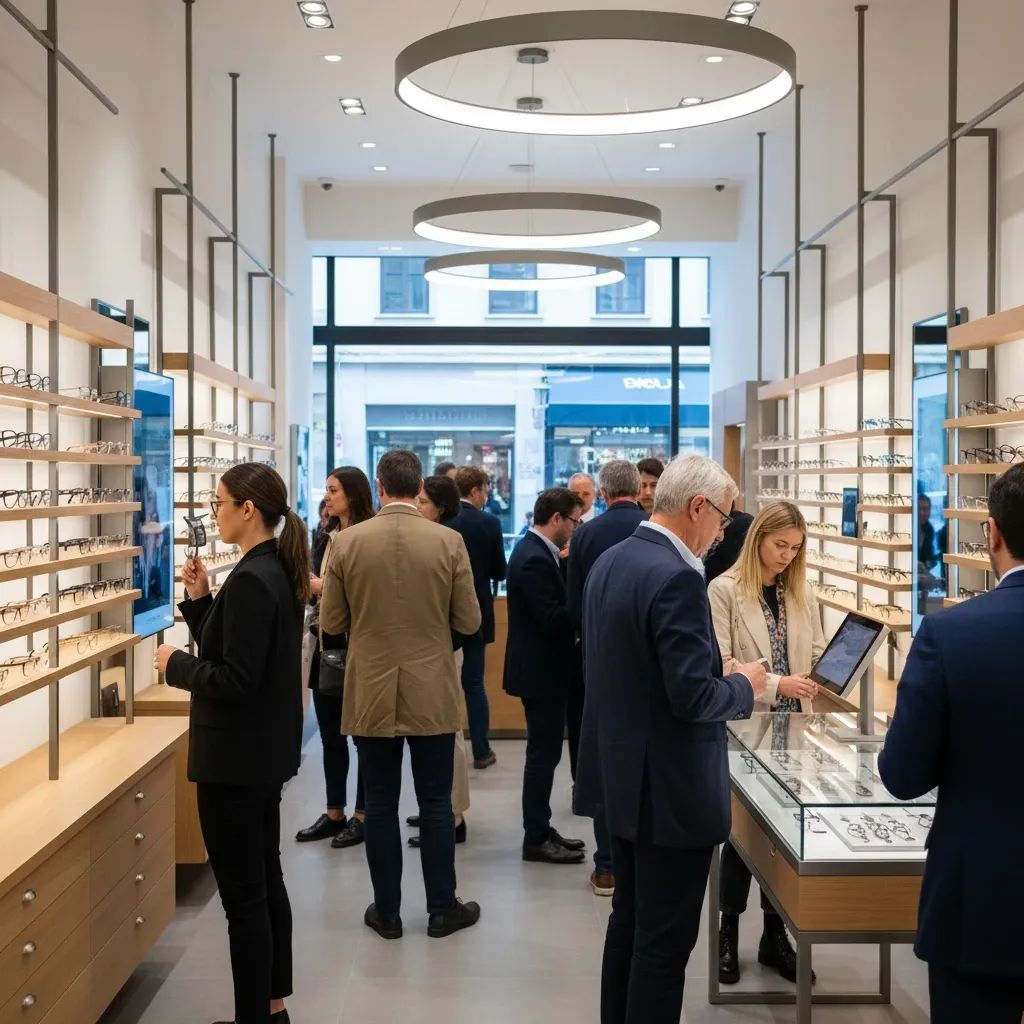
EssilorLuxottica Italia has posted revenue of €7.13B for the first quarter of 2025, marking its third consecutive quarter of double-digit growth at 10.8% on a constant currency basis. The performance reinforces the company's dominance in the global vision care and eyewear industry, with significant implications for its Italian workforce—who stand to receive performance bonuses exceeding €4,000 as the company continues its expansion trajectory.
Why This Matters
• Jobs and bonuses: Italian employees will receive a base performance bonus of €3,090, potentially reaching €4,095 if converted into welfare benefits—set for payment by June.
• AI eyewear boom: The new prescription-ready Ray-Ban AI glasses are driving revenue, with over 7M smart glasses sold in 2024.
• Retail expansion: The group now operates nearly 20,000 stores worldwide after strategic acquisitions in Thailand.
• Five-year outlook: Management forecasts sustained revenue and profit growth through 2030.
Revenue Surge Across All Geographies
The Italy-headquartered eyewear and lens giant reported consolidated revenue of €7.13B in Q1 2025, up 10.8% at constant exchange rates and 4.1% at current rates compared to the same period in 2024. This represents the company's third straight quarter of growth exceeding 10%, a streak that began in Q3 2024.
Both core business segments contributed meaningfully. The Professional Solutions division—which supplies optometrists, ophthalmologists, and optical retailers with prescription lenses and equipment—generated €3.36B in revenue, climbing 10.8% at constant rates. Meanwhile, the Direct to Consumer segment, encompassing the company's sprawling retail network of LensCrafters, Sunglass Hut, and other branded stores, brought in €3.76B, up 10.7%.
Geographically, North America led the charge with a 12.5% increase at constant rates, buoyed by strong demand for smart eyewear and premium prescription lenses. The EMEA region (Europe, Middle East, and Africa) recorded 9.5% growth, while China accelerated into "low-teen" territory—an industry term indicating 13–19% expansion—driven by myopia management solutions and improved retail performance in urban centers.
AI Glasses Drive Next Phase of Growth
The company's collaboration with Meta Platforms on Ray-Ban-branded smart glasses continues to reshape the product mix. In 2024, EssilorLuxottica and Meta sold more than 7M smart glasses units, a figure that more than tripled the prior year's total. The recently launched prescription-lens compatible Ray-Ban Optics AI glasses are "off to a strong start," according to company leadership, expanding the addressable market to include the millions of consumers who require vision correction.
Smart glasses contributed over 4 percentage points to the group's revenue growth in Q3 2024, with similar momentum carrying into early 2025. Reports suggest Meta and EssilorLuxottica are targeting production capacity of 20M units annually by the end of 2025 to meet surging demand, though inventory constraints have temporarily paused the international rollout of the display-equipped models.
The AI eyewear category is projected to ship more than 10M units globally in 2025, with a compound annual growth rate of 47% through 2029. However, these products currently carry lower profit margins than traditional eyewear, one factor cited for the company's adjusted operating margin of 16% in 2024—short of its 19–20% target for the 2021–2025 planning cycle.
What This Means for Italian Workers
For the approximately 10,000 employees EssilorLuxottica employs across manufacturing, retail, and corporate functions in Italy, the strong results translate into tangible financial rewards. The company and unions representing Filctem CGIL, Femca CISL, and Uiltec UIL have finalized the 2025 performance bonus agreement, which will be paid by June.
The base payout is €3,090 gross, but can climb to €3,723 gross when individual performance components are included. Employees who opt to convert the cash into welfare benefits—such as childcare vouchers, health insurance, or meal subsidies—receive favorable tax treatment, pushing the effective value to approximately €4,095.
"We believe that a company's success is not measured solely in numbers, but also in how those results are achieved and in its ability to create value for everyone," said Piergiorgio Angeli, Chief People Officer for EssilorLuxottica. "People, community, and social well-being are at the heart of our strategies."
Union representatives described the bonus as a "concrete recognition" of workers' contributions and a sign of the "solid system of labor relations" built over the years. The agreement comes amid broader efforts to safeguard employment and maintain the competitiveness of Italian manufacturing facilities in the long term.
Strategic Bets on Med-Tech and Retail
Beyond wearable tech, EssilorLuxottica is deepening its commitment to medical-grade vision care. The company's myopia management portfolio—which includes specialized lenses designed to slow the progression of nearsightedness in children—grew 26% globally, with an 18% increase in the critical Chinese market where myopia prevalence among youth exceeds 70%.
The group is also investing heavily in digital infrastructure for its retail network. New tools such as the Vision-R 800 phoropter, an advanced device for eye exams, and digital storefronts are intended to modernize the customer experience and improve diagnostic precision. EssilorLuxottica operates more than 50 R&D facilities across the United States, Europe, and Asia-Pacific, focusing on eco-design, lens coating technologies, and integrated audio solutions following its acquisition of Nuance Audio to enter the hearing aid market.
In Q1 2025, the company strengthened its retail footprint in Southeast Asia by investing in Top Charoen, a Thai optical chain with approximately 2,000 stores. That acquisition brought EssilorLuxottica's global store count to nearly 20,000 locations, spanning brands such as Sunglass Hut, LensCrafters, Pearle Vision, GrandVision, and Salmoiraghi & Viganò.
Competitive Landscape: Mixed Fortunes
While EssilorLuxottica accelerates, rivals face varied fortunes. Italy-based Safilo Group posted modest 1.8% revenue growth at constant rates in 2024, reaching €983M, with a focus on improving profitability rather than aggressive expansion. Japan's Hoya Corporation reported double-digit revenue growth in Q3 of its fiscal 2024, sustaining strong momentum in both lenses and healthcare technologies.
Conversely, Germany's Carl Zeiss Meditec saw revenue decline 4.8% in Q1 of its fiscal 2025 and suspended full-year guidance, citing geopolitical uncertainty and regulatory shifts in China that have dampened capital investments in ophthalmic equipment. Meanwhile, U.S.-based Warby Parker achieved its first full-year profit in 2024, with revenue up 13% to $872M, and plans to launch its own smart glasses in partnership with Google and Samsung.
The broader eyewear market is expected to reach $237B in 2025 and expand to $336B by 2029, driven by aging demographics, rising screen time, urbanization, and growing demand for premium and sustainable materials. Europe remains the largest regional market, followed by North America, with Asia-Pacific capturing an estimated 25% share in 2025.
Five-Year Growth Trajectory Outlined
Looking ahead, EssilorLuxottica's leadership—Francesco Milleri, Chairman and CEO, and Paul du Saillant, Deputy CEO—outlined expectations for "solid growth in total revenue" over the next five years at constant exchange rates, with adjusted operating profit expanding in line. The company emphasized its "pipeline of innovation" and the resilience of its integrated model, which spans lens manufacturing, frame design, brand licensing, and retail distribution.
"In an uncertain context, we are proceeding with clarity and confidence, continuing to build the future we believe in," Milleri and du Saillant stated in their commentary on the Q1 results.
The company's brand portfolio includes over 150 labels, from house names like Ray-Ban, Oakley, and Persol to licensed luxury brands such as Prada, Chanel, Versace, and Dolce & Gabbana—the latter recently renewed through 2050. EssilorLuxottica also inaugurated a new lens production facility in Laos and a center of excellence in France to expand manufacturing capacity.
Margin Pressure and Profitability Challenges
Despite robust top-line growth, EssilorLuxottica faces headwinds on profitability. The company's adjusted operating margin of 16% in 2024 fell short of the 19–20% target set for the 2021–2025 planning period, partly due to the lower margins on AI eyewear and increased investment in digital transformation and retail expansion.
Analysts note that smart glasses, while a meaningful revenue contributor, carry higher component costs—including processors, cameras, and audio systems—compared to conventional frames. The competitive environment is also intensifying, with Apple and Google both expected to enter the smart eyewear market in the coming years.
Nonetheless, the company's record cash flow of €2.8B in 2024 and its ability to self-fund acquisitions and R&D provide a cushion to absorb short-term margin compression while positioning for long-term category leadership.
Outlook: Stability and Innovation in Uncertain Times
EssilorLuxottica's Q1 2025 performance underscores its ability to navigate macroeconomic volatility—marked by currency fluctuations, consumer caution in mature markets, and shifting reimbursement policies for vision care—while capitalizing on secular trends such as digitalization, aging populations, and the convergence of eyewear with consumer electronics.
For residents and workers in Italy, the company's trajectory signals continued investment in local operations, both in manufacturing and retail. The performance bonus agreement, reached through constructive dialogue with unions, reflects a labor relations model that balances competitiveness with employee welfare—a notable example in an era of strained industrial relations across Europe.
As the global eyewear market evolves from pure fashion accessory to multifunctional wearable device, EssilorLuxottica's dual heritage—combining Luxottica's design and retail prowess with Essilor's optical and medical expertise—positions the group to capture value across the entire chain, from myopia management in children to augmented-reality glasses for aging consumers.


