
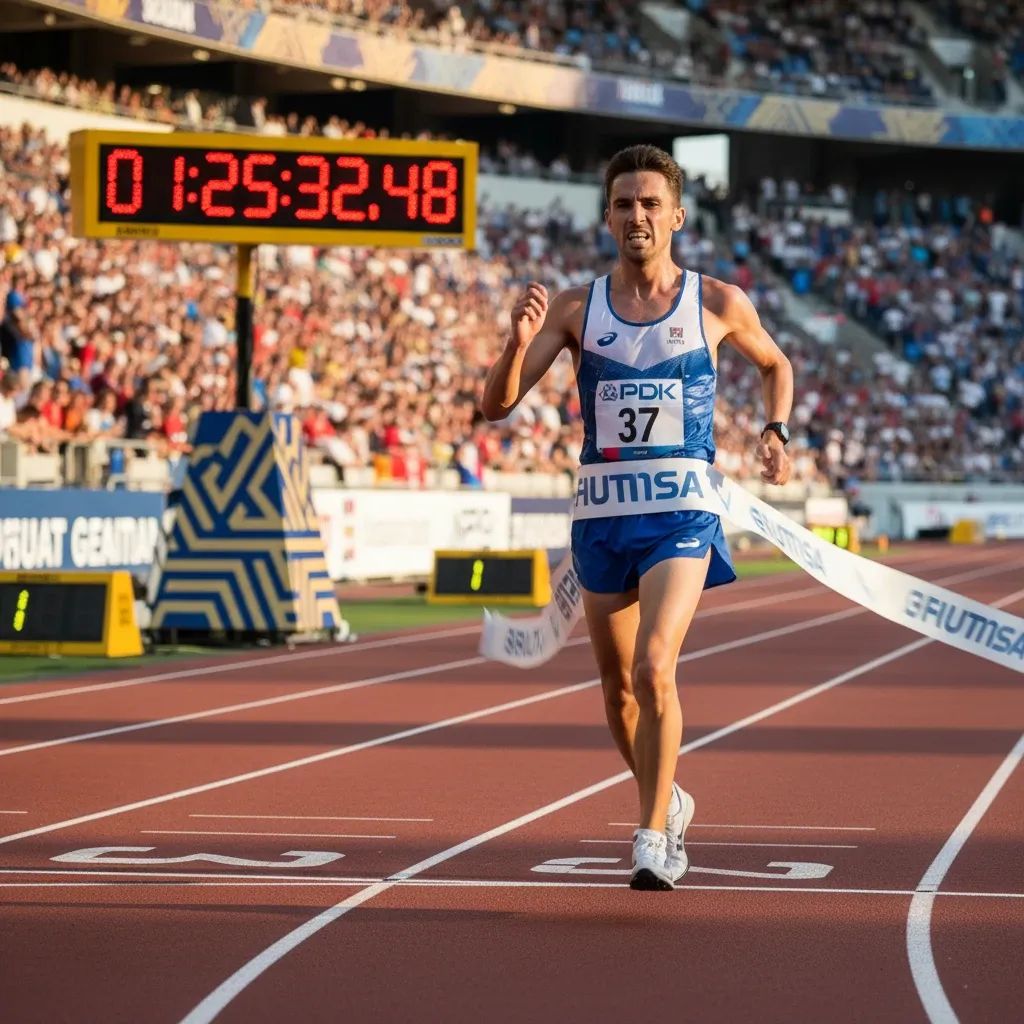
The Italy Athletics Federation now faces a complicated choice: Alex Schwazer, the 41-year-old race walker with two doping bans behind him, just clocked the Italian national record in the marathon walk, posting 3:01:55 at a German international open on April 26, 2026—automatically qualifying him for the European Championships in Birmingham this August.
Why This Matters
• Qualifying standard met: Schwazer's time ranks 3rd globally in the new 42.195 km distance and is the best European performance of 2026, officially securing the Birmingham minimum.
• New discipline, fresh slate: World Athletics introduced the marathon walk only this year, replacing the traditional 35 km format, meaning every national record is newly minted.
• Selection headache: Italy's federation must weigh sporting merit against Schwazer's controversial past, which includes an 8-year ban ending just 21 months ago.
• Non-professional status: Schwazer says he holds a full-time job and a family, casting doubt on whether he even wants a spot on the national team.
Record Performance Under Headwinds
The race unfolded in Kelsterbach, near Frankfurt, during an event that doubled as the German Open National Championships. Schwazer crossed the finish line more than 2 minutes faster than the previous Italian benchmark of 3:03:55, set by Andrea Agrusti. Speaking to Italy's ANSA news agency by phone minutes after the race, Schwazer acknowledged battling "strong headwinds that conditioned the entire race" and estimated his effort would translate to around 2:58 under ideal conditions.
"I came here to deliver an excellent performance," he said. "The form is excellent. We decided to prepare for the longer distance—it was five very demanding weeks, but the sacrifices have been fully repaid."
His result places him on the global leaderboard for a discipline that only gained official status in 2026, when World Athletics overhauled race walking to mirror road-running distances. The traditional 20 km and 35 km walks gave way to the half-marathon (21.097 km) and full marathon (42.195 km), a reform designed to make the sport more comprehensible to casual fans and boost participation. Schwazer's 3:01:55 trails only two walkers worldwide this season, underscoring that his training block—compressed into little more than a month—produced world-class output.
Comeback Shadowed by Doping History
Schwazer's return to elite racing carries unavoidable baggage. The Italy Olympic bronze medalist from Beijing 2008 and gold medalist in the 50 km walk at London 2012 served a 45-month ban after testing positive for EPO in 2012. He resumed competition briefly before a second positive test for testosterone in 2016 triggered an 8-year suspension, which expired only in July 2024.
A Bolzano criminal court acquitted him in 2021, ruling he "did not commit the act" and suggesting possible tampering with his sample. Yet World Athletics and the World Anti-Doping Agency (WADA) declined to recognize the penal verdict, and the Court of Arbitration for Sport (CAS) upheld the sporting sanction in full. His hopes of competing at the Paris 2024 Olympics evaporated when the final CAS appeal failed months before the Games.
Rocky Return to Domestic Competition
Schwazer made his federally sanctioned comeback on March 8, 2026, at the Italy National Half-Marathon Walk Championships in Alessandria, his first FIDAL race in 8 years. The event ended in frustration: judges issued multiple warnings for technical violations—both feet leaving the ground simultaneously, a cardinal sin in race walking—and he withdrew roughly 6 km from the finish rather than risk formal disqualification.
Despite that setback, he pressed forward, opting to skip another domestic attempt and instead traveled to Germany for the longer, less scrutinized international open. The gamble paid off. No technical infractions marred his 42 km effort, and the clock delivered validation his Alessandria outing could not.
What This Means for Residents
For Italian sports fans, Schwazer's performance reignites an old debate: should athletic merit alone determine national-team selection, or does integrity history carry a veto? The Italy Athletics Federation (FIDAL) has not yet published final selection criteria for Birmingham, which runs August 10–16 at the Alexander Stadium. Typically, FIDAL weighs European Athletics minimums, recent form, and coaching input—but Schwazer's profile adds a layer of reputational risk.
If selected, he would become one of the oldest Italian track-and-field athletes ever to compete at a major championship. His presence could also overshadow younger, untarnished talents in the walk squad, potentially diverting media oxygen from cleaner narratives. Conversely, excluding a legitimate record holder risks accusations of double standards, especially since his criminal acquittal remains on the books in Italy even as global sporting bodies reject it.
Open Question: Does He Even Want It?
Schwazer himself offered little clarity. "It certainly doesn't depend on me," he told ANSA when asked about Birmingham. "I'm not a professional athlete. I have a job, a family, and the last race I specifically prepared for was the one I hoped to run at the Paris Olympics. It's not easy—there are many things to understand. Now I've raced here, I'll take a break, and then we'll see."
That ambivalence suggests his Germany outing may have been a personal closure project rather than the opening salvo of a championship campaign. If FIDAL extends an invitation, he will face a binary choice: return to the pressure-cooker environment of international championships or walk away on a high note, record in hand.
New Era for Race Walking
The marathon walk's debut as an official distance has reset the record books worldwide. In men's competition, Japanese walker Toshikazu Yamanishi set a 20 km world record of 1:16:10 in February 2025, while Italy's Massimo Stano claimed the 35 km global mark at 2:20:43 in May 2025, just weeks before that distance was retired. Women's benchmarks include Yang Jiayu's 1:23:49 in the 20 km (2021) and María Pérez's 2:37:15 in the 35 km.
Because the 42.195 km format is brand-new, national federations across Europe are still calibrating what constitutes competitive depth. Schwazer's 3:01:55 would have placed him among medal contenders had the distance existed at prior championships, but the shallow field in Germany—an open event rather than a championship final—leaves uncertainty about how the time stacks up under true race conditions.
Timeline Ahead
FIDAL typically announces European Championship rosters in late June or early July, giving selectors roughly 8 to 10 weeks to assess form, review injury reports, and navigate any political minefields. Schwazer indicated he would "take a pause," which could mean anything from a few weeks of light training to a complete step back from structured prep.
If he does receive the call, Birmingham would mark his first appearance in an Italy national team uniform at a major outdoor championship since 2012—a 14-year gap bridging two doping bans, a criminal trial, multiple appeals, and now a national record in a discipline that did not exist when his career began.
Whether that arc ends in redemption or remains forever qualified by an asterisk will depend as much on federation politics as on the stopwatch. For now, the clock says 3:01:55, and the record is Italian.


