
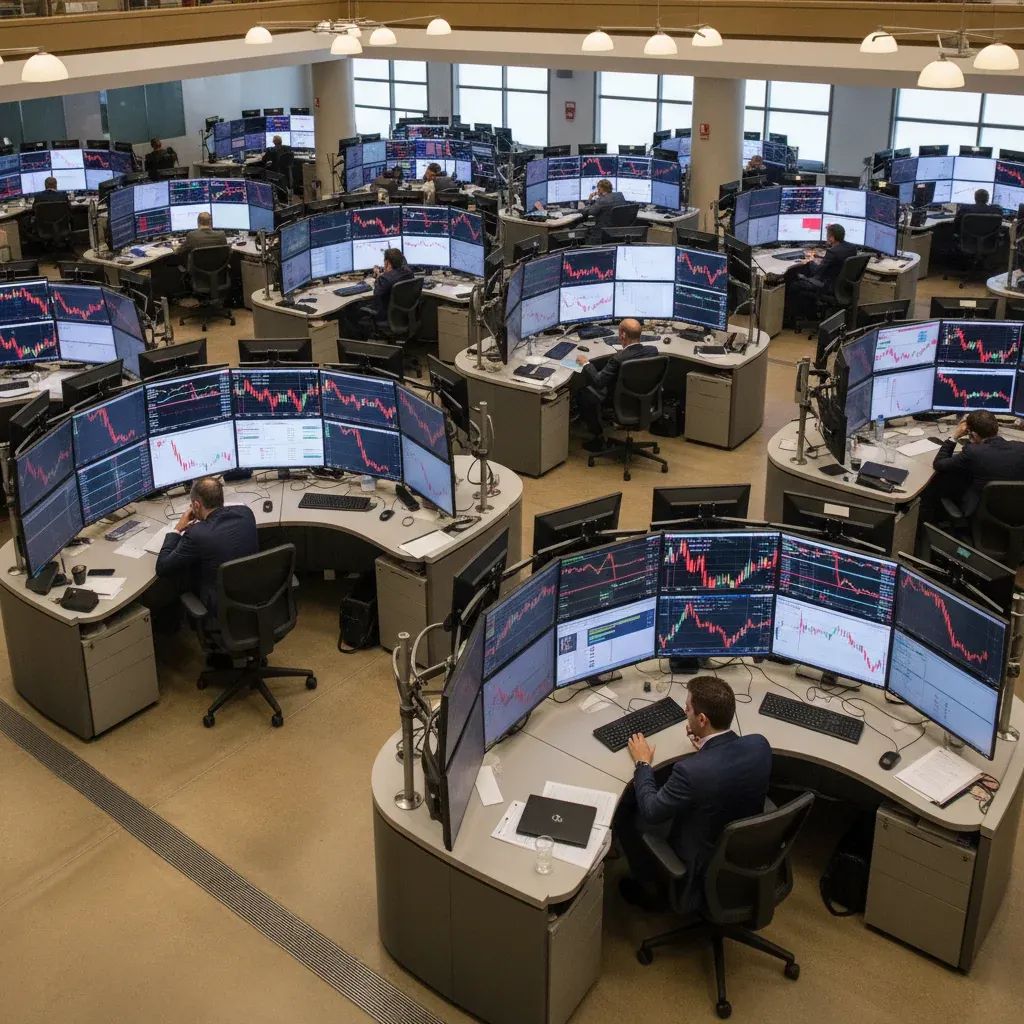
Italy's 10-year government bond spread over the German Bund closed at 79.6 basis points, an uptick from Friday's close and a reflection of heightened Middle Eastern tensions that continue to ripple through European debt markets.
Why This Matters
• Energy exposure amplifies Italy's borrowing costs – geopolitical shocks in the Strait of Hormuz are widening the premium investors demand to hold Italian debt.
• BTP yields climbed to 3.83% compared to 3.03% for German Bunds, signaling that markets see Italy as more vulnerable to oil price spikes.
• May auctions ahead – the Italian Treasury will test investor appetite with BOT auctions on May 7 and medium-to-long term BTP issuance on May 8.
The Daily Pulse of Sovereign Risk
The Italy Ministry of Economy and Finance saw its benchmark 10-year BTP yield rise by 5.2 basis points to 3.83% as trading closed, while the German equivalent climbed 3.9 basis points to 3.03%. French OAT yields moved 4.9 basis points higher to 3.68%. The spread—financial shorthand for the perceived riskiness of Italian sovereign debt relative to Germany's safe-haven Bund—opened the session at 79 basis points and drifted higher throughout the day.
This widening reflects a broader pattern visible since mid-April. On April 24, the differential briefly touched 81 basis points as crude oil prices surged on reports that Iran had seized cargo vessels transiting the Strait of Hormuz, a chokepoint accounting for roughly one-fifth of global petroleum flows. Markets immediately repriced energy-dependent economies like Italy, pushing BTP yields to a 3.85% average while Bunds held near 3.04%.
By contrast, the spread had closed at 78 basis points on April 23, with Italy's 10-year benchmark (maturing February 1, 2036) yielding 3.78%. The retreat to 79.6 basis points represents a modest stabilization, though analysts caution that any escalation in U.S.-Iran talks—or a prolonged Hormuz blockade—could push the differential back toward 80 or higher.
What This Means for Investors and Savers
For Italian households holding government bonds or considering new purchases, the current spread environment carries both risk and opportunity. BTP yields remain substantially above German levels, offering a 12.5% withholding tax advantage (versus 26% on most other investments) that makes them attractive for domestic savers seeking stable income. A 10-year BTP now delivers roughly 80 basis points more annual yield than a comparable Bund, equivalent to an extra €800 per year on a €100,000 investment.
However, the widening spread also signals market anxiety about Italy's fiscal resilience in the face of an energy shock. The country imports most of its natural gas, and any sustained spike in oil and LNG prices would weigh on public finances and growth forecasts. Analysts at AcomeA Performance argued in late 2025 that a spread around 70 basis points was "poorly justified by fundamentals," anticipating further tightening toward 50 basis points driven by institutional portfolio rebalancing. That thesis now looks premature; geopolitical instability has reminded investors why peripheral eurozone debt commands a premium.
Auction Calendar Adds Pressure
The timing compounds the challenge. Italy's Treasury conducted a short-term BTP auction on April 24 that attracted robust demand, with yields on two-year paper falling 8 basis points to 2.8% compared to the prior month. That success suggests investors still have appetite for Italian paper at the right price, but upcoming sales will be the real test.
On May 7, the Ministry will auction BOT bills; the following day, May 8, it will offer medium- and long-term BTPs with maturities of 3, 7, and 15 years, carrying gross coupons of 2.40%, 3.30%, and 3.95% respectively. If the spread remains elevated or widens further, the Treasury may need to sweeten yields to clear the targeted volumes—an outcome that would raise debt-servicing costs for taxpayers over the life of the bonds.
Historical patterns offer some reassurance. Italian auctions have consistently drawn bids exceeding the amounts on offer, a sign that global fixed-income managers view BTPs as a core holding despite volatility. Yet the April 24 spike above 81 basis points arrived at an inopportune moment, just as the last wave of April issuance hit the market.
European Context: Italy's Relative Position
Compared to its eurozone peers, Italy occupies a middle tier in the risk hierarchy. On April 17, the French OAT 10-year yield stood at 3.58%, implying a 62-basis-point spread over the Bund, while Spanish Bonos yielded 3.39%, a 43-basis-point premium. Italy's 72-basis-point spread that day placed it firmly above both, underscoring the market's view that Rome has less fiscal headroom and a heavier debt load—public debt-to-GDP hovers near 140%—than Madrid or even Paris.
Still, Italy benefits from political stability relative to the turbulence seen elsewhere in Europe over the past year, and its 2025 budget execution remained within EU guardrails. Analysts at Morningstar noted in December 2025 that after the spread collapsed to 15-year lows near 70 basis points, further tightening looked "limited" because fundamentals—weak potential growth, narrow fiscal margins, geopolitical exposure—offered little justification for pricing Italian risk much closer to Germany's.
Strait of Hormuz: The External Shock
The Strait of Hormuz crisis is the thread connecting every data point. Former U.S. President Donald Trump's threats against Iran and Tehran's subsequent detention of civilian cargo ships triggered a supply-risk premium in oil markets that cascaded into sovereign debt. Europe's energy-intensive economies, particularly those dependent on seaborne LNG and crude imports, saw investors demand higher yields to compensate for potential stagflation—a toxic mix of elevated inflation and stalled growth.
Italy fits that profile. Natural gas still accounts for a significant share of electricity generation, and industrial sectors from chemicals to steel are sensitive to input costs. When oil spiked in mid-April, markets immediately questioned whether the European Central Bank would maintain its accommodative stance or hold rates higher for longer to contain energy-driven inflation. That uncertainty pushed yields higher across the eurozone, but the effect was most pronounced in Italy, where the sovereign is perceived as less insulated from external shocks.
Talks between Washington and Tehran remain deadlocked as of this writing, and shipping insurers have raised premiums for vessels transiting the Gulf. Until a diplomatic breakthrough materializes—or the blockade eases—energy volatility will continue to weigh on peripheral eurozone spreads.
Outlook: Range-Bound but Vulnerable
Most fixed-income strategists expect the BTP-Bund spread to oscillate between 75 and 85 basis points through May, barring a dramatic escalation in the Middle East. The May 8 auction will serve as a live stress test: strong demand would validate current pricing and could nudge the spread back toward 75; tepid takeup would signal that investors want more compensation, pushing the differential toward the top of the range or beyond.
Longer-term projections from late 2025 had penciled in a spread around 50 to 60 basis points for 2026, premised on Germany's own rising borrowing costs to fund defense and infrastructure upgrades. That scenario assumed benign geopolitics and smooth ECB policy normalization—assumptions now in doubt. Daniele Bivona of AcomeA Performance had suggested that institutional flows could compress the spread to 50 basis points despite weak fundamentals, but April's events have reminded markets that Italy's risk premium can widen quickly when external conditions deteriorate.
For now, the Italian Treasury continues to enjoy relatively favorable financing conditions by historical standards—3.83% is well below the levels seen during the eurozone debt crisis—but the recent uptick serves as a reminder that Italy's borrowing costs remain tethered to forces beyond Rome's control. Residents holding BTPs or planning purchases should monitor Hormuz headlines as closely as domestic fiscal policy; in today's interconnected markets, a tanker seizure in the Gulf can move yields in Milan just as surely as a budget vote in Parliament.


