
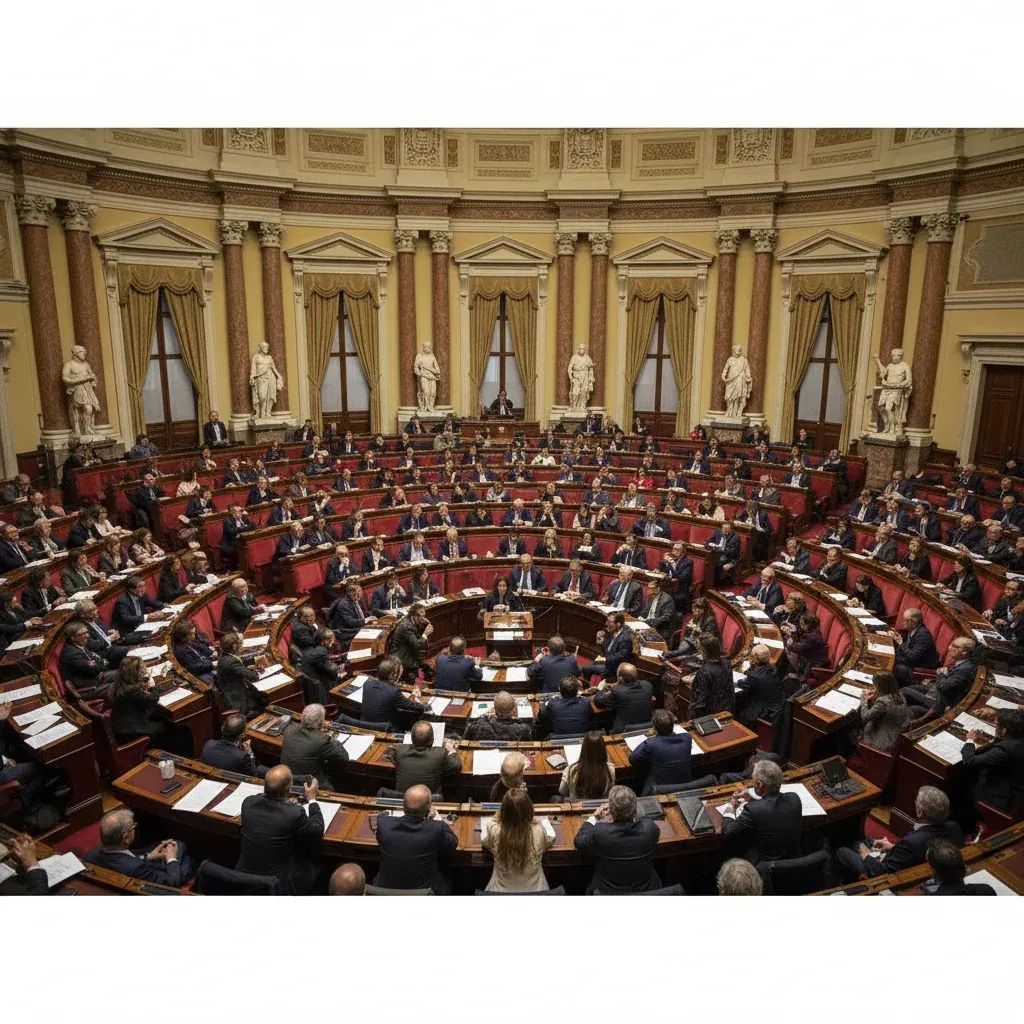
The Italy Liberation Day commemoration on this date, marking 81 years since the fall of the fascist regime, has once again exposed deep ideological fractures within the country's political class—divisions that continue to shape public discourse and complicate the national memory of wartime resistance.
Why This Matters
• Political division risks: The ongoing conflict over interpreting Liberation Day affects legislative priorities, including a stalled anti-fascist propaganda bill backed by 250,000 citizen signatures.
• Historical memory at stake: Calls for "national pacification" from governing coalition leaders are contested as attempts to dilute the anti-fascist foundation of Italy's republican Constitution.
• Daily impact: Cultural and memorial spaces remain contested terrain, with vandalism incidents and conflicting commemorations reflecting unresolved tensions.
Salvini Pushes "Pacification" Narrative at American War Cemetery
Italy Deputy Prime Minister Matteo Salvini, addressing reporters at the Florence American Cemetery and Memorial in Tavarnuzze near Florence, framed Liberation Day as "a day for everyone, by everyone," urging that the commemoration move beyond what he characterized as divisive rituals. The Lega leader acknowledged the sacrifice of over 300,000 Allied soldiers, including nearly 100,000 Americans buried across Italian soil, who fought against Nazi-fascism.
"I hope it won't take many more years before this becomes a day of reconciliation, of national pacification," Salvini stated. "After 80 years, still polemics, divisions, whistles, clashes at parades—on a day that should celebrate rebirth—that hurts."
The cemetery where Salvini spoke contains the remains of 4,402 U.S. servicemembers killed during the Italian campaign of World War II, one of two permanent American war cemeteries in Italy. The second, at Nettuno near Rome, holds 7,861 graves. Together, the sites memorialize over 12,000 dead and 5,500 missing from Allied forces.
Salvini's framing—positioning Liberation Day as a universal celebration rather than a specifically anti-fascist milestone—follows a pattern seen across Italy's governing coalition. On social media, the Lega leader broadened the definition further, writing: "Against every dictatorship and every regime, Nazi-fascist, communist or Islamist." Critics interpret such language as an effort to dilute the historical specificity of the anti-fascist Resistance that gave birth to Italy's democratic Constitution.
Left-Wing Leaders Demand Constitutional Enforcement
Giuseppe Conte, leader of the Five Star Movement (M5S), responded carefully to questions about whether Prime Minister Giorgia Meloni and her Fratelli d'Italia party fully embrace anti-fascist values. Speaking at a ceremony in Naples' Piazza Carità, Conte said he would not "arrogantly distribute certificates of democracy" to other leaders, but emphasized that all parliamentary forces must recognize anti-fascist principles.
"We take note of her [Meloni's] declarations," Conte said. "We also take note that until the other day, [Senate President] La Russa made statements of a different tone, we note that within Fratelli d'Italia, more ambiguous positions often emerge." He added that the important thing is that political forces "embrace these principles and anti-fascist values."
Conte underscored that Liberation Day should not be a "formal homage" but rather recognition of the moment Italy broke free from dictatorial repression and embraced democratic transformation, paving the way for the Constitution that took effect in 1948.
Democratic Party (PD) Secretary Elly Schlein took a harder line during her official address at Sant'Anna di Stazzema, the Tuscan village where Nazi SS troops massacred 560 civilians, including children, in August 1944. "If our Constitution sanctions freedom of expression and opinion," Schlein declared, "we must say that fascism is not an opinion—it is a crime, it is a crime, and neo-fascist organizations must be dissolved."
Schlein praised 32 parliamentarians who recently disrupted a neo-fascist conference by reading aloud from the Constitution, and committed the PD to advancing the popular-initiative bill born in Stazzema that would criminalize Nazi-fascist propaganda, including the production, distribution, or sale of materials featuring fascist symbols, imagery, or gestures.
Stalled Anti-Fascist Propaganda Bill Highlights Legislative Gridlock
The popular-initiative law against fascist and Nazi propaganda, promoted by Stazzema Mayor Maurizio Verona and backed by over 250,000 citizen signatures, remains blocked in the Justice Committee of the Italy Chamber of Deputies, chaired by a Fratelli d'Italia representative. The proposal seeks to close perceived gaps in existing legislation, specifically the 1952 Scelba Law, which prohibits the reconstitution of the fascist party, and the 1993 Mancino Law, targeting racial and ethnic hate speech.
Advocacy groups like the National Association of Italian Partisans (ANPI) have repeatedly called for the dissolution of organizations such as Lealtà e Azione, Forza Nuova, and CasaPound, invoking Article XII of the Constitution's transitional provisions, which explicitly bans the reorganization of the fascist party "in any form."
Counterproposals have emerged from the Lega. Deputy Eugenio Zoffili announced plans for legislation—not yet formally filed—that would classify "Antifa" groups as militant anarchist associations, with penalties of up to 15 years in prison, modeled on measures considered in the United States. Another Lega initiative from 2024 sought to eliminate so-called "anti-fascist certificates," which some municipalities require before granting access to public spaces.
What This Means for Residents
For people living in Italy, the Liberation Day debate is more than symbolic theater. The unresolved legislative standoff over anti-fascist laws affects how public spaces are regulated, what political demonstrations are permitted, and which organizations face legal consequences. The stalemate reflects broader questions about the legitimacy of Italy's constitutional anti-fascist commitments in contemporary governance.
The ideological conflict also shapes cultural memory and public education. Vandalism incidents—such as the defacement of a plaque honoring Norma Cossetto, a victim of the Foibe massacres, in Florence on this date—illustrate how contested historical narratives spill into urban spaces. Meanwhile, calls for "pacification" are viewed by many as coded language for historical revisionism, potentially weakening the legal and moral foundations that distinguish Italy's post-war democracy from its fascist predecessor.
President Sergio Mattarella, whose role as head of state places him above partisan politics, laid a wreath at the Tomb of the Unknown Soldier at Rome's Altare della Patria and later traveled to San Severino Marche in Macerata province, where he received a standing ovation and reaffirmed the slogan: "Now and always, Resistance."
Nationwide Commemorations and Tensions
Across Italy, tens of thousands participated in marches organized by ANPI, trade unions like CGIL, and local governments. In Rome, the main procession departed from Porta San Paolo, the symbolic site of resistance against German occupation in September 1943, and concluded at Parco Schuster. Flags representing ANPI, peace movements, and Palestinian solidarity were prominently displayed. A brief confrontation occurred when police moved to separate a group of Radical Party activists carrying Ukrainian flags, highlighting the complexity of contemporary political alignments.
In Milan, separate processions reflected internal divisions, with tensions surrounding the Jewish Brigade, a unit of Jewish volunteers from Mandatory Palestine who fought with the British Army. In Palermo, thousands marched with Palestinian flags visible throughout the crowd. Culture Minister Alessandro Giuli, a Fratelli d'Italia appointee, honored Lauro De Bosis—a poet and anti-fascist who died in 1931 after flying over Rome to drop anti-Mussolini leaflets—by laying a laurel wreath at his bust on the Janiculum Hill in Rome.
The Colosseum, Roman Forum, and Palatine Hill offered free admission to mark the holiday, part of a broader program of family-friendly activities and educational workshops across the capital.
Commonwealth and Allied Contributions Often Overlooked
While Salvini emphasized American sacrifice, Italy is also home to approximately 40 Commonwealth war cemeteries, where roughly 39,000 soldiers from Britain, Canada, India, New Zealand, South Africa, and other nations are buried. Sites like the Gradara War Cemetery (1,191 graves) and Coriano Ridge War Cemetery (1,939 burials) are maintained by the Commonwealth War Graves Commission.
The dual presence of American and Commonwealth memorials underscores the multinational character of Italy's liberation, a fact often minimized in domestic political discourse that tends to focus on the Italian partisan movement or, conversely, on relativizing the distinction between the Resistance and those who fought for Mussolini's Italian Social Republic between 1943 and 1945.
Historical Memory as Political Battlefield
The conflict over Liberation Day is fundamentally a struggle over constitutional legitimacy. Italy's republican Constitution, drafted between 1946 and 1947 by a Constituent Assembly that included communists, Christian democrats, socialists, and liberals, was explicitly founded on anti-fascist consensus. The opening phrase of Article XII states: "It is forbidden to reorganize, under any form whatsoever, the dissolved fascist party."
Efforts to recast the commemoration as a "day for everyone" are perceived by left-wing and centrist forces as attempts to erase this foundational distinction, effectively equating those who fought for democracy with those who fought to preserve a totalitarian regime allied with Nazi Germany.
The debate thus carries implications far beyond April 25. It touches questions of how Italy teaches its history in schools, which monuments receive public funding and protection, and whether organizations that openly reference fascist symbols and ideology can operate legally. As the 81st anniversary concludes, these tensions show no sign of resolution, suggesting that Liberation Day will remain a contested and uncomfortable annual reckoning for years to come.


