
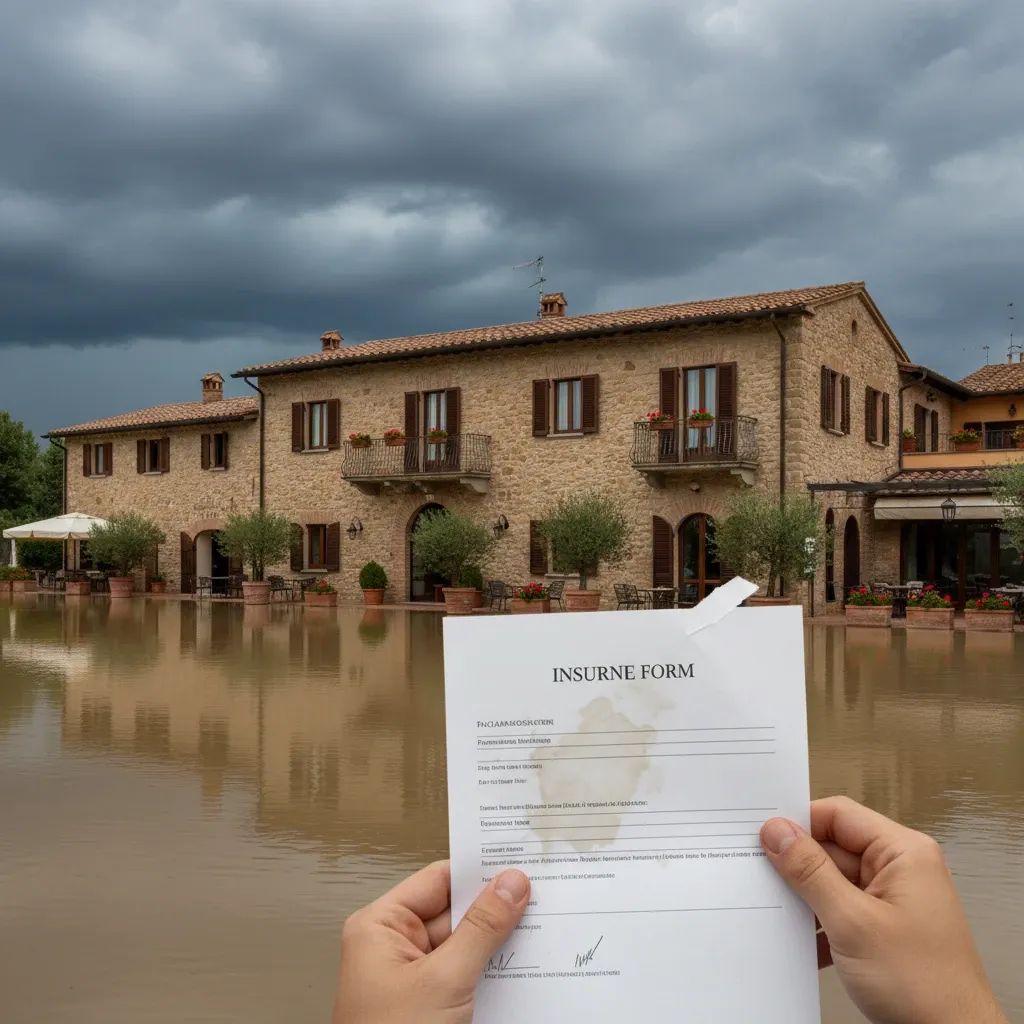
As of April 1, 2026, thousands of Italian tourism and hospitality businesses that failed to meet yesterday's mandatory insurance deadline are now locked out of public disaster relief — a consequence that is immediately and fully enforceable. Micro and small enterprises operating hotels, restaurants, and fishing activities must now prove they hold "cat nat" policies — or forfeit access to state subsidies, loans, and reconstruction grants if disaster strikes.
Why This Matters
• No insurance, no aid: Businesses without coverage are barred from all public contributions for damages caused by earthquakes, floods, landslides, or river overflows.
• Costs vary widely by zone: Annual premiums range from €272 for a Milan restaurant to €776 in Rome, and up to €2,100+ for a Palermo hotel — reflecting Italy's extreme geographic risk disparity.
• No fines, but real penalties: The law carries no monetary sanctions, but uninsured firms must self-fund all disaster recovery and face tougher credit conditions from banks.
• Compliance fell far short: Only 12–15% of Italian businesses had secured coverage by early 2026, leaving the vast majority now facing permanent exclusion from state assistance.
The Law and Its Delayed Rollout
Italy's 2024 Budget Law (Legge di Bilancio 2024) established compulsory natural disaster insurance for all enterprises registered with the national business registry, excluding agricultural firms. The rollout was staggered: large corporations faced a March 31, 2025 compliance date (with tolerance until June 30, 2025); medium-sized companies followed in late September and early October 2025; and micro and small businesses were due by December 31, 2025.
Tourism, hospitality, and fishing sectors — arguably among the most vulnerable given Italy's coastal and mountainous geography — secured a final extension via the Milleproroghe decree, pushing their deadline to March 31, 2026. That grace period has now expired.
The obligation covers damage to instrumental assets: land, buildings, machinery, industrial and commercial equipment. Covered perils include earthquakes, floods, landslides, inundations, and river breaches — precisely the hazards that have hammered Italy repeatedly in recent decades, from the 2012 Emilia earthquake to the devastating 2023 Romagna floods.
What This Means for Hotel and Restaurant Owners
If you operate a bed-and-breakfast in Liguria, a trattoria in Umbria, or a seaside resort in Sicily, the practical effect is immediate and permanent. Without a valid policy, your business is now ineligible for any form of public financial support tied to disaster events.
This exclusion covers:
• Emergency reconstruction funds
• Tax deferrals and payment suspensions
• Subsidized loans and direct grants
• All other disaster relief historically disbursed by regional or national authorities after calamities
The Italian Revenue Department and regional agencies now require proof of insurance as a precondition for accessing incentives, not just disaster relief. Banks and credit institutions are also expected to scrutinize coverage status more closely when evaluating loan applications, viewing uninsured businesses as higher-risk borrowers.
In the absence of penalties for non-compliance, enforcement relies entirely on this exclusionary mechanism. You won't be fined for refusing to insure, but if a flood destroys your kitchen or an earthquake cracks your hotel foundations, you will shoulder 100% of repair and replacement costs out of pocket — and the state will offer nothing.
How Premiums Are Calculated
According to analysis by Facile.it, in collaboration with brokers Italfinance and Finital, premiums hinge on a constellation of variables. Chief among them is territorial risk: insurers map seismic zones, flood plains, and landslide-prone slopes, then price accordingly. A restaurant in Milan — relatively stable geologically — might pay €272 per year to cover a €500,000 building and €150,000 in equipment. The same business in Rome, where seismic and hydrological risk is higher, faces a €776 annual bill.
Hotels command steeper premiums due to larger asset values. A property worth €1.5 million with €500,000 in fixtures and furnishings starts at €556 annually in Milan, but exceeds €2,100 in Palermo, where earthquake exposure and construction vulnerability converge.
Other pricing factors include building construction standards (reinforced concrete versus older masonry), floor level (ground-floor premises are more flood-prone), the type of activity (kitchens and heavy equipment raise fire and mechanical risk), and each insurer's internal tariff structures. Properties with unauthorized construction or code violations are uninsurable under the mandatory scheme, leaving owners in a legal and financial limbo.
Market Offerings and Where to Compare
Several major carriers now market dedicated cat nat products for the tourism and catering trades. Generali Italia offers "Generali Sei in Salvo – aziende," alongside sector-specific lines like "ATTIVA Commercio" for restaurants and bars and "ATTIVA Turismo" for accommodations. UnipolSai fields "Unipol Protezione Impresa"; AXA has its "Rischi Catastrofali" policy; Allianz provides "Catastrofi Naturali Impresa" and, for UniCredit clients, "UniCredit Allianz Calamità Imprese." Italiana Assicurazioni markets "Salvaguardia Italiana," which permits add-on coverage for business interruption, inventory loss, and demolition expenses.
Comparative platforms — Segugio.it, MioAssicuratore, Polizzamigliore.it — aggregate quotes from multiple insurers, enabling side-by-side cost and coverage analysis. Given the wide premium spread, experts recommend soliciting at least three customized quotes, specifying exact asset values, location coordinates, and desired extensions such as loss-of-profit coverage, which can prove critical if your hotel must close for months post-disaster.
Compliance Remains Alarmingly Low
As of early 2026, Giovanni Liverani, president of ANIA (Italy's National Association of Insurance Companies), reported that only 500,000 of Italy's 4+ million registered enterprises — roughly 12% — held catastrophe coverage. Other March 2026 estimates placed compliance at 15%. This marks a modest increase from the 7% recorded in early 2025, but still leaves the overwhelming majority now permanently excluded from state assistance.
Tourism and hospitality data are not yet disaggregated, but anecdotal evidence from trade associations suggests many small operators remained unaware of the deadline or underestimated its enforceability, assuming the state would revert to post-disaster bailouts as in the past. That assumption is now legally void.
European Context and Enforcement Precedents
Italy's mandatory scheme brings it in line with France, Germany, Austria, and Spain, all of which have long required or heavily incentivized disaster coverage for businesses. France operates a statutory "cat nat" regime bundled into standard property policies; Germany employs a mixed public-private model with strong regional participation; Spain mandates coverage through the state-run Consorcio de Compensación de Seguros.
None of these countries impose direct fines for non-compliance either, relying instead on public-funding conditionality. The French model, for instance, excludes uninsured businesses from post-disaster state compensation, a rule rigorously enforced after the 2010 Xynthia storm and subsequent flooding events. Italy's lawmakers studied these precedents closely when designing the 2024 legislation.
What Happens Next
The Italian Ministry of Economy and Finance and regional authorities will begin cross-referencing insurance registries with disaster-aid applications in the coming months. Trade groups, including Federalberghi and Confcommercio, are urging stragglers to secure policies immediately, warning that even a minor flood or tremor could trigger inspections and funding audits.
Insurers, meanwhile, are bracing for applications from businesses seeking retroactive or emergency coverage — many of which may be declined due to elevated risk profiles or compliance gaps. Properties in high-hazard zones without seismic retrofitting or those with outstanding building-code violations face outright rejection, leaving owners in a precarious position with no legal workaround.
For Italy's fragmented and often undercapitalized hospitality sector, the shift from implicit state backstop to mandatory private insurance represents a profound change in risk governance. The question now is whether coverage will spread quickly enough in the coming months to prevent a wave of closures when the next inevitable disaster arrives — and whether the state will hold firm on its no-aid pledge when cameras focus on ruined livelihoods.


