
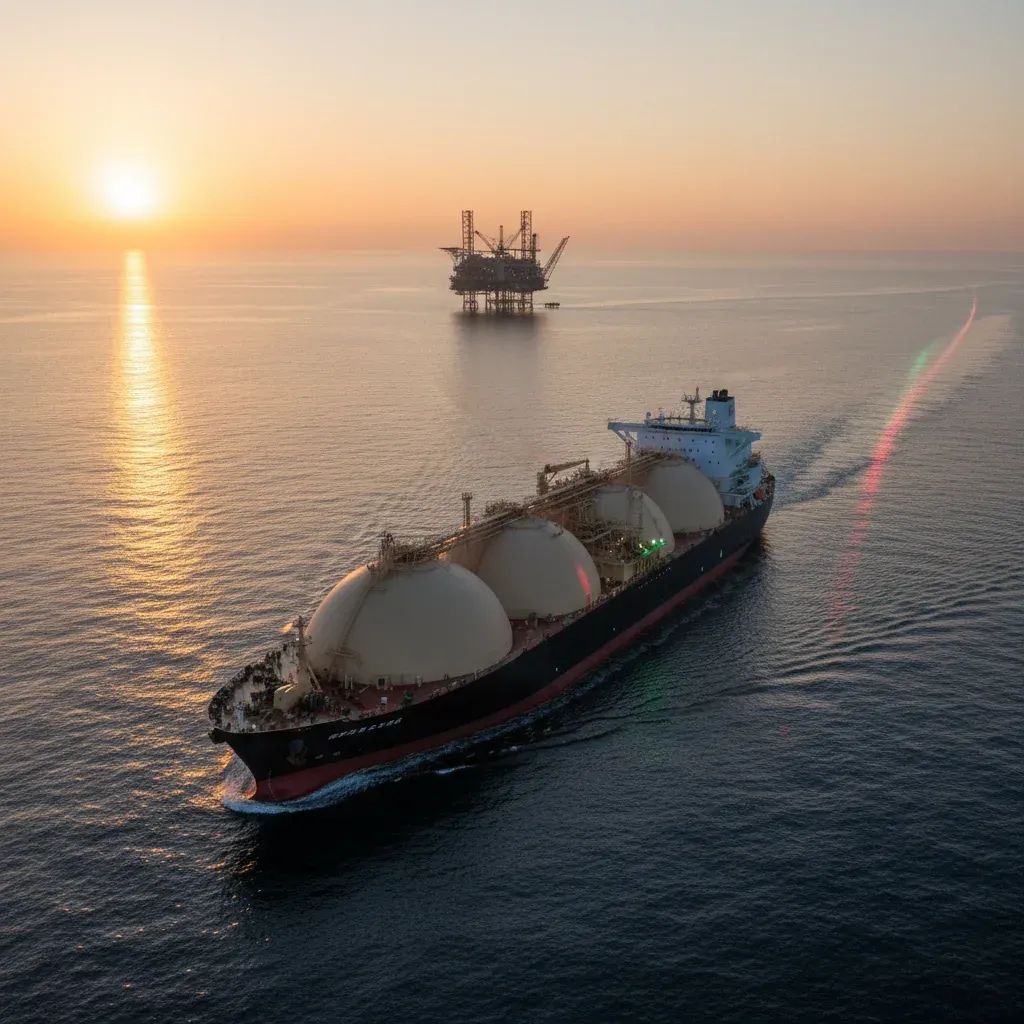
Italy's Eni has secured a major new gas discovery off Indonesia's coast, a development that adds substantial supply capacity to both regional and global energy markets while reinforcing the Italian energy giant's foothold in Southeast Asia's most prolific exploration basin.
Why This Matters
• Scale: The Geliga-1 well holds an estimated 140 billion cubic meters of gas (5 trillion cubic feet) and 300 million barrels of condensate, placing it among the largest global gas discoveries of the past three years.
• Timeline: Production could begin as early as 2028, leveraging Eni's existing offshore infrastructure and planned North Hub development.
• Strategic value: The find bolsters Indonesia's domestic energy security while positioning Eni to capture growing Asian LNG demand—critical for Italy's national champion as Europe pivots away from Russian gas.
The Discovery in Context
The Geliga-1 exploration well, drilled in the Ganal block roughly 70 kilometers off the coast of East Kalimantan in the Kutei Basin, represents Eni's second "giant" gas discovery in the region within 30 months. The Italian operator announced the results following preliminary appraisal work, with a production test now scheduled to determine flow rates and commercial viability.
What sets Geliga apart is its proximity to the Gula gas field, a previously discovered but undeveloped resource. Early assessments suggest the combined Geliga-Gula complex could deliver an additional 28 million cubic meters of gas per day and 80,000 barrels of condensate daily once infrastructure is in place. For perspective, that gas volume alone would supply roughly 15% of Italy's current daily consumption—a meaningful increment for global LNG supply chains.
The discovery sits just 20 kilometers north of Eni's Geng North field, where final investment decisions were approved in late 2025. This clustering effect allows Eni to share subsea tie-backs, floating production facilities, and export pipelines, significantly reducing per-unit development costs and accelerating time to first gas.
Eni's Kutei Basin Offensive
The Geliga find is the latest in a string of high-impact results for Eni Indonesia in the Kutei Basin. In October 2023, the company announced the Geng North-1 discovery with 5 trillion cubic feet of gas and 400 million barrels of condensate. Three months later, in December 2025, the Konta-1 well in the Muara Bakau block delivered 600 billion cubic feet, with upside potential beyond 1 trillion cubic feet.
Eni has committed to an aggressive exploration campaign through 2027, with four additional wells planned for 2026 and two more in 2027 across the Ganal and neighboring blocks. The Italian company is the operator of multiple Production Sharing Contracts in the basin and holds working interests ranging from 40% to 85%, depending on the block.
Together with Malaysian state oil firm Petronas, Eni has formed a new standalone entity—Searah—to consolidate upstream assets across Indonesia and Malaysia. The joint venture is expected to close in the second quarter of 2026 and plans to deploy over $15 billion across five years to fund at least eight new development projects and 15 exploration wells. The combined entity will hold roughly 3 billion barrels of oil equivalent in discovered reserves.
What This Means for Residents
For Italy-based investors, workers, and energy analysts, Geliga-1 underscores Eni's strategic pivot toward Asian gas markets at a time when Europe's energy security remains fragile. The discovery enhances Eni's portfolio resilience, diversifying revenue streams away from volatile European gas pricing and geopolitical risk tied to Russian supply corridors.
Eni shareholders may see upside from the ongoing farm-down process: the company is marketing a 20-30% stake in the North Ganal block and a separate 10% interest in its broader Indonesia portfolio, transactions expected to close in the second half of 2026. The Geliga discovery directly adds value to these divestments, potentially improving sale terms and accelerating capital recycling.
For Italian expatriates and businesses operating in Southeast Asia, the project signals expanded commercial opportunities. Eni's development plans will require engineering, procurement, and construction (EPC) contractors, subsea equipment suppliers, and logistics providers—sectors where Italian firms hold competitive advantages. The company's floating production, storage, and offloading (FPSO) vessel for the North Hub, along with pipeline tie-ins to the Bontang LNG plant, will generate service contracts worth hundreds of millions of euros over the next decade.
Indonesia's Domestic Energy Calculus
Indonesia faces a looming gas supply deficit projected to materialize by 2033 if new fields are not brought online. Despite being a major LNG exporter, the country's aging offshore fields are in decline, while domestic demand—driven by power generation and industrial expansion—continues to climb. The government aims to increase gas's share of the energy mix from roughly 18% today to 24% by 2050, part of a broader "gasification" strategy to reduce coal dependency.
Geliga-1 and Eni's adjacent discoveries arrive at a critical juncture. The gas will feed both domestic distribution networks and export facilities, with the Bontang LNG terminal in East Kalimantan slated to receive volumes from the North Hub starting in 2028. The plant, one of the world's oldest LNG export facilities, will see a production train reactivated to handle the new supply, extending its operational life into the 2030s.
Indonesia's state energy regulator has prioritized domestic gas allocation over exports for new fields, meaning a significant portion of Geliga's output will likely be reserved for local power plants and industrial users. However, surplus volumes earmarked for LNG export will strengthen Indonesia's position in the Asia-Pacific spot market, where prices remain elevated compared to long-term contract benchmarks.
Global Market Implications
On the international stage, Geliga-1 contributes to a global LNG supply surge expected to accelerate through 2027, primarily driven by North American project expansions. The International Energy Agency forecasts global LNG supply capacity will grow by roughly 100 million tonnes per year by 2028, potentially easing price pressures in Europe and Asia.
For Italy's energy security, the discovery indirectly benefits the national system. While none of the Indonesian gas will flow directly to Italy, Eni's strengthened position in Asian LNG markets improves the company's ability to secure flexible supply contracts and optimize its global portfolio. Italy imported over 70 billion cubic meters of gas in 2025, with LNG accounting for roughly 15% of the total. Diversified supply sources—including Eni's equity gas from Indonesia—provide optionality during supply shocks.
The Kutei Basin's resource potential also highlights shifting investment patterns in global oil and gas. While European upstream spending has stagnated amid regulatory uncertainty and climate policy pressures, Southeast Asia remains one of the few regions where major international companies are deploying multibillion-dollar exploration budgets. Eni's Indonesia strategy reflects a broader industry rebalancing toward gas-rich basins in Asia, Africa, and the Middle East.
Development Timeline and Risks
Eni has not disclosed a standalone development plan for Geliga, but integration with the North Hub project appears likely. The North Hub, encompassing the Geng North and Gehem fields, received final investment approval in late 2025 and targets first production in 2028, with plateau output expected in 2029. A new FPSO will be deployed, with subsea infrastructure designed to accommodate future tie-ins from nearby discoveries.
Geliga's production test, scheduled for mid-2026, will determine whether the reservoir can sustain commercial flow rates. If results confirm current estimates, Eni will likely fast-track a subsea tie-back to the North Hub FPSO, avoiding the cost and complexity of standalone floating facilities.
Regulatory approvals in Indonesia can be protracted, though Eni's established relationships with SKK Migas (the country's upstream regulator) and Pertamina (the state oil company, which holds participating interests in several Kutei blocks) should smooth the permitting process. Environmental reviews and community consultations in East Kalimantan will add 12-18 months to the development schedule, standard for offshore projects in Indonesian waters.
Broader Industry Context
Eni's Kutei Basin campaign aligns with the company's dual-track strategy: maintain a competitive upstream portfolio in gas-rich basins while accelerating investments in renewables and low-carbon businesses. The Italian firm has set a target to reach net-zero Scope 1, 2, and 3 emissions by 2050, with interim milestones including a 35% reduction in upstream carbon intensity by 2030.
Gas assets like Geliga fit within this framework as "transition fuels"—lower-carbon alternatives to coal and oil that generate cash flow to fund renewable energy expansion. Eni has earmarked €8 billion annually through 2027 for upstream projects, with roughly 60% directed toward gas developments in Asia, Africa, and the Middle East.
The company's Indonesia position also reflects a strategic hedge against European gas market volatility. While Italy's domestic gas production has dwindled to negligible levels, Eni's equity gas from international assets provides a partial buffer against spot price spikes and supply disruptions. Indonesia's LNG, delivered under flexible contracts, offers optionality that long-term pipeline commitments cannot match.


