
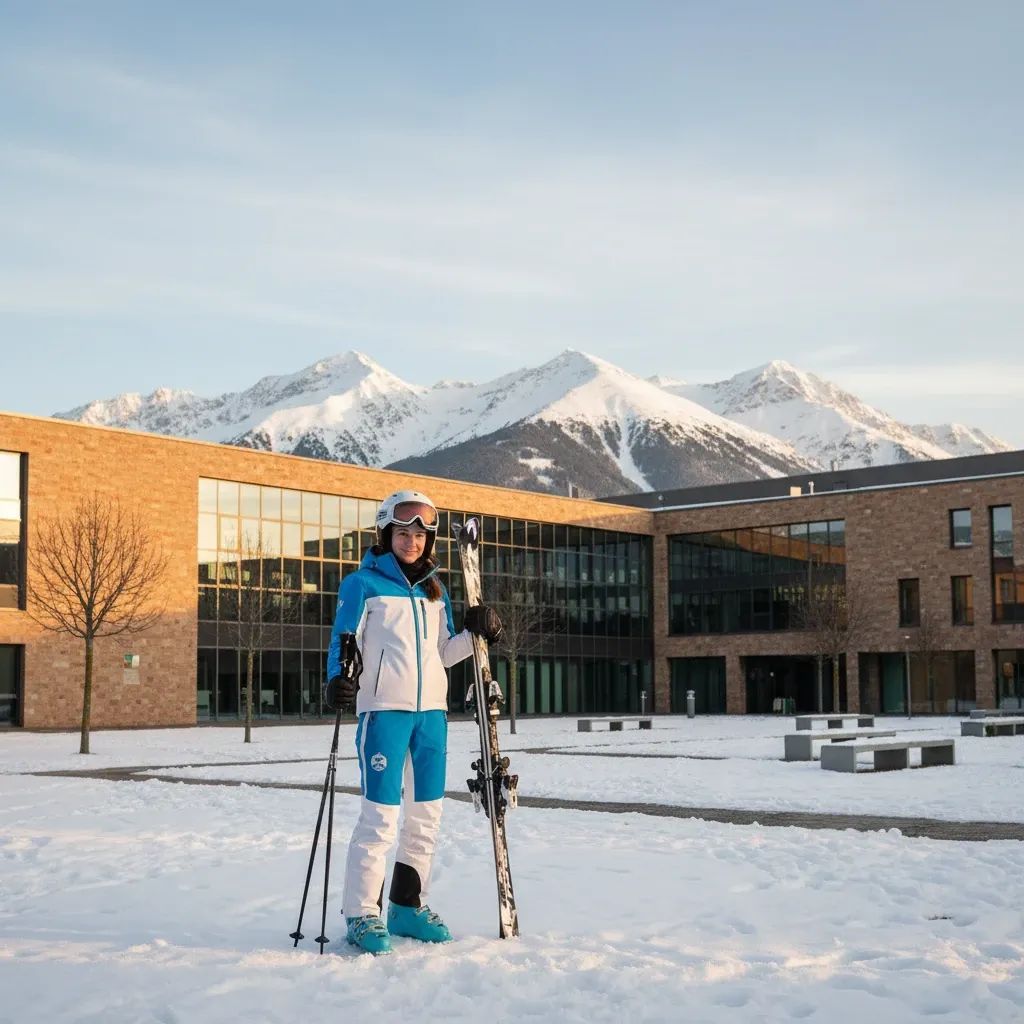
Italy's Olympic bronze medalist Sofia Goggia has completed her degree in Political Science at Luiss Guido Carli University, an achievement that places her among a growing cohort of elite athletes balancing academic pursuits alongside international sporting careers. Writing in April 2026, just weeks after competing at the Milano Cortina Winter Olympics, she submitted her thesis in late March and received her official grade on April 10, with the formal graduation ceremony scheduled for June.
Why This Matters
• Dual-career momentum: Over 10% of recent Olympians pursue university degrees, recognizing the value of academic qualifications for post-retirement life.
• Soft power as scholarship: Goggia's thesis explores propaganda and political influence in the Olympics, from ancient Greece to Milano Cortina 2026.
• Policy support in Italy: Universities like Luiss and Milano-Bicocca now offer dedicated programs to help student-athletes navigate exam schedules, online courses, and flexible calendars.
The Research Behind the Medal
Goggia's thesis, titled "Propaganda and Soft Power in the History of the Olympics, from Ancient Greece to Milano Cortina 2026," is a three-part academic investigation into how the Games have served as a political stage across millennia. Speaking at a health prevention event in Milan, she described the structure: a historical overview contrasting ancient and modern Olympic formats, an analysis of how propaganda shaped pivotal editions—most notably the 1936 Berlin Games under the Nazi regime—and a concluding chapter examining the Milano Cortina 2026 Winter Olympics through the lens of soft power.
The research fits a broader academic conversation. Scholars have long documented how host nations use the Games to project national identity and geopolitical ambition. Pierre de Coubertin, founder of the modern movement, envisioned the Olympics as a tool for educational transformation, yet the advent of mass media quickly converted them into a canvas for ideology. From Tommie Smith and John Carlos raising fists in Mexico City 1968 to the Cold War boycotts of Moscow 1980 and Los Angeles 1984, the Olympic stage has rarely been free of political theater.
Milano Cortina 2026, according to recent analyses, is no exception. The Italian government describes the event as a "powerful instrument of soft power", with an expected economic impact of €5.3 billion and a global audience of three billion. The organizers emphasize a "diffused" model across Lombardy, Veneto, and Trentino-Alto Adige, marketing sustainability and inclusivity as core messaging. Yet academic observers warn of potential pitfalls: manipulated information campaigns, the risk of local identity erosion in favor of globalized branding, and the acceleration of urban inequality.
What This Means for Italy's Athletic Talent Pipeline
Goggia's degree is emblematic of a structural shift in how Italy supports its elite athletes. The Luiss Dual Career program, in which she enrolled, provides flexible exam scheduling, online course access, dedicated tutors, and in some cases recognition of athletic activity for university credits. The initiative is part of a broader framework established by a 2016 protocol among the Italian Ministry of University and Research (MIUR), CONI, CRUI, CIP, and CUSI.
Other Italian Olympians have taken similar paths. Gianmarco Tamberi, Filippo Tortu, and Federica Cesarini—all medalists at Tokyo 2020—studied at Luiss. The same program has supported fencer Giorgio Avola, rower Vincenzo Abbagnale, and cyclist Letizia Paternoster. Milano-Bicocca runs a parallel structure, backing athletes like canoeist Giovanni Codato through the Paris 2024 cycle.
European data shows that student-athlete participation in higher education is climbing steadily. The benefits extend beyond credentials: studies point to improved time-management skills, expanded professional networks, and reduced identity crises post-retirement. International examples include figure skater Michelle Kwan (master's in international relations) and track star Gabby Thomas (neurobiology and epidemiology at Harvard). Balancing training and coursework remains demanding—stress and fatigue are common—but institutional support appears to be narrowing the gap.
International Framework and Italian Leadership
The European Commission has promoted dual-career frameworks since 2012, and the International University Sports Federation (FISU) provides research and advocacy. In Italy, the regulatory architecture now includes a recent interministerial decree formalizing dual-career guidelines, signaling that the policy is moving from pilot phase to permanent infrastructure. This positions Italy as a model for other nations seeking to integrate athlete education with elite competition.
The Intersection of Sport, Scholarship, and Diplomacy
Goggia's thesis topic reflects a reality that officials and academics alike acknowledge: the Olympics are never just about medals. They are a "cultural apparatus, a visual and political machine that transforms bodies and territories," as one sociological analysis describes Milano Cortina 2026. The event's communication strategy is "people-centric," aiming to connect Italian regional identity with a global spectacle.
Yet the risks are real. Adversarial narratives, amplified by AI-generated content, can delegitimize delegations or erode institutional trust. Mega-events have been shown to reshape urban perceptions, sometimes prioritizing global image over local authenticity. For a country hosting the Winter Games at this pivotal moment, scholarship on propaganda and soft power offers a critical lens—one that may inform how Italy navigates the spectacle, manages expectations, and leverages the event for long-term advantage.
What Comes Next
Goggia will celebrate her graduation formally in June, a milestone that underscores a career built on both physical and intellectual discipline. The bronze medal she earned at Milano Cortina 2026—her home Games—adds symbolic weight to a thesis that analyzes the very event in which she competed.
For prospective student-athletes in Italy, her example is instructive. Dual-career programs are expanding, with universities in Rome, Turin, Bologna, Verona, and Milan now offering tailored pathways. Eligibility typically requires national federation membership, participation in high-level competitions, or national team call-ups. Benefits range from part-time enrollment and personalized exam dates to financial aid and free access to sports facilities. Some universities even allow temporary suspension of studies during major championships.
The broader message is clear: athletic excellence and academic achievement are no longer mutually exclusive. With the right infrastructure, athletes can pursue both—and in doing so, equip themselves for life beyond the podium.


