
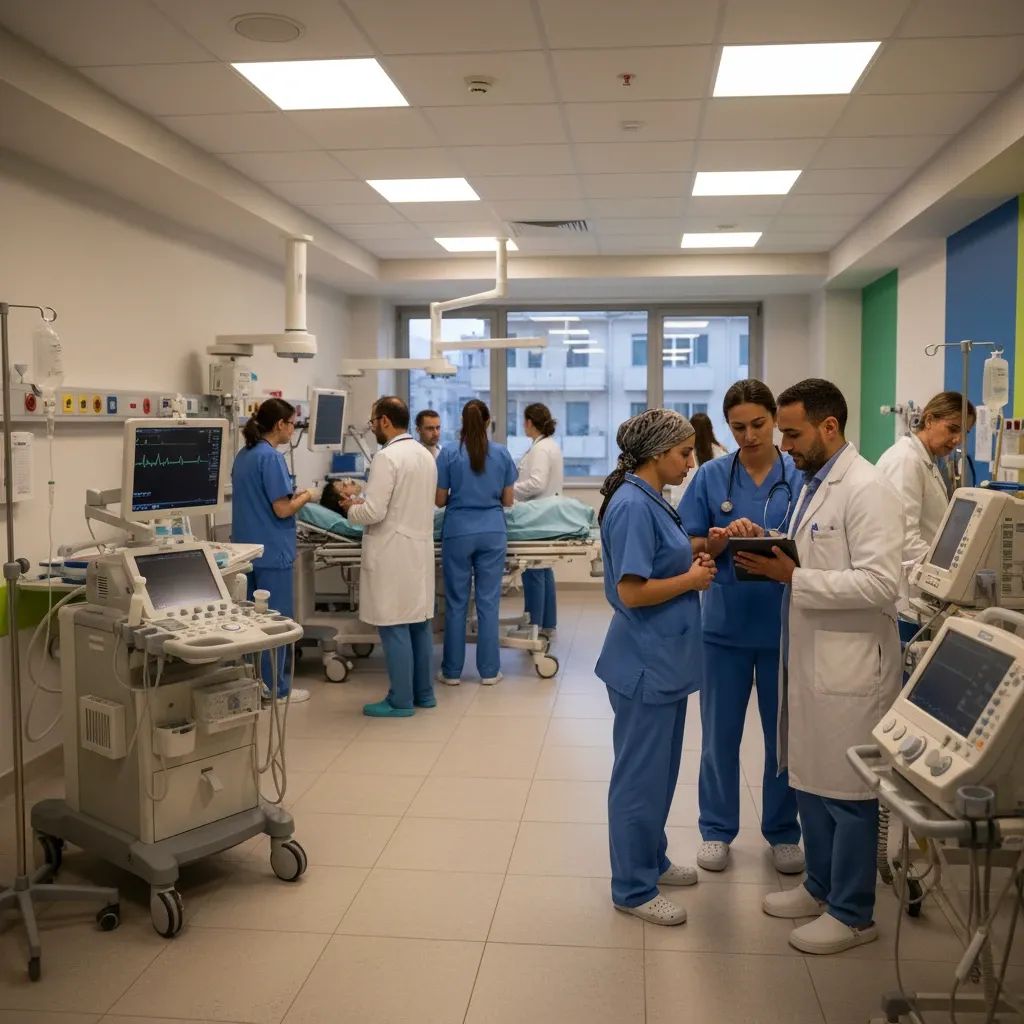
The regional government of Calabria has reaffirmed its reliance on Cuban physicians to keep emergency rooms and hospitals functioning. The decision navigates a diplomatic minefield between U.S. pressure and a chronic shortage of healthcare workers that threatens critical facilities across southern Italy.
Why This Matters
• 497 Cuban doctors remain under contract through December 31, 2027, after initial plans to expand the program to 1,000 were scaled back.
• Alternative recruitment launched in mid-January 2025 now targets EU and non-EU physicians willing to work in Calabria independently.
• Calabria's healthcare system has been under government receivership for 16 years, with hospitals in Polistena and Locri recently saved from closure by emergency staffing measures.
Diplomatic Meeting Signals Policy Shift
Roberto Occhiuto, president of the Calabria Regional Council, met with Mike Hammer, the U.S. chargé d'affaires for Cuba, and Terrence Flynn, the American consul general in Naples, at regional offices in Catanzaro. The discussion centered on the presence of Cuban medical personnel and the urgent staffing crisis plaguing the region's public health infrastructure.
Occhiuto told his American counterparts that the Cuban physicians currently deployed are "still a necessity" for Calabria, emphasizing that his "absolute priority is to ensure the right to healthcare for Calabrian citizens who already have a health system in great difficulty." The statement underscores the tension between geopolitical considerations and the immediate operational needs of a region where over 180,000 residents reportedly skipped medical care in 2024 due to closed appointment books or prohibitive wait times.
From Expansion to Diversification
The regional president revealed that he had originally intended to increase the Cuban medical mission to 1,000 doctors in 2026. However, following what he described as "fruitful cooperation" with the U.S. State Department and the American consulate, Calabria pivoted toward an alternative recruitment strategy.
In mid-January 2025, the Calabria Health Commissariat published a call for expressions of interest aimed at physicians from European Union member states and third countries. The decree, signed by Occhiuto in his capacity as regional health commissioner, targets specialists in 13 disciplines: pathology, anesthesiology, cardiology, general surgery, geriatrics, obstetrics and gynecology, emergency medicine, internal medicine, pediatrics, orthopedics, psychiatry, diagnostic radiology, and urology.
Critically, the call is open to Cuban doctors operating independently—those not bound to the existing government-to-government mission managed by Cuba's state enterprise Comercializadora de Servicios Médicos Cubanos S.A. (CSMC). Occhiuto emphasized that Calabria is "willing to welcome all doctors—EU, non-EU, Cuban doctors not tied to the existing mission—who autonomously want to come work in Calabria," offering the same logistical and financial support already provided to the Cuban contingent.
What This Means for Residents
For Calabrians navigating one of Europe's most understaffed healthcare systems, the policy recalibration translates to modest hope rather than immediate relief. The region remains in Plan di Rientro—a fiscal recovery program imposed by Rome 16 years ago—and faces a structural deficit in both funding and personnel.
Residents seeking care should check with their local ASP (Azienda Sanitaria Provinciale) for current staffing status. The Cuban physicians are primarily deployed in emergency departments and hospitals in Polistena, Locri, and facilities along the Ionian coast. Wait times for specialist appointments remain long, with some disciplines booking 6-12 months out.
Emergency legislation passed by the regional council in January 2025 allows health authorities to extend contracts for retired physicians by 12 months, renewable once. A February amendment to the national Decreto Milleproroghe raised the retirement age for medical directors to 72 years and authorized the recall of retired personnel to prevent ward closures.
These stopgap measures have temporarily staved off the shutdown of facilities like the hospital in Polistena, which faced closure due to a lack of anesthesiologists, and the Locri hospital, similarly at risk. Yet the region's recruitment target for 2025—approximately 1,300 total healthcare workers, including 350 doctors, 375 nurses, and 181 healthcare assistants—remains contingent on exiting receivership, a milestone with no confirmed timeline.
Calabria spends more than €300 million annually on out-of-region care, a figure that reflects both the inadequacy of local services and the financial drain on public coffers. Per capita health expenditure lags behind the national average, even as demand for treatment exceeds it.
Legal and Diplomatic Complications
The reliance on Cuban medical personnel has drawn sustained scrutiny from Washington, which characterizes the island's overseas health missions as a form of "forced labor" and "human trafficking." The U.S. government alleges that Havana retains nearly all compensation paid for the doctors' services, depriving professionals of their earnings and Cuba's domestic population of essential care.
While the Calabria administration denies that physicians are legally obligated to remit wages to CSMC, investigations have suggested oversight, withheld payments, and surveillance of personnel on European soil. The European Parliament has voiced concern in resolutions passed in June and September 2021, calling on member states to adhere to International Labour Organization (ILO) standards regarding contractual terms for foreign medical workers. A group of Members of the European Parliament urged Occhiuto to reconsider the hiring arrangements, citing potential labor exploitation.
The European Union does not directly fund Cuban medical missions and maintains that all countries, including Cuba, should comply with ILO conventions. Nonetheless, the bloc has refrained from imposing explicit prohibitions, leaving individual member states—and in Italy's case, individual regions—to navigate the issue independently.
Despite pressure, Occhiuto has maintained that no sanctions will apply to the current program with Cuban doctors already operational. His meeting with Hammer appears to have clarified that the existing agreement, covering up to 497 professionals through the end of 2027, will proceed without penalty, even as future expansion is redirected through open recruitment.
Broader Recruitment Landscape
The January call for interest represents a test case for whether Calabria can attract qualified foreign physicians without the scaffolding of a bilateral government agreement. Details on the volume and origin of applications remain sparse; as of late February, the regional administration has not released figures on how many expressions of interest have been submitted or from which countries.
The challenge is formidable. The region must compete with Northern Italian health authorities that offer higher salaries, better infrastructure, and proximity to major urban centers. Language barriers and credential recognition—issues that initially delayed the deployment of Cuban doctors—pose similar obstacles for candidates from non-EU countries.
Italy's Ministry of Health initially questioned the validity of Cuban medical qualifications, a hurdle that was eventually overcome through bilateral accreditation. Any non-EU physician hoping to practice in Calabria must navigate a similar process, adding months to the timeline between application and deployment.
A System Under Strain
Calabria's healthcare crisis is rooted in decades of underinvestment, administrative mismanagement, and population outmigration. The region's network of hospitals has been repeatedly restructured, with 14 facilities closed in prior years without conversion to alternative care models, according to opposition council members. The Ionian coast, in particular, has seen wards emptied and new hospitals left at risk of non-operation due to staffing shortages.
The reliance on foreign doctors—whether from Cuba, the EU, or elsewhere—is a symptom of a broader failure to train, recruit, and retain Italian medical professionals in the South. Calabria's medical schools produce graduates who overwhelmingly migrate north or abroad, drawn by better pay, research opportunities, and quality of life.
For now, the 497 Cuban physicians remain indispensable. They staff emergency departments, surgical wards, and rural clinics that would otherwise close. Their contracts, negotiated through CSMC, provide Calabria with a reliable, if diplomatically fraught, workforce. The alternative recruitment drive launched in January offers a potential path toward diversification, but until applications are processed, credentials verified, and contracts signed, the Cuban doctors will continue to be the backbone of emergency care in one of Italy's most medically underserved regions.
The regional government's pledge to offer equivalent logistical and financial support to all foreign doctors—regardless of nationality or recruitment pathway—signals an intent to build a more resilient, less geopolitically sensitive staffing model. Whether that model can deliver results in time to prevent further hospital closures remains an open question as Calabria navigates the intersection of public health necessity and international diplomacy.


